
by Lei Wang
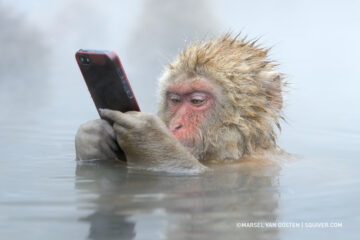
I used to be one of those people who used science to try to explain everything. The poetic part of me suspected science wasn’t the only ultimate truth, but I resisted my own knowing. I really did believe at one point that dopamine and oxytocin were the causes and conditions of love, and not just what love happens to imperfectly look like under a scanner for mammals.
Years ago, I argued with an ex-Orthodox Jew about God. Though to all extents and purposes he had left the religion and its practical edicts, he had not stopped studying the scriptures. He was adamant that it was impossible for humans to know God, and I said it was—to the extent that it was humanly possible. (Clearly, though, it was a matter of temporal lobes, right vs. left hemispheres, etc.) Otherwise, were all the mystics lying or deluded?
I wasn’t sure then (or even now, despite everything) if I believed in God as entity or object, however abstract or non-corporeal, but I believe in God as experience. I believe in the sense of God, the way I believe in the sense of love, even if it’s subjective and immeasurable and irreproducible in the lab, the opposite of science yet indisputably real.
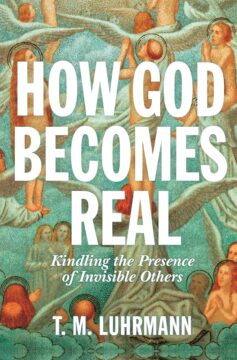
The anthropologist and religious scholar T.M. Luhrmann, author of How God Becomes Real, concludes after decades of research that faith is really hard work. “The most important question to ask about religion is not why but how,” she writes. “‘Why’ is a skeptic’s question—a puzzle around the seemingly absurd ideas (a talking snake, a virgin birth) that we find in religions. If we start not with the puzzle of belief, but with the question of whether the effort people invest in their faith helps them to feel that their gods and spirits are real, we are forced to focus on what people do when they worship gods and spirits, and on how those practices themselves might change those who do them.”
All devotees of religion, from pagans to evangelical Christians—as opposed to the mere lip-service believers—practice. Their practices are not just extrinsic rituals for show, the way they may look from the outside, but work that causes them to change on the inside. “Prayer, perhaps the most common religious practice,” Luhrmann writes, “is a method of attending to thought: an act of thinking about thinking.” And thinking about thinking changes both the thinking and the thinker.
Luhrmann thinks religion is a story that shifts attention away from the ordinary, by using rich detail, imagination, and the inner senses, so the story becomes real. To be religious, essentially, is like being utterly engrossed in the world of a juicy book. In fact, the more likely someone is able to lose themselves in imagination, the more likely they are to experience the presence of God—what Luhrmann refers to as an “invisible other.” Luhrmann calls these acts of real-making “kindling”—“ways of using the mind so that an invisible other can be grasped.”
Making God real seems to require both talent and training, a use of all our human capacities for meaning-making and imagination, and imagination IS real. Whatever is imagined exists in some way, as opposed to the utterly unimagined. A good book, after all, causes you to feel real feelings.
And yet our imaginations are limited. After all, we are monkeys. So neither the ex-Orthodox Jew and I were wrong, really; it was a silly argument, whether or not humans can know God. And yet the fact that so many people are religious is not nothing; they’re not all dumb and deluded, and religion is more than an allegory. Which is different still from your God story is wrong and mine is right—that is just monkeys doing a bad job of interpretation.
(I guess I don’t understand the Fundamentalist debate because why is evolution not just part of the divine plan unfolding? We are fancy monkeys, but why couldn’t God have used biology to create these fancy monkeys?)
The Tao that can be told is not the eternal Tao, the famous opening line states: but why then a whole book about it? According to the spiritual teacher A.H. Almaas, of course language can describe mystical experiences, but that language is useful mostly for communicating to people who already recognize the numinous states and can resonate. When you don’t have the experience, language can only point to it. But this is the case with many things.
How would you describe the sky to someone who has only ever lived in a windowless box or a cave? Imagine something with no boundaries, with none of these six lines? It is just as tricky to describe water to one who has never experienced it as it is to describe God. It’s smooth, one might say. But what is wetness? Might as well say the ocean is vast.

Try just describing ginger–it’s prickly?
My favorite philosopher, Bernardo Kastrup, likes to say that the intellect is the bouncer of the heart. He is my favorite philosopher because, as someone once described William James, he has the mind of a scientist and the heart of a poet. (Writers, too, according to Nabokov, should have precisely these qualities of both poetic precision and scientific imagination.) Kastrup says the gooey people of the world—exemplified perhaps by credulous hippies—would do well to rigorously vet their beliefs and close themselves more, so as to be open to the right things, while the pricklies of the world—often intensely analytic, world-weary intellectuals—might do well to not close themselves off too much.
Why not at least pretend then that God is in everything, or at least pretend the world is sacred? Pretend just for the day that the world is your ashram, that God is in the person driving the slow car in front of you.
Even with our imperfect tools and perceptions, there are some things we just know. When love is not quite right, we want to analyze it with our friends, but some animal part of us recognizes when something is right. For a long time, I couldn’t trust my own feelings, which is why I kept looking for some objective measure of rightness.
I’m still not sure what life is about, but I know what life is probably not about. It’s not about gaining the most bananas, a scared monkey way of being. We can remember we are monkeys, with our limitations, and also that we are something else. The monkey shouldn’t be the one that thinks it is God and now can do anything—that would be the worst monkey—but God is being expressed here and now through an evolved monkey.
“Monkeys are not in the business of ultimate truth any more than termites are in the business of understanding quantum field theory,” says my favorite philosopher. But we remain in the business of the truth that is good enough. Maybe we will never know where we go after we die because no one so far has managed to truly report back. Buddhism warns of the Four Imponderables, questions which cannot or should not be pondered upon lest one go insane These are: the powers of the Buddha, the powers of meditation, the workings of karma, and the origin of the world. And yet we have to do the hard work of understanding what can be the Good Enough Truth.
A friend in meditation group has a four-month-old baby she brings sometimes to our group sits. Everyone adores him, of course. He is discerning, for a baby, not immediately burbling for attention. He has those celestial eyes. We all think he’s a tiny guru. “Look at him,” someone said. “He’s meditating all the time.”

Is this your guru?
And yet this is untrue. He is not meditating, because he does not need to, as monkeys don’t. He has not yet lost God, and so does not need to work to find a way back. No disillusionment, no enlightenment. Rainer Maria Rilke has described human beings on the inside as being adorned with many festive frescoes. And yet as children, it is still too dark to see this magnificence. But as we grow up, the light comes in but we cover the frescoes up with our stories and problems so we can’t see them again, for other reasons.
In a recent talk between (who else) Bernardo Kastrup and the philosopher and neuroscientist Iain McGilchrist, McGilchrist said that the secret to objectivity is not the view from nowhere, as if that would even be possible. Rather, true objectivity is not just having one view but holding many truths and seeing what the truths can do together.
The rational, scientific part of me isn’t wrong, either. Science is the modern langauge, after all, and I must learn to speak it, to make sense to others, if I want to communicate at all. The monkey, the God, the child, the poet, the gooey, the prickly, the skeptic, and the fool all have a place in the pantheon.
A Hasidic teaching by Rabbi Simcha Bunim of Peshischa advises: keep two pieces of paper in your pockets, one in each pocket. One piece of paper says, “I am but the dust of the earth.” The other: “The world was created for me alone.”
***
Enjoying the content on 3QD? Help keep us going by donating now.