
by Philip Graham
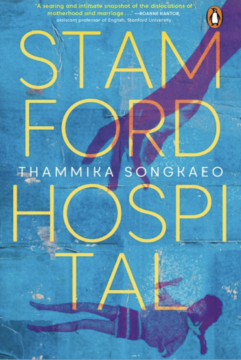 Set over a single weekend, Thammika Songkaeo’s novel Stamford Hospital (Penguin Random House SEA, 2025) follows a woman who hospitalizes her barely ill child—not out of neglect, but exhaustion—using the institution as a temporary refuge from her life. Songkaeo’s writing examines what happens when care becomes confinement, and when love is no longer enough to make a life feel habitable. Perhaps because Songkaeo treats all her characters with great empathy and never settles for easy answers, this beautifully-written debut novel has sparked—and continues to spark—a wide discussion on maternal ambivalence, sexual desire, and the limits placed on women’s choices.
*
Philip Graham: Early on in Stamford Hospital, your emotionally complex and deeply moving first novel, the main character, Tarisa, reflects with devastating succinctness that “feeling like a shell of herself had become familiar, and therefore navigable.” This seem to me to almost be a blueprint for the novel that follows, that moment where Tarisa, perhaps, realizes that she has a budding agency in the current dilemma of her life, space to wander and locate possible escape routes.
Thammika Songkaeo: I’d learn through therapy in my own real life that the response that Tarisa had was a trauma response. Numbing herself is a coping mechanism that allows her to “go with the flow,” and, at times, even flow well. Recognizing her own agency came in micro-moments that aren’t typical societal symbols of agency. She does not realize she has agency because of a possible job or a possible move to another country, for instance. Rather, she realizes that she can pivot the direction of things by moving bodies into new settings, and she can contain or expand them there.
PG: Yes, micro-moments! Stamford Hospital is filled with an exhilarating number of such moments, that’s one of your novel’s great pleasures. The reader becomes increasingly attentive to Tarisa’s evolving feelings of those around her. Particularly, as the narrative unfolds, her consideration and reconsideration of her role as a mother. I love this moment of insight during a tender moment when Tarisa washes her three-year-old daughter Mia’s hands in the hospital:
“She felt joy helping rub soap onto the small knobs of fat beside Mia’s knuckles, their fingers big and small collaborating. There was an intimacy in the act that Tarisa cherished—the mother chasing after spots yet uncovered, a promise of protection drafted as a practice of hygiene.”
TS: I wonder what I used to have in me to write sentences like that! I’m currently writing my second book, and I’m searching for such sentences. They have to come out of a somatic experience, more than anything. The micro-moments of Stamford Hospital came from the quietness with which I lived in—or could tap into—my body during the four years of writing it. And when it comes to motherhood—as a societal or literary topic—that’s one thing we seldom discuss: the somatics of the motherhood experience. We discuss mothers as tropes, oftentimes—but when was the last time we got into a mother’s body, which feels the micro-moments?
PG: Yes! And if I might add, engaged fathers can feel this micro-intensity too. For instance, the writer Lucas Mann describes, in his essay collection Attachments, a moment when he’s carrying his infant daughter: “She loves the wind more than anything. When it hits her, I feel her body taken over with sensation, like she’s forgotten how good the same thing felt yesterday and the day before.” I think that Stamford Hospital, with its attention to the intimacy and complexity of domestic moments, is a novel that can appeal equally to both female and male readers.
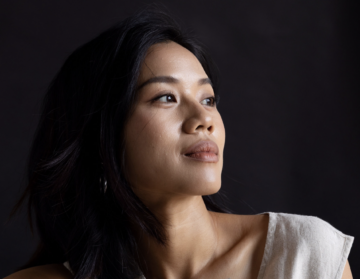 TS: That’s my dream—that it’s a novel about a woman that can also speak to men—and not in the sense of “informing men,” but rather, in the sense of an empathetic understanding. I think a man who can understand Stamford Hospital has his own interesting story to tell, and if he told his story, he’d have an impact on other men, too.
PG: Chris, Tarisa’s husband in your novel, has his own story. He is a caring, patient father, but the question arises whether his attentiveness is—at least in part—an unspoken apology to Tarisa for his having betrayed her possibilities of a career. And Tarisa has her own reasons for struggling on a daily basis to maintain her patience as a mother—she feels trapped in her life, her ambitions “kidnapped.” Their conflicting and yet compatible stories provide much of the novel’s simmering tension.
TS: That’s one of the quiet questions of the book, I think: How far can politeness and good will for the other keep a marriage going, when who you are as an individual is unmet? I think for some readers who grew up with more individualism in their culture, the answer to this question is obvious. But, because the protagonists are a mix of western and Asian, the latter which is more collective to the point of often being self-effacing, the tension that they have to carry is often within themselves. They’re trying to figure out for themselves how much of their individual needs are supposed to exist within the marriage.
PG: There’s an utterly devastating moment early in the novel, when Tarisa observes, “By now, Chris was both her friend and her enemy. She kept a part of him close and another part closer.” She never actually says anything like this to her husband, it’s a wariness she secretly nurtures, another private necessary navigation. But of course Chris must have some sense of this.
And for most of the novel Tarisa and Chris have parked themselves in the confines of a small hospital room, while the nursing staff attends to their daughter Mia’s minor illness. The necessity of this weekend stay in the hospital is a fiction, unspoken and complicit, so that a desperate Tarisa can be momentarily relieved of full-time parenting.
TS: I wonder why more people, in general, don’t add more fiction into their lives. They take every minute of it as though things were a given. They build routines to the point where the routines become crutches. I, too, am guilty of this, but I do think that, sometimes, creating a new and almost absurd way to address a daily pain point can become of the most fun things to do—if only to remember that there is always another way of doing something.
If there will always be the routine to return to, what is the fear of briefly leaving it?
I wonder now if how she doesn’t say some things she thinks about her husband is that he hasn’t shown sufficient evidence of being able to hold that space for her. At some point, we humans do hit a point where we can merge our thoughts with another human’s. She probably understood that where he began was so far from where she ended—and we’re in the moments with her, quietly recognizing that.
PG: Chris could be presented as a real villain here, the way he has purposely tricked Tarisa into their move from the U.S. to Singapore. Yet one of my favorite aspects of Stamford Hospital is that your novel insists on Chris’s humanity. We see his tenderness to Mia, his careful patience with Tarisa’s frustrations, and an easy-going personality from day to day.
And why shouldn’t he be content? Chris now has everything he’s ever wanted out of life: a cozy apartment in Singapore; a secure, well-paid job; and a room for his beloved piano, where he can play jazz. During their Stamford Hospital stay he can afford to give his wife the short leash of a visit to the library, taking a dance class, attending a modern dance performance. If only he could manage to quietly convince Tarisa to abandon her ambitions. Which means that he doesn’t understand her at all.
TS: Your idiom there was spot on—and if she, who didn’t know that idiom (she is most fluent in English, but, again, she didn’t grow up with English in the house), had had that idiom in her vocabulary, she would have understood things better. She would have understood the actual positioning of things: the power dynamics; why certain things are allowed to her; what restraints she’s supposed to be under—so that he can have everything he wants in life.
 When I look at Tarisa now, I wonder if she understood what was happening. The fact that she saw his humanity amid what he did to her reflects a sweetness related to something that’s very wrong: She’s living with her own abductor, married to him. She’s trying to see him as a good husband, but he’s really her abductor. He became a husband first, and then he abducted, which was why it was hard for her to see—or, at least, reconcile.
PG: Yes, if only she were a different person! But Tarisa’s attempt to rescue herself is the great drama of the novel. She and Chris seem to have come to a kind of truce, one that allows Tarisa to work her way through the implications of the complex situation in which she finds herself. She charts this secretly, without Chris, as she has come to realize that “life was a secluded journey.” And what she begins to discover is that any possible resolution that might offer gain will also come with loss.
TS: Is that the human condition or did our protagonist just really fall into some deep trouble? Is every relationship meant to feel so secluded in the end? How would someone like Tarisa ever fall in love again? Is it possible, when she’s gone through what she has? When you learn that a person who loves you minimizes you so much, but also provides for you so much, how do you wrap your head around what size you actually are? How do you even live in your own body, when you don’t understand the mechanics of how you exist?
Tarisa’s swarmed by these questions. They’re like incessant flies that buzz around her head the whole time she’s supposed to do this “living” thing.
PG: I think Tarisa’s indecision about her relationship is one of the reasons why your novel has hit such a nerve, most especially with women readers. While the particulars of Tarisa and Chris’s relationship fuel the novel’s drama, that general sense of feeling stuck echoes in the lives of readers who find their way to your book. They seek an understanding of their own specific details, and they seek it through your novel. And there is so much of Tarisa’s seeking in Stamford Hospital, such as the moment when she is finally alone for an hour or so in a library and yet doesn’t at first select someone else’s work from the surrounding shelves. Instead, she remembers some notes she had written on her phone two years ago in that same library and reexamines them because “she wanted to see what she had written for a sense of how she used to be.”
And then of course there’s that remarkable scene of the dance class and the instructor’s prompt to imagine one’s feet buried in honey.
TS: Hmm, “indecision”—we barely talk about it as one of the most relatable traits between any two humans. I think you’re right: many readers/humans, feel ambiguity and indecisive about so many things, and yet there’s no room to articulate that in a satisfying way, let alone make sense of how it feels in our own bodies because ambiguity, in and of itself, is experiencing so much all at once. To succumb to the ambiguity itself, you have to succumb to the lack of clarity of feelings. You have to let go and let the confusion be.
I don’t think many people thrive on that because, from a young age, we are taught to act, to choose. Confusion is typically not a recommended foundation for action or choice. Maybe what readers are searching for, and sometimes find, is an articulation of confusion. And it’s satisfying to see it displayed. It’s probably one of the most authentic things people can feel, at any given time, about many, many things in their own life.
 PG: Concerning readers, I’m delighted to see that you’re collecting quite a lot of them. I really admire how you’re traveling around the world (though mostly now in Asia) giving readings, attending literary conferences and giving master classes in creative writing, all of which serves to add to the readership of Stamford Hospital. The readers you encounter at all these events then go on to spread the word about your novel. You’ve hit some deep need with the emotional honesty of the book. Your audience feels seen, and rightly so.
TS: It’s becoming an interesting time for me because I try to connect with my readers as a community. I constantly ask, “How do we add to each other’s lives?” Yes, I love solitary writing, but there’s also a communal, post-publication process that I enjoy. I love it with the participants who come into my events or classes become friends, writing buddies, and independent writers who are finding their own voice.
I will soon be teaching online, open to a global audience! I feel deep joy seeing other writers, both new and seasoned, grow, and I’ll be offering classes both as collaborations with other institutions as well as on my own. Anyone who wants to write for honesty—what a story really is—is welcome to join me in my classes. I update the information on my Instagram (@thammikas) and on my website.
***
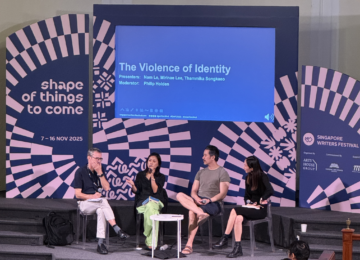
The photo of Thammika Songkaeo participating on the panel “The Violence of Identity” is from the 2025 Singapore Writers Festival.
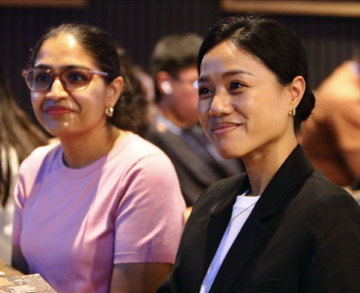
The photo of Thammika Songkaeo and Vidhya Sathyamoorty, the Malaysian author of Frappes for Three is from an event at Ateneo de Manila University in November 2025, titled “PANITIKMAN: A Salo-Salo of Southeast Asian Authors.” An article of the event can be found here.
***
Thammika Songkaeo is a transnational novelist and nonfiction writer. Her writing has appeared in Ninth Letter and World Literature Today, and her debut novel, Stamford Hospital, (Penguin Random House SEA) was named a must-read for International Women’s Day 2025 alongside The Handmaid’s Tale and The Second Sex, and has been praised by Elle Singapore as “dissecting motherhood, marriage, and the cost of selfhood with razor-sharp precision.” On tour in support of her novel, Songkaeo’s first masterclass, “Writing Fear, Anger, and Sadness,” immediately sold out at the Auckland Writers Festival. Born in Thailand and raised across cultures, Songkaeo writes from a third-culture perspective, exploring how migration, intimacy, and duty shape women’s inner lives.