
by Richard Farr
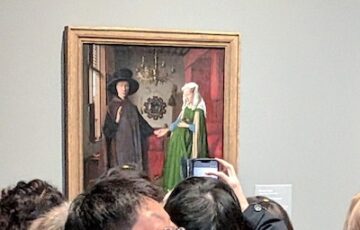
I’m on a trip to London and Spain. In Trafalgar Square with a spare half hour, I plunge into the National Gallery because I want to see the Arnolfini portrait again. Alas, van Eyck’s cadaverous old merchant and his heavily pregnant (or not pregnant) young wife (or betrothed, or recently dead ex-wife — pick you theory) are being attacked by a hundred-strong mob. I can’t even get close enough to see the annoying little dog, never mind the details.
But my consolation prize waits nearby, all but ignored: a lovely double portrait by Robert Campin from about 1435. Also, Rogier van der Weyden’s Mary Magdalene Enjoying Her Morning Latte.



I’ve never seen a painting by either Campin or van der Weyden of which I didn’t think “this deserves to be better known.”
Days later I’m in València. Near the entrance to the Museo de Bellas Artes some anonymous genius from the fourteenth century has gifted us a brilliantly expressive carving of John the Evangelist. Those eyes; that exact position of the head and neck; that subtle tension in the right hand. I don’t know what to say. What I want to say “Thank you! Thank you! How did you do that?”
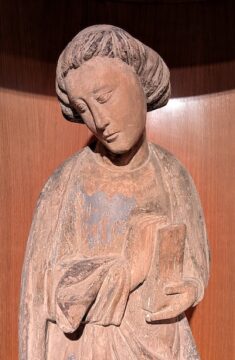
Behind him there’s a grand gallery of altarpieces from the same era or a little later. Some are more than 20 feet high; they all look as if they were painted yesterday in a color-mad frenzy of devotion. I most harbor some inchoate prejudice about the late Medieval world because I’m amazed by the psychological acuity and wit and sheer individuality in the rendition of the faces.
The next day, wanting something Modern, I go to the Centre del Carme, which has an enormous show that might be called, though it isn’t, Margins of the Unendurable. Some thousand or so dimly-lit square meters are devoted to a well-known video artist. There are, the blurb explains: “nine large-scale installations conceived as immersive stage sets that envelop the viewer and prompt reflection on issues such as emigration, violence, identity, and philosophical concepts like eremitism and the infinite seriality of life.”
I am not making this up.
I find myself wanting to say: the language may be absurd but it fits the work. I always feel guilty in galleries because my pleasure is dependent on the people who work there, and working security in an art gallery, even one filled with great art, must be one of the most excruciating jobs in the world. But I feel especially bad for the people in dark uniforms here. Every one of them looks painfully depressed. How could you not, when actually being tortured? When forced by the need for a wage to stand and shuffle hour after hour, pretending to not quite exist, in rooms that have had imposed upon them this loud, grating, lamentational vacuity?
I think: there might be a human rights issue here. I think: I must resist judging work that I obviously don’t understand. I think: well I am judging it, of course I’m judging it, and why should I not? But maybe I’m missing something? Maybe I’m missing everything! But what if every single person in here is missing everything?

After fifteen minutes I flee into the emollient streets, where there’s much better stuff spray painted on the walls.
A couple of beautiful Baroque churches later — the Parrochia de San Nicolás de Bari deserves its nickname, “the Sistine chapel of València” — I try for Modern again at the Centro de Arte Hortensia Herrero. The recipe for this successful and intriguing gallery: make $3 billion in the supermarket business, spend a lot of it on modern art, buy a ruined sixteenth century palacio and budget $50 million just for the restoration, then put in the art and open it to the public. No expense has been spared. Everything is gorgeous, down to the salvaged ancient beams and the little LEDs embedded in the stairways. And it’s always fascinating to see a collection that’s driven entirely by one person’s taste.
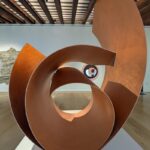
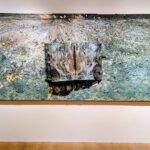
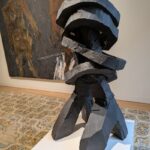
A big abstract wooden sculpture by David Rodríguez Caballero: nothing articulate I can say here except that I want to steal it and put it in the middle of my living room. Playful mirrors by Anish Kapoor: fun but forgettable; why is this worth collecting? A Calder mobile: if I wanted only one, this might be it, but it’s hard to say because it’s not well placed — there are no good angles to view it from. An abstract iron sculpture by Georg Baselitz that manages to have industrial heft and balletic lightness at the same time: I’ll take that too please, for the garden. Three vast paintings by Anselm Kiefer: thrilling to encounter but impossible to live with. Which is perhaps the point.
(Part of that $50 million went on reinforcing the walls. Somehow appropriately, one of the Kiefers is mostly lead and weighs 4 tons.)
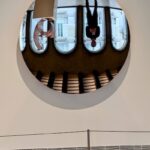
I’m looking forward to ending with the Hockney installation upstairs — his Four Seasons (2010-2011), a collage of videos of the same Yorkshire lane, projected onto the four walls of one square room — but it leaves me with mixed emotions. First: that it’s genuinely wonderful to see an artist still trying new things in (even back then) the seventh decade of his career. But also, let’s face it: that if this were a student portfolio project and not ‘a Hockney’ no one would take it seriously for a minute.
Up the coast in Tarragona, a full morning of Roman and Visigothic and Muslim and Byzantine ruins has me running out of bandwidth. Plus, the cathedral is next on my list and “not another bloody cathedral” is a European tourist complaint I’m not immune to. But I fortify myself with a quick cortado and find Tarragona’s Gothic pile to be not only vast and labyrinthine but wholly astonishing.
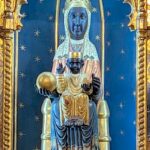
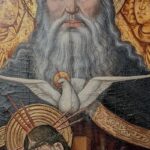
I’ve planned an hour, followed by lunch. Weak with hunger after two hours, I find that three is not enough. Then, on the point of leaving at last, I discover the attached museum, to which I almost don’t go. Perhaps it’s low blood sugar, but the riches there seem magical — especially (again) late-Medieval painting that seems to have been sprinkled with van Eyck’s Flemish Gothic and uses perspective to hint at Renaissance.


I have lunch in a sunlit square, at four o’clock. I’m still toying with a plate of fideuà, and wondering whether I can cram in the tarto de queso, around six.
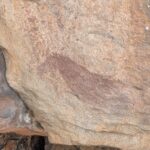
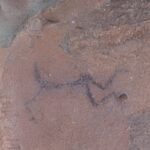
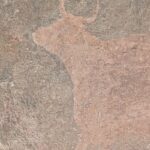
Three days later I’m standing in a forest in Aragón, not far from the dramatic mountain town of Albarracin. It’s a gallery of sorts, but this gallery is made of silence, scented pines, pillowy red rock, and dramatic fifty-mile views. A dozen or so images were painted here between 4,000 and 7,000 years ago. They show cattle, horses, humans. Why or in what mood they were painted we can never know, but it’s impossible not to read into them a kind of half-mad joy at the very shape of living creatures. All are on the extreme verge of disappearing.
*
Back in London, wandering the old City near Spitalfields, I find myself by chance at the grave of William Blake. He lies in Bunhill Fields Burial Ground (originally Bone Hill), which has been a graveyard for a thousand years. As well as Blake, it contains the earthly remains of Daniel Defoe, John Bunyan, Thomas Bayes, and (they estimate) at least 120,000 other people just since the seventeenth century — over time, the bones literally created a low hill in the marshy surrounds. Seeing Blake’s name, after weeks of greedily consuming art, reminds me of something I scribbled down years ago from one of his letters:
The taste of English amateurs has been too much framed upon pictures imported from Flanders and Holland; consequently our countrymen are easily brow-beat on the subject of painting; and hence it is common to hear a man say: `I am no judge of pictures.’ But O Englishmen! know that every man ought to be a judge of pictures, and every man is so who has not been connoisseured out of his senses.
I am happy to lean on this in my defense, if defense is needed. Blake, who was so very good at looking, wrote it 220 years ago. It says a lot that when I showed up, 199 years after he was laid to rest, there was a bunch of fresh flowers at his feet.
*
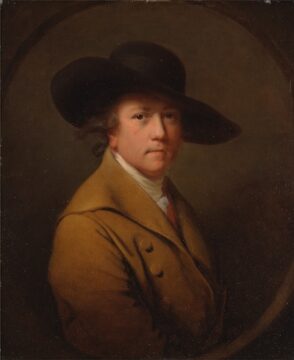
One last treat before flying home: back to the National Gallery for Wright of Derby: From the Shadows.
Perhaps a better subtitle for this small, rich show might be Looking at Looking, because that’s what Joseph Wright is most fundamentally about. In 1751, aged 17, he came to London to train as a portraitist, but proudly styled himself Wright of Derby for life. He was obsessed with the revolution in illumination brought about by the extreme chiaroscuro of Caravaggio. His own innovation (in technique) was to use sources of light that are not directly visible even thought they sit within the frame; his equally bold innovation in subject matter was the Mechanical Philosophy — or rather, people captured in the act of engaging with it.
Some of these canvases are themselves merely experiments. In Two Boys Fighting Over a Bladder a candle has been knocked over. Its holder is visible, but the unextinguished flame can be seen only through the inflated bladder and reflected back to us in one boy’s contorted face. It feels like a performance, an essai, curious but not convincing. The trick works better in A Girl Reading a Letter with an Old Man Reading Over Her Shoulder, where a candle illuminates the letter for her but the letter hides the candle from us. Both the faces and the light work better here, but you get the sense that Wright is still practicing, still looking for his subject.
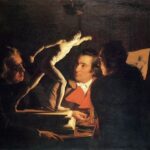
It’s in three great paintings about art and science that he finds it. Three Persons Viewing ‘The Gladiator’ by Candlelight shows two friends, plus the artist himself in profile at right, doing exactly what we are doing — looking at, admiring, and experiencing the aesthetic shock of art. The famous Greek sculpture is at the center, and we scarcely notice it. The painting’s subject is not it but its observers. In A Philosopher Giving a Lecture at the Orrery, from about a year later, this dramatic doubling is taken even further: we are looking directly through the great new scientific instrument at the human planets in fascinated orbit around it.


The icing on the cake — An Experiment on a Bird in the Air Pump, from 1768 — is famous and endlessly reproduced because it perfects Wright’s ideas while energetically summarizing an age. The chicly disheveled natural philosopher, a cross between Newton and Alan Rickman, holds his hand and his attention out to us. We too are in the room, looking; he encourages us not to be shy, but to step up and look closer. Triangular relationships abound in painting but here the triangle is three dimensional. At its vertices are the natural philosopher, the anguished little girl looking up at the dying bird, and you.
Wright was much more prolific than these few paintings suggest. There’s at least one self-portrait from virtually every decade of his adult life. Moonlit landscapes from his Italian travels, some with redly spewing volcanoes. Dozens of portraits of Sir Richard Arkwright, Erasmus Darwin, and other notables and nobles.
But the core is right here — the looking at looking.
***
Enjoying the content on 3QD? Help keep us going by donating now.