
Benjamin Clifford at the Brooklyn Rail:
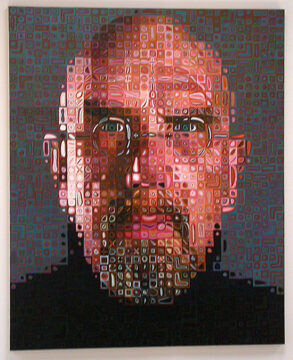 Take Self-Portrait (Rigid) (1982), one of the most straightforward examples of what Close is up to. In this work, the bearded and bespectacled face of the artist, familiar from his paintings, is assembled as an orderly array of handmade paper chicklets, small squares in twenty-four shades of gray that Close has marshalled into a pixelated image. Close’s characteristic grid structure maps the material surface of the image’s support, marking the lines of division between individual image units: inexpressive squares of pulp paper that measure out the surface of the page one cell at a time. But in many of Close’s later paintings that make the geometric structure of their composition visible, the grid also serves as a kind of screen to look through onto a pictorial space that, although shallow, is certainly volumetric and illusive. One cannot help but think of Leon Battista Alberti’s famous veil: the gridded scrim the painter interposed between his eye and his subject as a means of regimenting the perception of space. Remnants of this optical experience remain in the pulp paper works, even those as decisively material- and surface-oriented as Self-Portrait (Rigid).
more here.
Enjoying the content on 3QD? Help keep us going by donating now.