
by Robert Jensen
 Not so long ago, the conventional wisdom in most liberal/left circles was that people concerned about population growth tended to be racists, nativists, and eugenicists. And mostly old white guys, according to a leading UK environmental writer.
“It’s no coincidence that most of those who are obsessed with population growth are post-reproductive wealthy white men: it’s about the only environmental issue for which they can’t be blamed,” wrote George Monbiot.
That description was a caricature when Monbiot wrote it, but today’s wealthiest white men (think Elon Musk) are more likely to advocate population expansion, not reduction. Environmentalists who highlight the problem of population growth—the threats to the health of ecosystems from too many people consuming too much—can’t be dismissed with slurs and stereotypes.
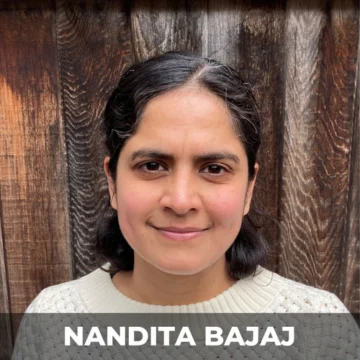
Nandita Bajaj—who is brown, female, and definitely not wealthy—defies those stereotypes. She chose not to have children and has dedicated her life to research and advocacy on behalf of women, vulnerable people, animals, and planetary health. Bajaj is executive director of Population Balance, a group that includes no racists, nativists, or eugenicists. Instead, its members face tough questions about the trajectory of the outsized human presence on Earth.
More differences from Monbiot’s stereotype: She’s not “obsessed” with population or interested in blaming individuals. Instead, Bajaj offers a compelling argument that population decline to a sustainable level is crucial not only for human survival but human flourishing, reflected in the group’s tag line, “shrink toward abundance.” Ironically, if anyone is obsessed about population these days, it’s those worried that falling birthrates endanger the fever dream of endless economic growth.
 “Human overpopulation is not the only factor driving ecological overshoot, but it is the most neglected one, and the factor that intensifies every crisis confronting us. And it really should be one of the most important progressive issues given its patriarchal roots,” Bajaj said. “Population growth happens on the backs of women and girls who are denied the autonomy to make liberated and informed reproductive decisions in order to serve the powerful forces of religion, nation-states, and economies. And those who deny the role of population are carrying water for the oppressive aspects of those institutions.”
Eileen Crist—a Population Balance advisor and retired professor of Science, Technology, and Society at Virginia Tech—said the group’s efforts to change the conversation under Bajaj’s leadership “have been a breath of fresh air.” But the message is blunt: “Population Balance is showing how consumption, population, and technospheric growth are connected and compounding variables of planetary disaster, suffering, and extinction,” Crist said.
Conventional background, unconventional choices
Bajaj was born in India in 1981 and has lived in Canada since 1998. In 2021, she took the leadership job at Population Balance, a small U.S.-based nonprofit that is growing in influence through its two podcasts (“Overshoot” and “Beyond Pronatalism”), research reports, media articles, guest presentations, and Bajaj’s debating skills. She also is a senior lecturer at Antioch University, where she teaches graduate courses about the links between pronatalism and human supremacy.
None of those endeavors was part of her plan as a young woman, when she trained to be an aerospace engineer and assumed she would be a mother. “My love for science, math, and airplanes drew me to study aerospace engineering, but a number of personal epiphanies in my late 20s pushed me to start exploring overpopulation, reproductive rights, and overshoot more seriously,” Bajaj said. “The deeper I looked, the more I started questioning the received wisdom of my cultural values.”
Bajaj grew up in a middle-class family with relatively progressive views. Both her parents were educated and had successful careers, and she had the freedom to choose her vocation. After working in aerospace engineering for a few years, she was a high school physics and math teacher and administrator. But Bajaj said marriage and motherhood seemed inevitable, even inescapable.
During that time, she met her now-husband, Mike Farley, a white Canadian who teaches high school and university courses in geography and environmental studies. Their interracial relationship caused some consternation within her family, but the decision not to have children was seen as far more radical. Bajaj remembers that when Mike first asked her about her views on having kids, she was confused.
“I asked him, ‘What do you mean? Don’t we have to?’” she said. “Mike assured me it was a decision we would make together.” Bajaj said she felt both joy and shock. “That I could choose to not have children was overwhelmingly liberating,” she said. “That I—a feminist, an aerospace engineer, and a seemingly independent thinker—hadn’t thought I had a choice, that was a shock.”
That was Bajaj’s introduction to pronatalism, the “internalized cultural expectation that motherhood was inevitable,” which led her to begin exploring the idea’s origins and consequences. She asked herself: “Was there a connection between my internalized lack of reproductive choice and the fact that India is the world’s most populous country?” She started to see how pronatalism undermines reproductive choice and drives overpopulation, not just in India but around the world.
In 2019, Bajaj enrolled in the graduate program in humane education at Antioch University, where she now teaches, to study the links between pronatalism, overpopulation, human supremacy, and ecological overshoot. She brought that framework to her role as executive director of Population Balance.
Overshoot
For many environmentalists, the key threat is climate change. For Bajaj and Population Balance, climate change and other ecological crises (chemical contamination, soil erosion, loss of biodiversity and species extinction) are the result of overshoot—humans drawing down the ecological capital of the planet beyond replacement levels. Since sociologist William Catton’s 1980 book, Overshoot: The Ecological Basis of Revolutionary Change, the term is used to mark the point where a population’s demands exceed the environment’s ability to regenerate resources and absorb wastes. Ecologist Bill Rees, an advisor to Population Balance, describes overshoot as a meta-crisis, the root cause giving rise to the varied environmental problems.
Bajaj said that many environmentalists focus on a single crisis, which leads to downstream “solutions,” such as renewable energy, that are important but inadequate. Too often, environmentalists embrace temporary technological fixes that avoid the most obvious long-term fix for all ecological crises: a reduction in human consumption by lowering both the population and our aggregate consumption of energy and material resources. Consumption is not equally distributed around the world, of course, but Bajaj said that anyone concerned about equity and justice can’t ignore these questions. Many do just that.
“On the podcast, we try to look at the many ideologies that contribute to the problem and to the denial,” Bajaj said, “from the pronatalism that fuels overpopulation, to the growth-biased economies based on consumerism and social injustice, to the worldview of human supremacy that exploits animals and nature.” Just as important, she said, is highlighting “transformative pathways that go beyond technological fixes and toward interconnectedness with all beings.” In the episode “The ‘Energy Transition’ Delusion,” for example, Bajaj and cohost Alan Ware interviewed a historian of science and technology who explained why decoupling economic growth from energy and materials use—a favorite claim of the techno-optimists—is delusional and discussed ecologically realistic alternatives.
Crist said Population Balance is working to get beyond the dead-end framing of consumption versus population, as though these factors are separable. “Population Balance is exploring how the unstrange bedfellows of technological fundamentalism and human supremacy—both doctrines of human omnipotence—are blindsiding humanity to the breakdown of everything that runaway growth has unleashed,” Crist said.
Pronatalism
After five years of producing the “Overshoot” podcast, Bajaj and Population Balance launched a second podcast in 2024, “Beyond Pronatalism.” Far from being the province only of the right, pronatalism is rarely critiqued, including within mainstream feminism.
Bajaj defines pronatalism as the cultural pressure to have children to meet the demands of state power and economic growth. She said pronatalism has been a feature of patriarchal states for thousands of years, and those societies that continue to impose oppressive sex/gender norms tend to have the highest fertility rates. Pronatalism, Bajaj asserts, undermines not only reproductive choice but also the right of children to be born into conditions conducive to their wellbeing—socially, materially, and ecologically.
“My epiphany about my choice to not have children made me wonder how many others believed that parenthood is their destiny,” she said. “Following my graduate studies, I designed a graduate course—which is the first of its kind as far as I know—on the links between pronatalism, population growth, and overshoot.” Bajaj said that the popularity of the course demonstrated to her that people were eager to discuss these issues.
“The questions about whether or not to have children—and the impacts of that choice on parents, on the potential child, and on the larger community of people, animals, and ecosystems—can be uncomfortable, even threatening,” she said. “But in the safety of our class discussions, students feel validated and transformed when given the opportunity to explore their most intimate feelings and worldviews without judgment.”
Bajaj said she gets that kind of engaged response from many students when she gives presentations at other universities, and the podcast grew out of those responses.
“The stories I hear are different in details from mine, but at the same time so similar,” she said. “We all want to make liberated and informed choices, and in a patriarchal world that sees women as reproductive vessels, those choices can be largely invisible or, at worst, completely absent.”
Critiquing pronatalism does not mean she is antinatalist, in the sense of haranguing people not to have children. Bajaj rejects anti-procreation or voluntary human extinction arguments, which she thinks are simplistic. “Antinatalism—an anti-life, anti-human position—reduces 3.5 billion years of evolutionary processes to a utilitarian calculus of joy versus suffering to justify non-procreation and ends up inappropriately blaming those who have little say over their own reproduction,” she said. “Our goal is a world where people are neither pressured into having children nor scorned for having them, and where people arrive at reproductive decisions with maximum autonomy, education, and informed responsibility.”
Bajaj said that for those with the privilege of choice, informed responsibility means that we ought to consider the ethical implications of our reproductive decisions. “There’s a difference between imposing a worldview on others, as antinatalism does, and awakening others to a sense of reverence and responsibility toward Earth and other beings,” she said. “A person can reasonably choose not to procreate, either in anticipation that children born will likely suffer in this time of planetary crisis or out of a sense of joyful connection with, and care for, the existing community of life.”
Crist said Bajaj has done the most in the contemporary NGO scene to explain and expose pronatalism as a key driver of population growth. “We have to understand that overpopulation is not only ecologically unjust to countless nonhumans and nature, but it is also based on longstanding, often brutal forms of injustice against countless girls and women who have been, and continue to be, stripped of authentic choice in the reproductive sphere,” Crist said. “Nandita is leading the way.”
Spreading the word
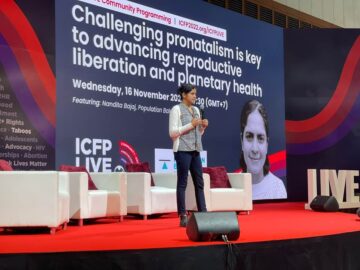
Much of Bajaj’s work at Population Balance focuses on research, education, and public information. She travels—albeit reluctantly, with mixed feelings about getting on the airplanes she once dreamed of designing—to speak, especially when invited to debate.
At the 7th International Conference on Family Planning—held in November in Bogotá, Colombia, with 3,500 attendees from 120 countries—she participated in a debate on the question, “Should we fear falling birthrates?” Her team’s call to abandon growth-obsessed economics in favor of caring economies that respect ecological limits won the debate with an overwhelming majority of votes.
Bajaj said it is always heartening when people listen and engage with these issues, especially when she sees the relief most women feel when they realize they have choices. “Watching people awaken out of these ideologies with a sense of urgency and responsibility to move toward a more humane and just pathway is the most powerful antidote to the emotional heaviness this work can bring.”
Those human connections take a bit of the sting out of the dire ecological realities that she confronts every day.
“If it weren’t for the joy of being surrounded by the deeply meaningful connections with family, friends, animals, and nature, it would be impossible to do this work,” she said.
————–
(Author’s note: I was a guest on the Overshoot podcast in 2022 to discuss “An Inconvenient Apocalypse,” the title of my book coauthored with Wes Jackson.)