
by Philip Graham
In the first part of our conversation at 3 Quarks Daily, the writer Kipling Knox and I spoke of the parallels of our recent books: dappled with ghosts, in similar Midwestern landscapes, they’re also fictions that are expanding into world-building versions of themselves.
From there our conversation has turned, in Part 2, to how taking the road of independent publishing allows writers to attempt tactics–in the writing, production, presentation and marketing of their work–that would likely not otherwise be available to them. Perform a radio play version (with actors from Second City) of one of your collection’s stories, accompanied by live music? Done. Drive through the country and deposit free copies of your novel in Little Free Libraries? Ditto. Illustrate your books with original photos, or line drawing? Yes. Have readers fan out across the world (the Coliseum in Rome, the Ubud Monkey Sanctuary in Bali, etc) to drop off mysterious cards that link to your novel? You bet.
Philip Graham: So, to continue. We have both, as authors, recently explored our own pathways that veer from traditional publishing models—you, at the beginning of your career, and I near the tail end of mine. Under the Moon in Illinois: Stories from a Haunted Land, your first book, arrived from an independent publishing house you founded, Prairie State Press. The book is beautifully illustrated with your own evocative photos, and there are even eerie videos of two of the stories, both of which feature music by your son. You’ve even created events that seem to rise above the usual book signing appearances. I’d love to hear more of how you gave yourself agency in this project.
Kipling Knox: I think once you decide that you’re not going to try to chase benefactors in traditional publishing, a lot of creative avenues open up. When you become an indie publisher for your work, you own all your intellectual property and you can expand or riff on it however you like. For my first book I just kept adding things to enhance the overall experience of the stories. As you say, there are photos in the book, and audio versions of some of the stories, backed by my son’s music. I made a few videos. And then we put on a really fun show, where I adapted one of the stories into a radio play. We had actors from Chicago’s Second City come down and read with me, and my son’s band played an original score. But I didn’t set out to do all these things at the beginning. It was more that at each turn, we thought about what would make the material more interesting for people.
PG: Actors from Second City! I love this. Please, tell me more.
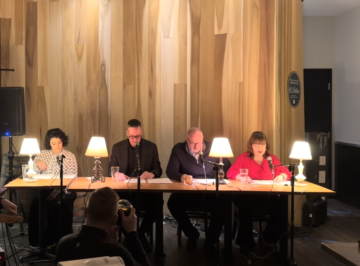 KK: One of my best friends from high school, Brian Boland, was a regular on the main stage at Second City, which helped define improvisational comedy and produced so many famous comic actors. He’s also an accomplished voice actor and has been in some ads our readers have probably seen (like for Geico). He brought two of his colleagues and they each took on characters in the story, “The Ad Man After Dark.” It was amazing to witness how they brought the characters to life and entertained the audience.
PG: I watched that Second City-powered reading of your story online, and it’s a hoot. The mix of voices works so well, and I love the story itself. A ghost story whose understated humor (though sometimes it’s laugh-out-loud funny, and is not without its poignant moments) reminds me of James Thurber.
KK: Philip, I recall that one of your stories was given a dramatic reading, along with stories by four other authors, at Symphony Space in New York City.
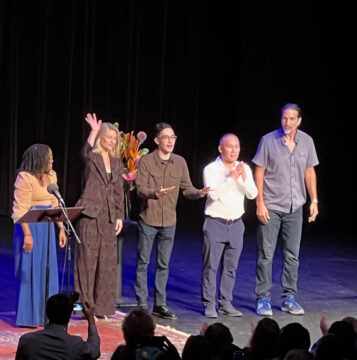 PG: Yes, that was quite a show, I was honored to be a part of it. The program included stories by the likes of J. Robert Lennon and Charles Yu, and each individual story was assigned to a single performer (such as Claire Danes and BD Wong; my story was performed by the evening’s host, the comedian Gary Gulman). When their turn came the different actors stood at the podium and read the short story they’d been assigned. This created an interesting challenge: each performer was alone on the stage and couldn’t wander around, they had to stick to the podium. So they stood within what was essentially an invisible box and moved their eyes, their bodies subtly, like another form of vocal inflection, to shape their interpretations.
Did any of the Second City performers surprise you with their takes on the characters you created?
KK: Oh yes. I told the actors they should feel free to change the dialog where it felt right, and that turned out great. Brian, in particular, made his characters funnier than I had originally written them—he was more animated and bombastic and that made the story better for the stage.
For me, that show was another example of how as writers, we can allow our stories to live on and grow into other forms. You’ve seen this from both sides—publishing traditionally and independently. Have you observed a kind of contrast in creative liberty?
PG: Absolutely. And I also found that, when releasing myself from the constraints of traditional publishing, ideas kept bubbling up that never would have occurred to me otherwise: the designing of my novel’s book cover that sports virtually none of the usual sales pitches: no blurbs, book description, author’s bio or photo, not even the author’s name. A QR code hidden behind the back French flap, which leads to a secret narrative not included in the print version of the novel. Then a 10,000-mile journey around the country, secretly depositing nearly 1,000 free copies of this mystery in the shape of a book in Little Free Libraries. I went a little crazy—if there was a rule of publishing, I would try to break it. And I had the time of my life doing so. Then there’s the current digital expansion of the novel, which also goes its own way. But I’ll save that for later.
I’d really like to continue talking about the process behind the extravaganzas you’ve produced for your two books: events with multiple readers for your story collection Under the Moon in Illinois, your son and his band performing beautiful music composed for the book, and then of course those haunting short films and you’ve done much the same for your second book, the novel How to Love in a World Like This. How did you put those events together, and what other ideas are you spinning that I may not know about?
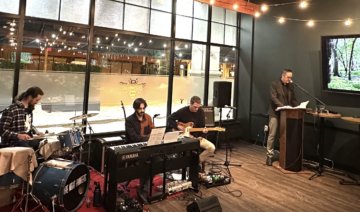 KK: The events started with a recognition that I needed to do something to promote the books. Ordinarily, authors would do a reading and a book signing. But it was hard for me to imagine that people would want to come just to hear me read. So I began to think about how we might make such an event more interesting… We could add some music—people love music; we could make it into a play—and include some other actors; we could produce some multimedia to add to the mood. Honestly, a lot of it was me trying to direct the focus away from myself, and turn it toward the story and a group of artists collaborating. I’m fortunate in that I know some wonderfully creative people, but I think any author can create an event like this.
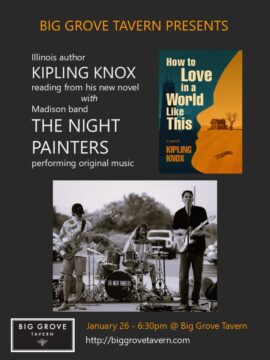 How I did it was very practical. We wrote down a script and set list for the show. We talked with a local restaurant who have banquet rooms and who like to support local culture. We sent out invitations. We practiced a little. And then we showed up for the evening and did our best. As far as I can tell, people really enjoyed themselves. I strongly encourage independent authors to use events like this as a form of promotion for their work. In my experience, they are a far, far more effective way to reach people (and sell books) than social media. And they are much more fun and fulfilling and good for the community.
One other idea I’ve pursued is a book club promotion. When How to Love was first released, I offered to send books for free to any book club committed to reading it. My theory was that the novel is more suitable to the kind of thoughtful readers who participate in book clubs. I was hoping they would be more motivated to tell other people about the book—and research shows that people mostly choose books based on word-of-mouth. This was, admittedly, an expensive tactic. I can’t say yet how successful it has been. In this overwhelming ‘attention economy,’ it’s very difficult to convince people to make even the smallest effort.
So back to you—have you been doing readings for What the Dead Can Say? Or other unconventional forms of promotion?
PG: Unconventional is indeed the word—though really, the efforts you and I have come up with for our books seem normal and logical—unfortunately, they’re just not usual.
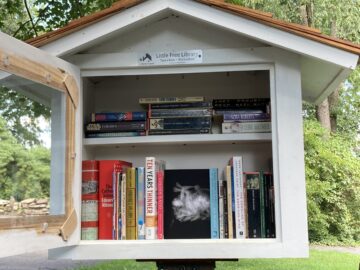 That 10,000 mile distribution adventure for my novel in little free libraries around the country guaranteed a readership of a thousand, and because the book offered no authorship attribution other than “Author Unseen,” the focus was certainly taken off me! Instead, it was on the book. If someone found the first few pages engaging, then they’d take it home and likely keep on reading the exploits of the book’s main character, a ghost named Jenny. If not, they could always place it back on the little library’s shelf for someone else to discover.
I didn’t want the book’s journey to end there, so I worked up a digital version of What the Dead Can Say, which any prospective reader can easily subscribe to.
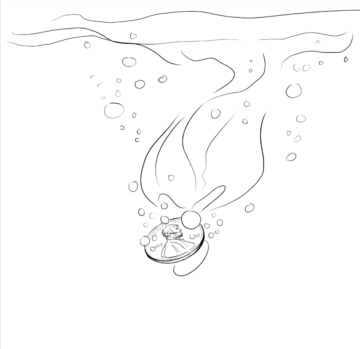 Evocative line drawings by the artist Emily K Mell grace each chapter. A section titled “The Jennyverse Chorus” offers readings by a wide range of contemporary authors of brief sections from each chapter. Appended to the end of every chapter is an addition titled “What Jenny Could Have Said (but didn’t),” which features new narratives that might have been pursued in the previous pages.
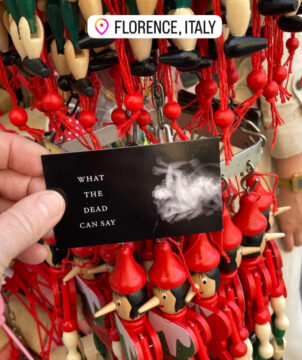
Finally, I printed little cards made up with the novel’s cover art, title, and URL for the digital version. Friends and admirers of What the Dead Can Say have taken these cards with them when they travel, and place them in unusual locations for potential readers to discover: the Freud Museum in London, the Coliseum in Rome, the Forest Monkey Sanctuary in Bali, the Graz Art Museum in Austria, St. Anthony’s Basilica in Padua, and an abandoned British telephone booth converted into a Little Free Library in Oxford, among many other corners of the world (examples can be found on Instagram: @jennyandherghosts).
 By the way, as I really admire the photos and videos you’ve produced for Under the Moon, I’d love to hear some background on that.
KK: Oh yes, I took most of those pictures while cycling around Champaign County, IL. Many of them predate the stories. When I moved back to Illinois after 20 years in western Washington, I was struck by the sort of mythical but austere beauty of the landscape. You see these dilapidated old grain elevators and corn cribs—some torn down since I photographed them. But you also run into these rich corridors of wildlife, especially around rivers, that stand as ghosts of the grand prairie that once thrived here. To me, they enhanced the mood and mystery of what I was trying to capture in the stories. Since I produced the book myself, it was easy to pop them in between stories. The videos were just an extension of this effort. I was also thinking the videos would capture some prospective readers’ attention on social media. I don’t think that had much effect, as it turned out, but I did have this nice image collateral I could project while I did readings, or made posts to my website.
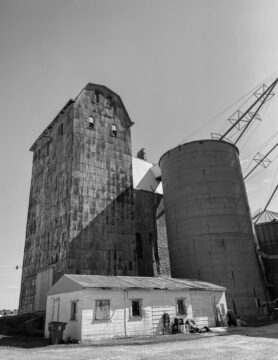 PG: These photos are wonderful. They don’t portray any particular story, per se, but they are quite effective in portraying the emotional aura of the book. From beginning to end the prose and the images seem to proceed together like two parallel lines, and they do indeed add to each other: the stark reality of the photos’ locales and the eerie imagination of the stories. I’d love to hear more about the choices you made, taking and then placing individual photos.
KK: Thank you for saying so, as I am definitely an amateur photographer! The images are intentionally arranged in the book. The cover image, duplicated in full on the first page, is called ‘Inverted River,’ literally an inverted picture of the Sangamon River in Illinois. It’s meant to hint at the inversion that happens among the characters in the book, where ghosts are the predominant consciousness, and the living become the reflection. Some of the images of buildings seem to have faces that carry a lot of emotion—like the old grain elevator that has a kind of comical pensiveness. Or the old schoolhouse that, when viewed in context with “For Their Own Good,” feels haunted and tragic.
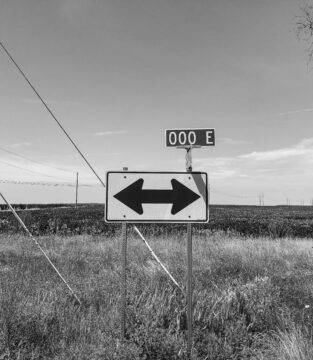 And the last image of the book, which shows the sign for County Road 000 above endless corn fields, suggests the true middle of nowhere. But of course it is as much somewhere as anywhere else. This sense of place in fiction is so important to me. I think the cover of How to Love also conveys a beautiful sense of place—thanks to the design work of Marcus Lehto, one of the creators of the Halo video game franchise.
It’s clear that one of the benefits you and I have seen in independent publishing is this unlimited creative potential. But I’m struck by your reference to ‘guaranteed readership of a thousand.’ That’s a nice audience, by my standards! What would you say to an emerging author who worries that independent publishing won’t allow them to reach many readers?
PG: Well, remember those are a thousand free copies, intended as unexpected gifts for curious readers investigating their local Little Free Library—readers that would have likely been impossible to reach otherwise. By contrast, the digital version works as a paid subscription, and sign-ups continue as I expand the novel into bonus chapters. Jenny’s story keeps wanting to be imagined, and I’m trying to step up to the plate. None of this could happen if the book was constrained as a physical product meant to be the definitive version.
In many ways, your novel How to Love in a World Like This has accomplished its own metamorphosis, continuing the seventeen-page story “Downriver” in your first book.
KK: Yes, like Jenny’s story, “Downriver” wanted to be continued. The characters Morgan and Arthur had more story that needed to come out. I’ll say that as my body of work expands, I’m starting to discover more continuity through it. I write a series of essays, called Small Talk, which are folksy dives into a topic, that find connections between science and philosophy. How To Love has stream-of-consciousness digressions that are a lot like Small Talk.
This reminds me of the benefits of publishing something regularly, as a means to reach more people. If we assume that most writers want to expand their audience (and I think we can), then a good piece of advice for writers is to try other forms of writing and share it frequently. Small Talk was just an experiment and an outlet for me, but it’s become the best way I reach people now. It gives me a quick sense of accomplishment, an opportunity to learn, to share more photography, and possibly to enlighten the world in some small way. But I’ve found that Small Talk subscribers became interested in my fiction. I’d say that if writers put their effort into sharing something honest and of value, consistently, the odds are very good they’ll build an audience. And the human connection you get is much richer than any number of ‘likes and subscribes.’
Your publishing credits are numerous, but I know they also include web-published pieces, like your series on the craft of writing.
PG: I’ve taken most of those essays off the web, as I plan to collect and arrange them more structurally into book form. Which I would have done by now, but What the Dead Can Say keeps expanding. The part of my imagination that continues to be engaged with this unexpected unfurling of my novel needs most of my attention. Though twelve of those craft essays remain available on my author’s website.
By the way, I’m a real admirer of those Small Talk essays, which are collected on your website. They’re beautifully written and far more thoughtful than the modest title of the series implies. And such a range of topics, from the intelligence of crows, to “the elegant piece of truffle candy” that is the moon, to how trains are miraculous, or how smell transforms coffee, how thinking of trees can be an exercise in humility, and on to the latest, which observes that “Earth is one big-assed magnet.” It’s always a pleasure when another Small Talk essay arrives in the mail.
KK: I’m glad to hear that! I really enjoy writing Small Talk, and I think most good art comes from the artist enjoying its creation. As I reflect on our conversations here, I’m struck by the theme of having fun with your writing, and letting yourself feel unconstrained—in the story itself, but also in how you publish and promote it. As an English professor, you’ve helped many young writers find their voice—but in particular, I think you’ve inspired people to follow a more inventive, creative approach to writing. Thank you for that. And thanks for a great conversation, Philip. I’m looking forward to reading that collection of craft essays!
***
Kipling Knox is the author of the 2025 novel How to Live in a World Like This, and the 2022 story collection Under the Moon in Illinois. His stories have won the Chris O’Malley Prize in Fiction and the Wild Women Award, were finalists for Tobias Wolff Awards, and have been published or recognized by the Madison Review, Narrative Magazine, the TulipTree Review, the Bellingham Review, and the Whitefish Review. He also writes Small Talk, a series of essays covering science, philosophy, culture, and the arts—all with a touch of humor.
He has worked as an engineering manager at Microsoft, an editor for World Book Publishing and Reed Elsevier, and Director of Web Services at the University of Illinois. A native of Illinois who’s also lived in western Washington and Alabama, he works to promote biodiversity, even on a backyard scale, with a special interest in prairie lands.
Philip Graham is the author of eight books of fiction and nonfiction, including the novels How to Read an Unwritten Language and (as Author Unseen) What the Dead Can Say, and the story collections The Art of the Knock and Interior Design. He has also written a collection of travel essays, The Moon, Come to Earth: Dispatches from Lisbon and is the co-author with his wife, anthropologist Alma Gottlieb, of two memoirs of Africa, Parallel Worlds and Braided Worlds. His work has appeared in The New Yorker, Washington Post Magazine, North American Review, Paris Review, Missouri Review, McSweeney’s Internet Tendency, and elsewhere. He is a Professor Emeritus of the University of Illinois, Urbana-Champaign. A co-founder and fiction/nonfiction editor of the literary/arts journal Ninth Letter, he currently serves as an Editor-at-Large for the journal’s website.