
by Philip Graham
I’m still amazed that Kipling Knox was my student during the mid-to late 1980s, the earliest days of my teaching at the University of Illinois. A more-than-promising creative writing undergraduate student, he then went on to live his professional life in the tech and editing worlds before embarking on a literary career that so far has produced two excellent books—a story collection and a novel—set in the Illinois landscape where he grew up. A landscape also filled with actual ghosts, a popular condition of so much imaginative writing set in the Midwest. My own latest novel has a dance card filled with ghosts, so it was inevitable that Kip and I would eventually sit down and compare notes. Another point of comparison has been our individual decisions to explore the possibilities of independent publishing and the unexpected avenues such a decision can lead authors in search of autonomy. It seems we had a lot of say, and so have divided our chat into two digestible parts.
Philip Graham: In the past three years you’ve published two beautifully-written works of fiction. In 2022, Under the Moon in Illinois, and at the end of 2025, How to Love in a World Like This. Both books are set—largely—in a Midwestern town that you’ve conjured up and call Middling, Illinois. And so they seem to be a part of a larger—and still growing?—world-building enterprise of fiction.
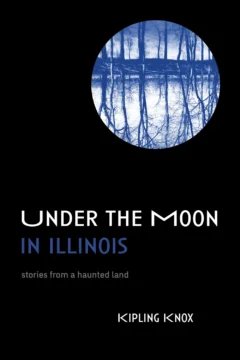 Kipling Knox: Thanks, Philip. Yes, that’s true—both books share a world with common characters. But that wasn’t my original intent. Between publishing these two, I started two other novels, with different settings. I put them both aside because I found myself drawn back to Middling. The story “Downriver,” in particular, ended so ambiguously that I was curious to know what would happen to its characters, Morgan and Arthur, and how their mystery would play out. It’s a difficult trade-off—sticking with one fictional world versus exploring others. When you write a book, you are deliberately not writing others, and there can be a sense of loss in that. But it’s very gratifying to explore a world you’ve built more deeply. I think of how a drop of ocean water contains millions of microorganisms, each with their own story, in a sense. So the world of Middling County (and also, in my second book, Chicago) has infinite potential for stories!
As I consider my next project, I do feel very committed to the American Midwest. Midwestern people and culture fascinate me. I think this is partly because Midwesterners are so often unburdened by a sense of superiority. We’re always trying to prove ourselves, politely. This is a gross generalization, of course, but I think it’s grounded in truth. These qualities make Midwestern characters nuanced and earnest and, hopefully, a little comical. It also makes for rich social satire—I think of midwestern-born authors like Mark Twain, Kurt Vonnegut, and George Saunders.
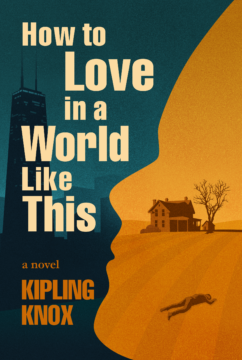 PG: I’d like to speak a little more about world building. Under the Moon in Illinois is an interrelated story collection that might also be seen as a novel. How to Love in a World Like This, a novel, takes off from the ending of the story “Downriver” in that first book, so your new novel might also be seen as part of an interrelated story collection! And yet who cares about labels? The two books simply share a world and circle each other in subtle and sometimes startling ways.
KK: Ha! I love that. How to Love is a just a big short story that didn’t fit in the original book. But I think you’re on to something. Our digital age provides opportunities to extend and evolve works of art beyond conventional boundaries. In the world of digital music, what is an ‘album’ now? Well, of course it’s a finite collection of songs, which are still sometimes pressed into vinyl. But musicians regularly release longer versions of albums, or alternate mixes, or a series of singles. What is a playlist but a newly-curated album that has no limit?
What you’re doing with the digital version What the Dead Can Say is a great example of crossing traditional boundaries of fiction. Fans of the original book get new chapters, and ‘outtakes’ of sorts for the original chapters. That’s wonderfully inventive, and also a gift to your readers.
But I do think there’s something valuable in some of the conventional forms, and the creativity that comes from limits and restrictions. (No better example than a haiku, which you use as a metaphor in WtDCS.) I’m curious to know what you think of that—in exploring the limitless horizon of digital art, do we risk getting sloppy and undisciplined, and does the product suffer?
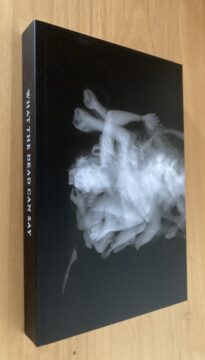 PG: Ah, a great question. It’s a risk I’ve grappled with, in the transition from the print version of What the Dead Can Say to its digital incarnation. When to stop? The answer I give myself is that this fictional afterlife I’ve imagined still calls to me. The print version ends with the main character, a ghost named Jenny, preparing to explore the wider world. Initially, I was happy to stop here—let the reader imagine, if so inspired, what might happen next in Jenny’s afterlife. But my own wondering grew stronger, and so the digital version is slowly extending into the novel’s future, to the tune of five additional chapters. As for those digital sections appended to the end of the original chapters, they’re little narratives or scenes that explore possibilities I hadn’t considered (or barely mentioned) when first writing the book. Every novel, I think, contains silent side doors. I just decided to open some of them. The fluidity of digital platform allows a freedom I never would have considered when younger.
I thought How to Love in a World Like This ended with some threads still untied, and I wondered if you’re planning to boomerang back to Middling at some point down the line.
KK: Yes, some of my early readers have asked that too. In my mind, the novel answers the questions it puts forth, and its leading characters, Morgan and Arthur, have a satisfying transformation. So in that sense, it’s ‘done.’ But you’re right that some plot points remain open at the end, and that’s intentional. I love stories that allow debate and speculation among their audiences. Life is eternally open-ended, and so if good art reflects life authentically, it can’t be neatly tied up. Plus, I think readers of How To Love are having fun debating what happens next.
So, I’m disinclined to answer these plot questions in a future book. But I do expect to return to Middling, and Chicago, and this family of characters (or, possibly, their future descendants!). No fictional world can be completely portrayed of course, because the imagination is infinite. So when it comes to fictional series, I’m drawn to ones that find stories that are tangential cuts through their world. For example, I think Rogue One is among the best of the Star Wars movies, and it’s pretty far off the central narrative of the franchise. But it’s a fantastic exploration of the world.
What the Dead Can Say does both at once—the stories of say Kwame and Tama and Edward all work as independent vignettes in the world. But Jenny’s narrative brings it all together, and in a way provides further interpretation of those stories. It occurs to me that both of our recent work has a strong supernatural element, with ghosts as characters who yearn for something. But I think these books also illuminate some persistent social problems. Do you think having a ghost narrator gave you a better angle on this than a living narrator would have? Was that your intent?
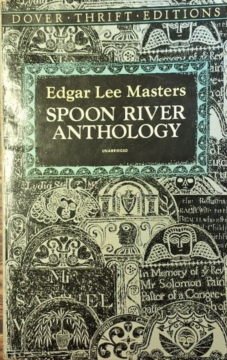 PG: Yes, ghosts! You and I have both written ghost-haunted books (which are each centered, for the most part, in a small Midwestern town). I love how our ghosts—who rub elbows geographically, so to speak—are so different. Yours can be seen by the living and the possibility to communicate remains, while my ghosts unfold their afterlives invisibly. Differences that are as natural as can be! The ghosts of Edgar Lee Masters’ Spoon River Anthology speak from their gravesites, the fictional ghost of the artist Ana Mandietta in Xochitl Gonzalez’ Anita de Monte Laughs Last attempts revenge upon her murderer, and the character of Melquiades in One Hundred Years of Solitude is able to return from the dead again and again. And as a reader I am willing to believe in all of them. Ghosts in literature, however varied they may be, I believe are among the purest distillations of a writer’s imagination.
Concerning our country’s social problems, well, they have persisted since forever haven’t they? In your fiction, the threat of right-wing extremists haunts the countryside around the town of Middling—those folks are who you should be afraid of, not ghosts! And that sense of menace is quite powerful in both books. As for my novel, it’s kind of a tour of US history, as Jenny encounters fellow ghosts from many eras, and all of those eras are conflicted in some way.
KK: I love the idea of ghost characters possessing a kind of wisdom not possible among the living. My ghost characters are always watching living people saying, Oh no! Don’t do that! Don’t make the mistakes I did! And sometimes they try to interfere, with mixed results. There’s also the intriguing notion that ghosts can eventually come to rest, if they resolve the troubles present at the time of their death. This is an important distinction, because the alternative is immortality, which can be a terrifying prospect. Your ghosts, I think, may be destined for immortality? That’s what I concluded.
In writing ghost characters, I realized I had to do as much world building as in sci fi. As you say, you have to establish the rules between the living and the departed. You have to conceive of what makes a ghost and what their physics are. And then you have to adhere to the rules you’ve established. It’s a form of magical realism, where the fantastical still has to follow rules, or it becomes silly.
Readers often ask me whether I believe in ghosts. Do you get that question, and what do you answer?
PG: I believe in the ghosts I’m able to imagine. I also believe that there are people, even those alive and not currently present in your life, that can serve as a form of ghost able to haunt you. And this kind of ghost can arise from someone you’ve known all your life, or someone you once met for mere minutes. Perhaps this is why ghost stories can be so compelling, even if we’ve never encountered a “real” ghost. Everyone lives with multiple hauntings. And we in turn haunt others, whether we know that or not.
As for immortality for my novel’s ghosts, who knows? Immortality is a long, long way from home.
KK: I think of ghosts as a continuation of a person’s consciousness and their biological energy. In that respect, we have no idea whether ghosts exist or not, and we may never know. So we are free to have fun with the idea. It also fascinates me that humans even conceived of the idea of post-life forms. It’s not an obvious idea. Do other animals have a notion of ghosts? Some species (especially elephants) behave in ways that suggest they mourn the loss of a family member, which means they conceive of their existence after death, which opens the possibility of imagining they have a presence in the afterlife. So… if there are human ghosts, there have to be ghosts of other species. This is why I included the ghosts of ancient creatures in the story “Resurrection Mary” and others in Under the Moon in Illinois.
PG: I love the ghostly mastodons in that book, as well as “the giant sloths, and the passenger pigeons and all the phantoms of the beasts we’ve destroyed,” as Earl, one of your ghosts, has observed. (Watch this video before reading on, if you like.)
I find it so interesting that literary ghosts often skulk around Midwestern towns. Your books, of course, and my most recent novel, and then of course there are others, including perhaps the ur-text of this trope, Edgar Lee Masters’ Spoon River Anthology (Sherwood Anderson’s Winesburg, Ohio—though ghostless—also comes to mind). As a transplanted East Coaster who lived thirty years in the Midwest, something that struck me, besides the utterly flat stretches of East Central Illinois, was that the towns have actual borders. When a town ends, the farmland begins. Long stretches of the Midwest resemble an inland archipelago—the towns serving as islands in a vast sea of corn and soybeans. But ghosts are, in a sense, an antidote to this: having been released from their physical borders, they now possess a freedom previously unthinkable. Or are there now different constraints?
 KK: Yes, I think there’s the question of emotional boundaries. (Which can also be strictly defined among Mid-westerners!). If you imagine there are ghosts, you have to ask how they feel, and how their emotions evolved since their lives. Do they still hold grudges? Are they more sanguine, with a new perspective? Can they still love?
PG: Love. That’s one of your great subjects. Earl the ghost and his still living wife Helen exchange, in a way, tender letters. She writes hers, then sets them in a drawer, “knowing that there was no address to write.” Yet Earl is hovering beside her, reading as she writes, and whispers silently his own news.
Perhaps my favorite story in Under the Moon is “The Corruption of Time.” The mourning Milo has constructed an odd and hopeful machine that he hopes will allow him to visit Emily, his dead wife. He turns a dial, and because “his heart is in command,” he finds himself in a canoe with her “on the day before Emily first felt signs of illness.” This gentle, painful, charged encounter—which may or may not be imagined—gets to me every time I read it. And your novel How to Love in a World Like is This is an emotionally intricate, attempted healing of a broken marriage.
 KK: “The Corruption of Time” is my favorite story from the collection too, so I appreciate you saying so. Love is such a powerful, complex emotion—and also one of the most elusive ones. There are so many ways of experiencing love, and they change over time. The ancient Greeks had six distinct words for love, each precisely defined. So it’s no surprise that so much art has been dedicated to love. And yet, it’s very difficult to write about authentically and originally.
When I set out to write something—whether it’s my fiction or my Small Talk essays—I usually start with something I’d like to understand better. For How to Love, I wanted to better understand romantic relationships and the love a couple shares. I was particularly interested in how our contemporary world puts a stress on love among young people. Morgan and Arthur are certainly in love, but their marriage began with a kind of naïve love. They were ill-prepared to deal with hardship, and disappointment, and the cruelty they witnessed in Middling. So the central question became the title of the book—how can our love endure despite these challenges?
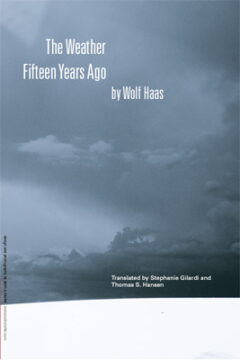 PG: What I admire about your writing on the subject is that you mostly seem to be interested in the process of love, how the structure of attraction and commitment unfolds for two individuals struggling to fit together (with an added geographic challenge, too: he remains in Middling, while she has moved to Chicago), and you don’t settle for a clichéd turn to the tragic. At least in my experience of reading, there aren’t too many books in contemporary literature that attempt this, though a few spring to mind. The novel Autumn Rounds, by Jacques Poulin, quite patiently explores the mysterious pull of two people; José Saramago’s Balthazar and Blimunda also springs to mind, as well as the magnificently inventive The Weather Fifteen Years Ago by Wolf Haas. And Rónán Hession does this for friendship in his novel Leonard and Hungry Paul.
What makes How to Love work so well, I think, is that while Morgan and Arthur are engaging individuals, they are also flawed, and are perhaps imperfect candidates for each other. There’s no attempt to create an impossibly idealized ending.
KK: And yet there is hope. Or at least, room for the possibility of happy outcomes. I think that’s an important (and maybe underappreciated) element of the most satisfying stories. Because it’s true to life and gives the reader room to imagine that fictional future. Autumn Rounds does this really well, because under the sweetness of the narrative lies a dark current, but by the end, we are hopeful. To bring it back around, I would say What the Dead Can Say ends hopefully—if it ends at all!
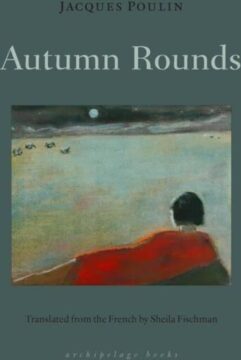 PG: Autumn Rounds is a beautiful book, not only for the risks it takes by being such a granular exploration of attraction and love (like your novel), but also for its unabashed devotion to books and reading. For readers who are unfamiliar with this novel: the main character, known only as the Driver, travels up the St. Lawrence River coastline in a book mobile, delivering books to isolated villages that are so small they don’t have a library. But they do have readers. The Driver’s mobile lending project, sponsored by Quebec’s Ministry of Culture, is a method of reaching eager readers who just so happen to live far from the nearest bookstore or library. Another form of love.
Speaking of searching for readers, in this case a search off the beaten paths of contemporary mainstream publishing, you and I have both experimented with this quest (as a growing number of other authors have done recently). Shall we compare notes?
KK: Yes, let’s! Indie publishing has grown and matured so much in the past decade. It’s a liberating path for authors, and ripe for experimentation. Thanks so much for this conversation, Philip. Looking forward to Part 2!
(Black-and-white photos featured above taken by Kipling Knox, for Under the Moon in Illinois.)
***
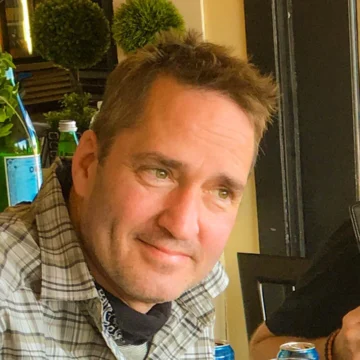 Kipling Knox is the author of the 2025 novel How to Live in a World Like This, and the 2022 story collection Under the Moon in Illinois. His stories have won the Chris O’Malley Prize in Fiction and the Wild Women Award, were finalists for Tobias Wolff Awards, and have been published or recognized by the Madison Review, Narrative Magazine, the Tulip Tree Review, the Bellingham Review, and the Whitefish Review. He also writes Small Talk, a series of essays covering science, philosophy, culture, and the arts—all with a touch of humor.
He has worked as an engineering manager at Microsoft, an editor for World Book Publishing and Reed Elsevier, and Director of Web Services at the University of Illinois. A native of Illinois who’s also lived in western Washington and Alabama, he works to promote biodiversity, even on a backyard scale, with a special interest in prairie lands.
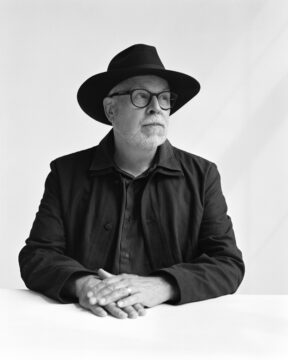 Philip Graham is the author of eight books of fiction and nonfiction, including the novels How to Read an Unwritten Language and (as Author Unseen) What the Dead Can Say, and the story collections The Art of the Knock and Interior Design. He has also written a collection of travel essays, The Moon, Come to Earth: Dispatches from Lisbon and is the co-author with his wife, anthropologist Alma Gottlieb, of two memoirs of Africa, Parallel Worlds and Braided Worlds. His work has appeared in The New Yorker, Washington Post Magazine, North American Review, Paris Review, Missouri Review, McSweeney’s Internet Tendency, and elsewhere. He is a Professor Emeritus of the University of Illinois, Urbana-Champaign. A co-founder and fiction/nonfiction editor of the literary/arts journal Ninth Letter, he currently serves as an Editor-at-Large for the journal’s website.