
by TJ Price
I. Hook
And I’m a true doomscroller
I can’t seem to shut it down
Until the worst is over
And it’s never over
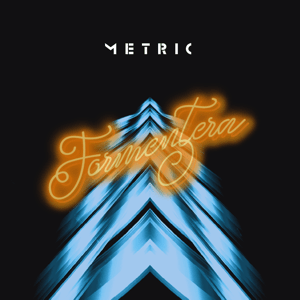
Metric’s album Formentera, released about three years ago, begins with “Doomscroller,” a deranged, multilayered, pulsing epic that lasts for approximately nine minutes. As an opening statement, this is audacious—in music, as in fiction, I often find common emphasis on the presence of a “hook,” engineered solely to cater to the fickle, capricious whims of the terminally impatient. In other words, if you can’t seduce someone effectively and immediately, then you don’t deserve their attention. Personally, I find this mode of artistic creation vulgar and repellent. There’s nothing inherently wrong with a hook, but programming it into a piece of art to ensure maximal audience engagement feels evil, somehow, to me. (Even worse, declaring it as a necessity!)
I think most would agree that an eleven-minute long track with lyrics such as ruling classes trickle piss from champagne glasses, that’s just how the evening passes, history on repeat relapses, and involving the turgid swelling of discordant electronics—like the buzzing of agitated bees!—might not be alluring bait for most. In fact, I think most might agree it would scare off any intended prey. However, I’m a weird fish. It’s like catnip to me—not to make a zoological hybrid of my metaphors. I was caught from the first moments of “Doomscroller,” from the frantic, febrile pulsing, a cybernetic heart gone tachycardic and slightly asystolic. (In fact, it seems to warp slightly, like something pausing just for a moment to catch its breath before being swept back up into the destructive sonic whirl.) Then Emily Haines breathily intoned, against that ripping, saw-like background: Was it an act of God or an accident?
Don’t give up yet
Don’t give up yet
Don’t give up yet
Don’t give up now
About a year ago, I simply stopped posting on social media, and then I stopped scrolling the feeds, which led to my disuse of their platforms entirely. I was around for the very beginning of bluesky (once the blue bird fell out of favor and changed its name, like an angsty teenager, to a single menacing letter) but the appeal of it palled quickly for me. I’d never loved the way my feed would just emphasize the same posts over and over again; the reposts and quote reposts; eventually, Who Liked what Post and Suggested for You—which never seemed to be able to offer anything of interest.
It’s a common myth that you have to have a social media presence to “make it,” whatever that means, as a [ fill in the blank: writer/artist/musician/poet/jeweler/craftsperson ]. You have to be actively engaged in the world of marketing and promotion if you want an audience, if you want to maximize and develop your readership. Even if your work is being produced by someone else—even, so I hear, the Pros—you have to engage in your own marketing and promotion campaigns. The budget just isn’t there, they’ll explain. In my own experience, the publisher was more concerned with getting their foot in the door to the larger community, and once that had happened, immediately dropped all of their concerns with the artists they’d published—even those whose books had only just been released. (Watching their crocodile tears flow during a recent acceptance speech, I felt a very distinct nausea.)
The trouble is—the trouble is!—that art has become more variable and unpredictable in response to increasingly unfamiliar and dubious times. Traditional marketing and promotions is based mostly in the field of what has been proven. What works. Because it is inherently recursive, this pattern spawns echo after echo, resulting in eventual generation loss with every iteration. The chamber of social media, then, has the perfect acoustics for such recursion to occur, and it is even better as evidence for generation loss. You see replications in every aspect of any art that is promoted on social media. Even if that art is the first of its kind, is wholly unique to itself, representing an authentic and fresh voice, the promotions for it will inevitably tack toward the expected, the safe—even in the declaration of how singular it is!
It is now glaringly obvious how tied the industry of artistic promotion has become to identity as a marketing strategy. It has seized upon the proliferation of microlabeling as its newest index of avarice, casting out bait of more and more specialized varieties, enhanced to only attract specific types of prey. The anglerfish has developed a palate, you see, and evolved to match its new appetite—now its esca radiates light of specially-calibrated wavelength in order to attract the attention of specific prey. Even more frightening, the prey seems to lean into this behavior, broadcasting their identity as loudly as possible before being snapped in half by powerful jaws.
Even promotional “blurbs” from well-known artists do little to hook, I find. Maybe this is because I’ve been on that side of publishing and find the established protocol for such a thing to be ludicrous at best, potentially humiliating at worst. It’s led to banners sprawled out over every single website featuring sloppy, vague neologisms like “UNPUTDOWNABLE” and “IMPACTFUL.” It is almost as though these words have no inherent meaning of their own, functioning only as signifiers for a binary of YES and NO. This binary, of course, translates well to the simple language of capitalism, where YES becomes CONSUME and NO becomes DO NOT CONSUME. Sometimes the opposite even indicates spreading a warning to others about just the possibility of consumption, as in the case of particularly negative reviews.
But to move to matters more littoral in nature: this phenomenon inevitably creates enclaves of audiences, restricted by shibboleth, all the while claiming a broader inclusivity. Whereas I suppose a tidepool might be mistaken for the ocean if the inhabitant is small enough, by and large I feel that using identity to market art runs counter to true artistic endeavor. To be clear: using identity to make art, or using art to interrogate the nature of one’s own identity, or even incorporating one’s own identity into the work, might almost be inevitable. However, using one’s identity to propagate and disseminate that work is what feels unsettling and anathema to me.
II. Line
Every ten year-old enemy soldier
Thinks falling bombs are shooting stars sometimes
But she doesn’t make wishes on them
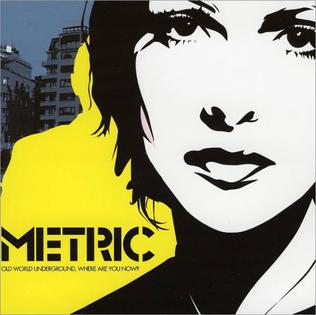
Metric’s first album, Old World Underground, Where Are You Now?, released in 2003, opens with a decidedly different kind of song—a svelte couple of minutes, compared to “Doomscroller”—and yet somehow, the lyrics are still terribly relevant. Later on this album, another song, titled “Succexy,” has another topically appropriate refrain:
All we do is talk, sit, switch screens
As the homeland plans enemies
All we do is talk, static, split-screens
As the homeland plans enemies
I have to do a double-check, honestly, when I listen to these angular, pulsing songs, delivered with the needle-quick, jagged sound of Emily Haines’ vocals. Was it really 2003 when these songs came out, over 20 years ago? I was driving around a frozen cove somewhere north of here with the windows down, listening to this album, gristly winter wind shrieking into the car.
At the time, COVID was still the purview of fiction: that is to say, largely speculative; like any apocalypse—fictional, until it isn’t. AI was only a movie, starring Haley Joel Osment. Most acronyms, in fact, referred to agencies rather than existential threats—though let it not be said that ne’er the twain have met. We were only two years out from the impact of late 2001, and it seemed like ashes were still falling from the skies over lower Manhattan. In fact, I think I still had a MySpace account, speaking of social media.
The more things change, the more they stay the same, goes the old calque. It’s a cynical statement to some, wryly supposing that larger shifts in paradigm are impossible, despite seeming agitation. But it’s a failure of perspective to assume that repetition to one is repetition to another, even though bombs still fall from the sky in 2026 just as they once did in 2003; even though screens still flicker with the images of buildings falling. It’s easy to reduce tragedy to a headline when one is halfway around the world, abstracted from all that connects us.
Anecdotally, around the same time in 2003, I was in college, conducting a brief investigation into acting. It’s seductive to think of slipping into another’s skin, if only metaphorically, for a role. This was Acting I, and I’d been assigned a scene from Othello, due to be performed at the end of the week—the classic bedroom scene, where Othello smothers Desdemona to death for her perceived iniquity. During class, rehearsing with my partner, I’d inquired of my director how exactly I was supposed to access the emotion necessary to do the deed. After all, I’d never killed anyone before—how could I possibly understand the rationale for doing so?
“Well, let’s say you’ve just discovered a mosquito has landed on your arm, and it’s busily begun slurping the blood from beneath your skin. How would you react?” my crafty director responded.
“I’d slap it away!” I said, vehemently, feeling on my skin the creeping crawl of the insect in question.
“Well, then there you have it,” my director said, enigmatically, striding away to another couple’s practice. “And you said you’d never killed before.”
I later learned that this—albeit strangely-prompted—technique was called “transference,” originally called “substitution,” developed by Uta Hagen in opposition to the then commonly-known Strasberg Method. It was the idea that, given something similar or at least adjacent in your own personal life, you could extrapolate from that experience to portray a magnified view of it, onstage. It felt electric to discover that I could do this—it even seemed to be the art of sympathy, writ large. A kind of willing possession, a kind of exorcism.
(I have no pithy line, no moving phrase, no stanza that hasn’t been wrought into being already by minds far more knowledgeable than mine to speak on the subject of war and bombs. I know exactly one person who currently lives—who I hope is still living—in Tehran. She is a student attending university there, a bright, creative spark amidst the flames. Even without my worry for her wellbeing, I think I would still have empathy for the people whose lives are currently being destroyed, even without having lived beneath a bombardment of shooting stars. I don’t think I can say as much for the men who have the Big Red Button right in front of them. I don’t think they even hesitate—in fact, I think they gleefully mash on it, again and again and again, marveling at the wishless death-lights they make in the sky.)
III. Sinker
I lie awake with a stomachache
And the first man drowns in the last man’s tears
How much guilt can we tolerate?
Count myself among liars and cheaters
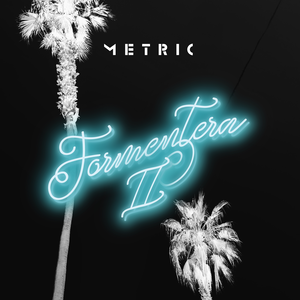
Metric released a followup to Formentera about a year after, which was odd in their traditional release schedule. For twenty-odd years, they have reliably released an album every two to three years. Some of them have enjoyed heavier rotation in my listening than others, and some I’m only just now starting to investigate (like 2018’s Art of Doubt, whose title track includes the line: well I really don’t know how we call this peace, ‘cause it’s a goddamn shame about the wall-to-wall wars).
The lyrics above, however, come from the followup mentioned, Formentera II, released in 2023—a mere three years ago. The song occurs as the penultimate track, entitled “Descendants,” and has—to my admittedly unskilled ear—a strange musical similarity to “Doomscroller.” In fact, it almost feels like “Doomscroller” turns itself inside-out: the first minute of the track incorporates a warbly, aquatic tone overlaid by warm synth notes, then slides into the jagged, frenzied pulsing of the bass. There is a terror in it, too, that comes from a droning litany of words set to music, much like the first track in the album(s), but whereas the original begged the listener not to give up, “Descendants” instead is a cry of frustration:
Stuck in my ways and afraid of conforming
Stuck in my ways and afraid of conforming
It goes by in a rush and there’s only so much you can change
In an interview with Emily Haines from 2023, regarding this very song, she mentions that the lyric depicts “how I feel a lot of the time, like I’m afraid of becoming someone I’m not and stubbornly protecting myself from social erosion.”
Most of us carry our identities with us—in our pockets, our wallets, and—increasingly—electronically, on our phones. Soon enough, it will be injected on a chip the size of a dust mite into the palm of our hand. Soon enough, it will be obvious just by glancing at someone what their identity is. And by this time, we probably won’t have the ability to program it—it will be chosen for us, by algorithmic deduction.
Even just writing that sentence now caused hot loathing to boil up inside of me—my identity? Chosen for me, by a program? Absolutely not, I say, revolted. Never!
And yet, we love to be labeled, don’t we? We love a quiz that interrogates our personality traits, our peccadilloes, our likes and dislikes. We love that quiz to then assign us based on some unknown process what our “role” would be in a different universe, like who we would be on Friends, or in Harry Potter. There are entire websites designed to be hubs for these kinds of heuristics. There’s an old game that tells you what your pseudonym should be (or “porn name,” if you’re feeling risqué): you simply take your first pet’s name, and the name of the street you grew up on, and you mash them together.
But such seemingly-frivolous behavior—that innocent little game—takes on a dimension of menace when you consider that these two data-points are also frequently used as the answers to security questions; possession of this information could very well lead to identity theft. It used to be that it had to be a person, a human operator, manipulating the technology as a mask to coax this information out of the unassuming—but now, the machines themselves avidly scour the internet, scraping for useable data. Now, it isn’t even necessary that we hide our identity for it to be at risk of theft.
In talking about this frustratingly complex subject with a friend of mine just a day ago, she remarked that identity in art was actually increasingly important to her in the age of LLM. Ensuring that the artist has a backstory, a verifiable and credible position amongst those of us considered “human” was a good thing, she said, and something she found herself actively seeking. I had no argument against this, really, other than appealing to a sense of mistrust in one’s own ability to judge what is “real” and what is not.
As the days go on, I find myself constantly asking this very question, challenging the reality of what is presented to me. A quick jaunt through the ruins of Twitter (presently “X”) included a video post, ostensibly of someone’s last moments in Iran. In the post, a missile suddenly strobed into view from the night sky above, growing larger and larger in the camera’s eye until the screen is obliterated in a white-hot flash, accompanied by distorted screaming. Below this post, miles of comments, each of them tagging the resident daemon with their doubts as to its veracity:
“@Grok is this real?”
“@grok is this AI?”
They are, essentially, asking the devil if the devil exists. (The devil, of course, has no real answer, or else is lying, and there’s no way anyone can tell the difference. Asking the devil anything and expecting to trust the answer might be indicative of a larger problem, though that’s a different essay. I might point to the line which describes “the greatest trick the devil ever pulled,” were I to write it.)
So, what’s the solution? Is there one?
Or do all of our unanswered questions about trust and self and the future drop helplessly into the unlit depths, accruing by a magnitude and steepening the rate of their descent?
Enjoying the content on 3QD? Help keep us going by donating now.