
by Derek Neal
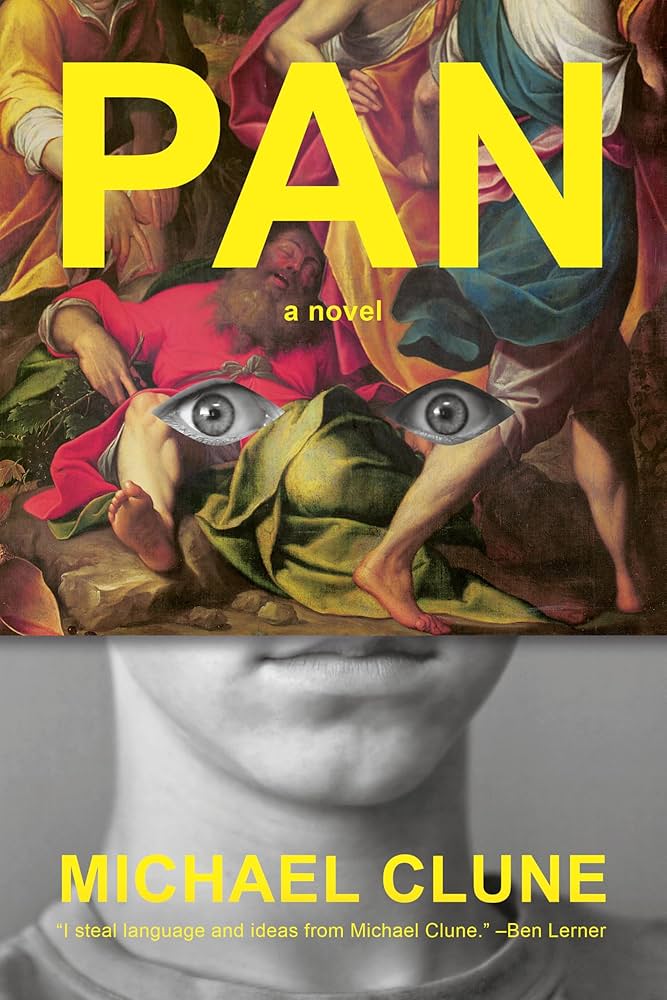 Allopathy and homeopathy are two contrasting theories of medicine. Allo, meaning other, and homo, meaning same, indicate how suffering (pathos) is cured in these two approaches. Modern medicine, speaking generally, is based on the principle of allopathy, meaning that sickness is counteracted by healing and therapeutic treatments; homeopathy, often considered alternative medicine or pseudoscience, is based on the idea that “like cures like,” so rather than introducing an antidote to an illness, the medicine used is meant to produce a response similar to the illness itself, stimulating the body’s natural healing mechanisms and curing the underlying ailment.
Some illnesses, however, are incurable. This is what a psychiatrist, Dr. Host, tells 16-year-old Nick in Michael Clune’s recent novel Pan. Nick visits Dr. Host midway through the story to help with panic attacks he has been experiencing for over a year. Early in the novel, Nick is able to calm himself by breathing into a paper bag, which is recommended after a visit to the emergency room, and he has found other temporary reprieves, such as reading (he delays a panic attack by staying up all night reading the 19th century classic Ivanhoe), not thinking about the panic when it’s happening (he refers to “a gate in [his] mind,” which he can keep mentally closed, preventing a full blown attack), and, most intriguingly, through a sort of pagan ritual that he and his friends conduct on a day they call “Belt Day.” Unlike the first two remedies, which work by acting in opposition to the panic, the Belt Day ritual functions by inducing panic.
The events of Belt Day take place in an abandoned barn that functions as the hang out spot for Nick and his group of friends, which includes Ty (best friend), Sarah (girlfriend), Ian (group leader), Tod (coolest/most mysterious kid in high school), Steph (stoner friend), and Larry (comedic relief). A good portion of the novel takes place in the barn, which revolves around drug consumption (usually marijuana and later, acid) and the adolescent philosophical speculation that follows. The other settings are Nick’s Catholic high school, his father’s anonymous townhouse, and other suburban locations, such as Ace Hardware and 7-Eleven. Part of the pleasure of the novel lies in seeing these soulless and sterile American places imbued with a sense of, not necessarily beauty, but the worthiness of being artistically rendered (“There are mystical places and times of the year in the American suburbs,” thinks Nick).
On Belt Day, the ceremony begins with everyone removing their shirts, brushing red paint on each other’s torsos, and ingesting a concoction of ecstasy and herbsbane. Nick is the only participant who doesn’t partake in drugs as he’s read that they can exacerbate panic attacks, but Ian tells him not to worry because “you don’t have to drink it for it to work.” Here another principle of medicine is introduced: the placebo effect.
The group plays techno music on the stereo system and forms a circle, holding hands, before performing a ritualistic dance. Once Nick begins to feel the rhythm, he says that “Panic was loose—it was loose—Pan was loose in the room.” Then Ian comes up to him, speaking in a drug induced frenzy:
“That woke Pan up, right? Right? Right? The dance woke up Pan, and it’s ok, it’s Belt Day, it’s ok Sarah told me, it’s Belt Day, how do you think I got cured? Are you ready?”
In an earlier scene, Sarah connects the concept of panic to the Greek god Pan through research in the school library. Along with Nick, she reads in the encyclopedia (the book takes place in the 90’s, so there are few computers and no smartphones) that “Pan is the god of the wild,” and suggests that Nick’s “panic…was strange, even magical, something that couldn’t be accounted for in the everyday adult language of medicine and psychology.” In many ways, Pan can be understood as an exploration of this idea, as Nick cycles through different understandings and treatments of what he sometimes refers to as his mental illness.
When Ian reminds Nick of Pan, Nick says that “panic vibrated every molecule of the thing of my body,” but rather than reaching for his paper bag or diverting his attention, Nick decides to follow through with the ritual. He leaves the loft of the barn and descends into a crawl space, then moves on his hands and knees into a tunnel that has been set up in a corner. As Nick advances physically through the course, “the panic grew stronger than [he’d] ever felt it before,” but once he completes the process, which involves a confrontation with “something truly alive” inside the tunnel, “the panic was absolutely gone.” At this point in the novel, this is the most successful Nick has been in treating his attacks.
Two other details of the Belt Day ritual are important. The process begins—before the music, dancing, and painting—with the blowing of a “long, curved horn” that produces a sound like “an insanely loud drone…a sound like metal, no like animal, no like metal animal.” This, similarly to the encounter in the tunnel, removes feelings of panic for Nick (“No panic. It was gone. Totally gone. My body was my own, vacated by the unthing, by Pan.”), although the feelings return when Nick begins dancing. Then, as Nick moves through the course towards the tunnel, the text repeatedly refers to animals and fur:
“She [Sarah] led me down the stairs, speaking in her lovely, low Svetlana voice, burred with the fur of shadow.”
“My panicked breath for an instant became the eager impossible hunger of an animal, a dog, a possum, a goat…”
“I felt the fur-like burr of the dried red paint.”
“I felt as if Pan might extend from my eyes—His horns out of my eyes.”
When Nick encounters the presence in the tunnel, he’s not sure what it is, but he later learns that it’s a mouse, which has been placed there purposely even though “for real Belt Day it’s supposed to be a goat.” The ritual, then, functions as a way to celebrate Pan through its emphasis on goats and horns, as Pan was understood to have the upper body of a man and the lower body of a goat, along with horns on his head. Horns, historically, were considered to concentrate the essence or “virtue” of an animal, and so Pan’s horns can be seen as a representation of his wild, erotic nature. After Nick exits the tunnel, he and Sarah have sex for the first time, seemingly a direct result of the invocation of Pan.
The events of the novel jump ahead one year, with Nick noting that “the symptoms of panic had grown rare since Belt Day.” But this doesn’t last. Nick has taken a summer job at Ace Hardware when a thought appears to him—“It’s killing me.” The thought worries Nick because it has the characteristics of panic, and he blames Ace Hardware, which, although he doesn’t use this language, seems to represent something akin to “late capitalism”—“Brash and big and bold was Ace’s substance. Big reds and wild yellows, bright fluorescence, catchy tunes—the bars of my prison.” Ace is a “deathly spiritual threat” with “tools like animal bodies.” Compare this with the barn, where animals and spirits come alive.
Headaches begin to affect Nick, too, and when he finds himself unable to fall asleep, he decides to visit the aforementioned psychiatrist. Dr. Host tells Nick that his panic attacks have now developed into Generalized Anxiety Disorder (GAD), which “is without a cure, and never goes away…” A cognitive behavioral therapist doesn’t help either, so Nick turns to Ian (also diagnosed with GAD), who advises meditation and offers a different understanding of his illness:
Panic and life are not two things. They are one thing. When you are aware of the panic, you are seeing the truth of ordinary life. The darkness of ordinary life makes the brightness of panic visible.
At first, meditation seems as ineffective as the breathing technique suggested by the therapist, but when Nick pairs it with journaling, he begins to see results. Later, Nick comes up with a new theory, tracing his parents’ divorce to the emergence of Pan/panic—“in the breaking of my family lay the secret of Pan’s birth.” This explanation supersedes Ian’s theory, which Nick renounces after Ian betrays Nick’s trust and begins to spiral out of control, culminating in his expulsion from college. Yet even the divorce theory, which in another novel might function as a typical “trauma plot,” cannot bring Nick the peace of mind he craves. Pan does not progress linearly but moves in stops and starts, complicating Nick’s (and the reader’s) search for a simple cure to his panic and anxiety.
Another novel that deals with illness, anxiety, and most importantly, horns, is The Horned Man by James Lasdun. That book, which features a section on the historical beliefs of the medicinal properties of unicorn horns, also references the Greek god Dionysus (another passionate, horned deity), and features a protagonist, like Nick, who has difficulty accepting the unruly parts of his own psyche. The underlying idea of The Horned Man is:
If you bring forth what is within you, what you bring forth will save you. If you do not bring forth what is within you, what you do not bring forth will destroy you.
The narrator reads this line from the Gnostic Gospels, which he notes were “excluded from the canon of scriptures that make up the authorised version of the New Testament.” Elsewhere, the narrator learns that some historical scholars, “wishing to see the unicorn as a symbol of Christ, naturally adhered to the allopathic doctrine, which held that the horn was the ultimate pure substance.” In this way, a contrast emerges between a pre-Christian, Greek worldview and a later Christian worldview.
Whereas Christianity separates a fallen world of sin and a pure Heaven, the boundaries of the Greek world are less clear, as gods mingle with humans and deities such as Pan and Dionysus take human form. The Greek world suggests something more akin to Ian’s philosophy—panic, or sin, is not eliminated, but integrated into one’s life. Pan represents both fertility and panic, meaning that “panic and life…are one thing.” Following the homeopathic doctrine, one doesn’t seek to counteract the panic, but to bring it forth. The unicorn horn is toxic, but in small doses it can be medicinal.
Lasdun’s narrator learns this too late. The novel ends with a magical realist twist, as a horn sprouts from his head and he finds himself alone in an abandoned fairground, plotting revenge against his imagined enemies. Throughout the novel, he has sought to suppress his vital instincts, but they eventually burst forth, destroying him. Something similar happens to Ian, but for opposite reasons. Rather than pacifying his horned nature, he actively encourages it, losing himself as Pan takes complete control. But what about Nick? Can he find the balance (another Greek idea) between his civilized, human side and the wild lifeforce of Pan? And how could we expect a 16-year-old to do this?
This is another question running through the novel—are Nick and his friends simply getting high and spouting nonsense (Larry, rather funnily, refers to Sisyphus as “Sissyfuss”), or are they producing real, meaningful insights about their lives? In addition to its portrayal of suburbia, one of the other impressive aspects of Pan is how realistically it portrays the lifeworld of a teenager. Ty and Nick take a taxi to Ruby Tuesday one evening, but neither of them knows about tipping, and Ty attempts to talk to the driver about sports in an imitation of what he’s seen in movies. When they visit the barn for the first time, Tod picks them up and Nick remarks that it “would be the first time I would enter a car driven by someone who wasn’t a parent or a taxi driver.” Arriving at the barn, Nick shakes hands with Ian, who is a few years older, and notes that “I’d never shaken hands with someone in a social setting before. With another kid, I mean.” These are important milestones in the maturation of an adolescent, but as an adult, we forget their impact. By immersing us in his consciousness, Nick’s revelations do seem profound, even as some readers might find the simple and straightforward prose to be merely functional.
One of Ian’s lessons for Nick is that he must “put on his [Pan’s] knowledge along with his power.” Speaking about himself, Ian says that “when he [Pan] comes back I put on a little more knowledge with his power,” and Steph likewise notes that Ian “has the knowledge and the power.” At the end of Pan, Nick experiences a final panic attack that is triggered by seeing a reproduction of Bellini’s painting of Doge Leonardo Loredan, which shows the Venetian ruler adorned with a “Doge’s hat giving it the panic horn.” The hat, called a “corno ducale,” (literally “Doge horn”), does give the appearance of a horn, but the idea that it’s a “panic horn” is Nick’s invention (interestingly, Lasdun’s narrator conceals his horn with a hat). When the attack begins, Nick accepts it, just as he does on Belt Day. This time, upon feeling that he has exited his body, Nick tells us that he “saw something I could keep. I put on a little of His knowledge,” which he then calls “the calmness and silence of Pan’s gaze.”
It appears that Nick has taken Ian’s advice. Yet there is a clear difference between Nick’s acceptance of Pan and Ian’s. Whereas for Ian, knowledge is a tool of or a means to power, Nick never mentions power. Instead, his new understanding seems to be a type of self-knowledge, or wisdom. If he can maintain the balance he has found and accept the knowledge of Pan without letting it consume him, he can avoid becoming a horned man.
Enjoying the content on 3QD? Help keep us going by donating now.