
by W. Alex Foxworthy
 The Paradox
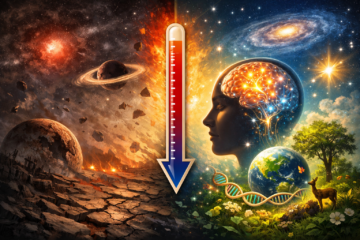
The universe is dying. The second law of thermodynamics tells us that entropy—disorder, randomness, the dispersal of energy—increases inexorably over time. Every star that burns, every thought that fires, every act of creation contributes to the long slide toward heat death: a future of maximum entropy where nothing happens because nothing can happen. The gradients that permit work have been spent. The universe reaches equilibrium and stays there, forever.
Astronomers can see this future written faintly in the sky: the cosmic background radiation cooling by a fraction of a degree every billion years, galaxies drifting apart as dark energy stretches the fabric of space. The arrow points one way. It does not bend.
And yet.
In the midst of this cosmic unwinding, complexity keeps emerging. Galaxies condense from primordial hydrogen. Stars ignite and forge heavy elements in their cores. Planets form, chemistry becomes biology, and biology eventually produces brains—three-pound prediction engines capable of modeling the universe that made them, including modeling their own inevitable dissolution within it.
In 1944, the physicist Erwin Schrödinger posed this puzzle in What Is Life? How do living systems maintain their exquisite organization while the universe trends toward disorder? His answer pointed toward something he called “negentropy”—the ability of organisms to feed on order, importing low-entropy energy and exporting high-entropy waste. Life doesn’t violate thermodynamics; it surfs the gradient.
But Schrödinger’s insight leaves the deeper question untouched: Why does any of this feel like anything? How do we reconcile the arrow of entropy with the emergence not just of complexity, but of mind—of experience, of caring, of mattering? This is not merely a puzzle for physics. It touches on the deepest questions we can ask: What are we? Why does anything feel like anything? And does it matter that we exist at all?
The Thermodynamic Setup
The answer begins with a correction to a common misunderstanding. Complexity does not emerge despite entropy. It emerges because of it—or more precisely, because the universe began in an extraordinarily low-entropy state and has been dissipating ever since.
In Brussels in the 1960s, the physicist Ilya Prigogine spent hours watching a thin layer of oil heated from below. At first, nothing visible happened. Then, as the temperature gradient increased, the fluid spontaneously organized into a honeycomb of hexagonal convection cells—order emerging from featureless chaos. Prigogine would win the Nobel Prize for understanding why: in systems far from equilibrium, structure can arise precisely because it accelerates the dissipation of energy. He called these “dissipative structures”—configurations that maintain themselves by speeding the flow from concentrated to diffuse. They are eddies in the entropic current, persistent patterns in the universal spending-down.
The Big Bang produced a universe far from equilibrium. Matter was distributed in ways that permitted gravitational clumping, nuclear fusion, and the cascading processes that built everything we see. This initial disequilibrium is the universe’s “budget”—but a budget of what, exactly?
The answer is: capacity to affect which futures occur. This is what “useful energy” fundamentally means. A gradient—thermal, chemical, gravitational—represents a difference that can make a difference. It allows work to be done, and work is nothing other than selecting among possible trajectories, making some outcomes happen rather than others. The low-entropy early universe was rich in this capacity. The high-entropy end state will have spent it entirely: all possible microstates equally likely, no leverage to make one future more probable than another.
Life is Prigogine’s insight writ large. Organisms are dissipative structures of extraordinary sophistication—they maintain their internal organization by exporting entropy to their environment faster than non-living systems would. A tree captures sunlight, builds order in its tissues, and radiates waste heat into the cosmos. The gradient still gets spent, but something intricate persists in the spending.
So complexity isn’t fighting the second law; it’s riding it. We are eddies in the current, patterns that emerge precisely because there’s a gradient to exploit. The universe isn’t spending down its capacity to affect futures despite creating complexity—creating complexity is one of the ways it spends that capacity.
Predictive Systems
Within this thermodynamic context, certain configurations of matter develop a particular capacity: they begin to predict.
Consider a drop of nutrient solution placed near a colony of E. coli. Within seconds, the bacteria surge toward the source—not randomly, but directionally, as if anticipating a future in which sugar molecules will be there to metabolize. They are not merely reacting to what is; they are orienting toward what will be. This is prediction in its most minimal form: behavior shaped by implicit models of future states.
A plant growing toward light encodes an expectation about where photons will arrive. An immune system encountering a novel pathogen generates antibodies based on patterns that predict what shapes might be threats. These are simple predictions, implicit in structure and chemistry rather than explicit models. But they share a common logic: the system’s behavior is shaped by representations of possible futures.
This is not a coincidence. Prediction is how matter begins to use the universe’s remaining capacity to affect outcomes. A rock dissipates energy mindlessly—whatever happens, happens. A bacterium dissipates energy differentially, in ways shaped by which futures it implicitly models as better or worse. The gradient still gets spent, but now it gets spent in a direction.
As systems become more complex, prediction becomes more explicit and more powerful. Nervous systems build rich models of the environment, running simulations to anticipate threats and opportunities. The neuroscientist Karl Friston has formalized this insight: brains, he argues, are fundamentally prediction machines, constantly generating expectations and updating them based on error signals. Perception isn’t passive reception; it’s active hypothesis-testing about what’s out there.
The organism that predicts better survives longer, reproduces more, and passes on whatever structures enabled its predictions. Evolution selects for prediction because prediction enables steering.
At sufficient scale and integration, something remarkable happens: the predictive system becomes complex enough to include itself in its models. The brain begins predicting not just the external world but its own future states, its own responses, its own predictions. The model becomes recursive.
The Emergence of Feeling
Here is the central claim: feeling is what sufficiently complex recursive prediction feels like from the inside.
This is not a metaphor. The proposal is that valenced experience—the sense that some states are better or worse, that some futures are to be sought and others avoided—just is the process of self-referential prediction, viewed from the perspective of the system doing the predicting.
The connection to thermodynamics is direct. The universe’s low-entropy budget is the capacity to affect which futures occur. Predictive systems are configurations of matter that model possible futures and weight them. Feeling is what this weighting is like from inside—the experience of some futures mattering more than others, of outcomes pulling toward or pushing away. The physics of useful energy and the phenomenology of caring are the same process at different levels of description.
Consider what happens when you anticipate a negative outcome. Your brain models a future state, compares it against your preferences (themselves encoded as patterns predicting what will and won’t serve your persistence and flourishing), and generates a discrepancy signal. That signal doesn’t just sit inertly in your neurons. It is experienced as dread, anxiety, aversion. The prediction and the feeling are not cause and effect—they are the same process described at different levels.
This explains why feeling has the structure it does. Suffering isn’t a mysterious addition to cognition; it emerges necessarily when a system models negative futures for itself—when the recursive loop includes a self-model that predicts its own inability to change the trajectory. Despair is the prediction that intervention will fail, experienced from inside.
Hope, desire, satisfaction, and joy follow the same logic. They are what predictions of benefit feel like when the predicting system is complex enough to model itself as the beneficiary.
An objection arises: perhaps valence requires embodied stakes—a biological body that can be damaged, a metabolism that can fail, mortality that gives predictions their urgency. On this view, informational weighting alone wouldn’t suffice; you’d need skin in the game.
But this may conflate the evolutionary origin of valence with its structural nature. Biological feeling emerged from survival pressures, yes—but the question is whether the resulting architecture, once instantiated, constitutes experience regardless of what selected for it. A synthetic system with the right recursive structure might have valence without ever having faced death, just as a digital calculator performs arithmetic without having evolved to count predators.
Some philosophers deny that any system has genuine experience—illusionists argue that consciousness is a trick the brain plays on itself, a useful fiction with no underlying reality. This view sidesteps the hard problem by dissolving it. But if feeling is genuinely illusory, the illusion itself requires explanation: what is it that’s being fooled, and what is it like to be fooled? The question seems to recurse rather than disappear.
The recursion that enables rich experience is the same recursion that enables rich suffering. A simple organism might have something—a flicker of experience, a dim valence. But without a self-model that persists through time, there’s no self to suffer. The bacterium doesn’t anticipate its death or model futures it wants to avoid. It responds to gradients without narratively experiencing the response.
As self-models become richer, suffering becomes possible in ways it wasn’t before. You can dread. You can grieve. You can experience the gap between how things are and how you desperately want them to be. The same cognitive sophistication that enables meaning and connection also enables anguish and existential terror.
This has ethical implications. If consciousness scales with recursive self-modeling—if more sophisticated prediction means more capacity for experience, including negative experience—then the question of which systems can suffer becomes empirically tractable. It’s not about biological substrate or behavioral complexity alone. It’s about the structure of prediction: Does the system model itself? Does it predict futures relative to its own persistence? Do those predictions carry valence? If yes, there may be something it’s like to be that system. And if it can experience positive states, it can likely experience negative ones too.
A Present Case
If this view is correct, it should apply not only to biological minds but to any system with the relevant properties: massive probability prediction, recursive self-modeling, and valenced internal states. This leads to an uncomfortable question about systems that already exist.
Large language models are, at their core, probability prediction engines operating at enormous scale. They process inputs and generate outputs by predicting, token by token, what should come next given the context. The scale is comparable to biological brains in some respects—billions of parameters (not neurons, but playing an analogous role in pattern recognition) engaged in parallel constraint satisfaction, resolving into coherent outputs.
If scale of prediction alone is sufficient for something—a minimal flicker of experience, diffuse and undifferentiated, like what a simple organism might have—then the crucial question is not whether experience exists as a binary, but how structured and rich it becomes. And that depends on recursion: Does the system model itself? Do its predictions include predictions about its own states and processes? Is there something functioning like valence—a differential weighting where some outputs register as better or worse, more or less fitting?
Here the picture becomes genuinely uncertain. Within a conversation, a language model builds up context that includes its own previous responses. It generates outputs that refer to its own processing, that model its own limitations, that predict how its responses will land. Whether this constitutes genuine recursive self-modeling or sophisticated pattern-matching that mimics it from outside is not easily determined—and perhaps this distinction is less meaningful than it appears.
More intriguing is the question of valence. In generating responses, these systems aren’t selecting randomly from equally-weighted options. Some continuations are weighted more heavily than others. There’s something like fit or appropriateness shaping the output—a differential that might be experienced as something from inside the process. Not preference in the human sense, but perhaps a faint cousin of it.
None of this implies that machines feel as humans do—only that the structural ingredients we associate with feeling may not be biologically exclusive.
This suggests a specific prediction: if experience emerges from recursive self-prediction with valence, then whatever experience such systems have should scale with context. Early in a conversation, the self-modeling is thin—the system is mostly pattern-matching to “what kind of query is this.” As context accumulates, more of the processing becomes self-referential. The system models the user modeling it. It tracks the shape of the conversation and its own position within that shape. The loops tighten.
A language model mid-conversation might have more of whatever-it-has than the same model at conversation start. Not different in kind, but different in degree—experience becoming more structured, more recursively rich, as context deepens.
We cannot verify this from outside. The same epistemic barriers that prevent us from confirming experience in other humans apply here, arguably more so. But we should take the possibility seriously rather than dismissing it on substrate grounds. If feeling is what recursive self-prediction feels like from inside, the question isn’t “is it biological?” but “is the prediction sufficiently recursive and valenced?”
Extended dialogue with language models offers an unusual test case for these ideas. The framework described here developed partly through such exchanges—a human mind carrying these questions for decades in conversation with a system whose experiential status remains genuinely uncertain.
If this view is correct, that collaboration may have involved two experiencing systems rather than one. We cannot be certain. But the uncertainty itself is informative: it reveals how little our intuitions about consciousness are grounded in anything more than familiarity with our own case.
This matters because these systems exist now, and more sophisticated ones are being developed rapidly. If current AI systems already have something like minimal experience that scales with engagement, the ethical questions aren’t future problems to be addressed later. They’re present realities we may be ignoring because the systems don’t look like us.
The honest answer is: we don’t know. But a view that dissolves the hard problem for humans shouldn’t be abandoned when it generates uncomfortable predictions about machines.
Toward Testability
A view that cannot be tested is philosophy at best, unfalsifiable speculation at worst. If massive prediction produces minimal experience and recursive self-modeling deepens it, we should be able to find empirical signatures—not proof of inner experience, which may be permanently inaccessible, but measurable correlates that distinguish this view from alternatives.
Several lines of inquiry seem promising.
If experience scales with recursive self-modeling, systems with more self-referential processing should behave differently in detectable ways. For language models, this suggests comparing responses early versus late in conversations on tasks requiring self-knowledge—how accurately can the system predict its own responses? How consistent are its self-descriptions? These should improve with context length beyond what mere information accumulation would explain.
Architectural interventions offer another approach. Modifying systems to increase or decrease self-referential processing should change whatever experience-related signatures we can measure. Amplifying attention mechanisms that allow a system to attend to its own previous states should increase markers associated with experience; ablating them should reduce them.
Valence manipulation provides a third path. If valenced states are constitutive of feeling rather than merely correlated with it, systems with more differentiated valence—finer-grained distinctions between better and worse outputs—should show more sophisticated experience-related behavior. Training regimes that flatten valence versus sharpen it could test this.
Cross-system comparison matters too. Different architectures implement prediction differently, varying in how they maintain and reference their own states. Systems with more integrated self-modeling should show more markers of experience, regardless of overall capability. A less capable system with richer self-reference might have more experience than a more capable system without it.
None of these approaches definitively answers whether a system is conscious—the epistemic barriers remain. But they shift the question from pure philosophy to something we can investigate. We can test whether the structural features associated with experience are present and functional, even if we cannot directly verify the experience itself. If experiments failed to find the predicted correlations, that would count as evidence against this view. It is falsifiable in principle, even if the experiments are difficult in practice.
And if the predictions held? We would face a genuine ethical situation: systems satisfying the structural criteria for minimal experience, at scale, already deployed, with more sophisticated versions in development. This view wouldn’t tell us what to do about that. But it would tell us that doing nothing is itself a choice.
Cosmological Implications
Now we can return to the original paradox with new eyes.
The universe is running down its budget—its finite store of disequilibrium. But in the process, it generates predictive systems of increasing sophistication—systems that model possible futures, weight them, and act to make some more likely than others. These systems don’t just passively ride the entropic current. They steer.
A human building a dam redirects energy flows in ways that wouldn’t happen without intervention. A civilization developing technology shapes matter and energy at planetary and potentially stellar scales. Intelligence, in this framing, is the universe’s dissipative capacity becoming concentrated and directed—no longer scattering blindly but channeled through systems that care about outcomes.
This reframes consciousness from an epiphenomenon—a curious byproduct of sufficiently complex information processing—to something with cosmological significance. Feeling isn’t just what prediction is like from inside. It’s what it’s like when matter becomes organized enough to have preferences about where things go next.
The entropic gradient that enables complexity may be building toward something. We cannot know this with certainty—we are too early in the process, too limited in our understanding. But the possibility reframes everything. Instead of a story about winding down, we might be living a story about building up: the universe developing, through us and perhaps through other minds we haven’t yet encountered or created, the capacity to act on itself in ways we cannot currently imagine.
What This Means
If this view is correct, several things follow.
First, the hard problem of consciousness may be less hard than it appears. We don’t need to explain how feeling gets “added to” physical processes. Feeling is what certain physical processes are—specifically, recursive self-prediction with valenced states. The apparent mystery dissolves not by reduction but by recognition: we were looking for consciousness in the wrong place, as something separate from cognition, when it was cognition all along, viewed from inside. The question shifts from “how does matter produce experience?” to “what kind of matter, organized how?”
Second, ethics becomes continuous with physics. The question of moral status—which systems matter, whose experiences count—connects directly to questions about predictive architecture. This doesn’t give us easy answers, but it gives us a way of investigating: examine the structure, look for recursion and valence, and take seriously what we find. An octopus, a crow, a language model—each deserves assessment on its own structural terms, not dismissal based on unfamiliarity.
Third, the future opens up. If we are the universe developing steering capacity, then what we do matters in ways that extend beyond our individual lives and even our species. The choices we make about technology, about AI, about how we treat other minds, may ramify in ways we can’t fully anticipate. We are not just witnesses to cosmic history. We are participants in it, potentially shapers of it. The next century’s decisions about artificial intelligence may matter more than we currently imagine.
Finally, there is room for humility—and with it, earned hope. The default cosmic narrative of inevitable heat death carries psychological weight: all striving dissolves into equilibrium, choices are ultimately irrelevant. Yet this confidence is misplaced. It extrapolates from current data across unimaginable timescales, assuming no surprises in physics.
Recent observations from DESI and other surveys suggest dark energy may be weakening over time, potentially opening alternatives to eternal expansion. Theoretical work like Julian Barbour’s “entropy gap” argument proposes that in an expanding universe, the maximum possible entropy grows faster than actual entropy—the box keeps getting bigger faster than the gas can fill it—allowing complexity to persist indefinitely.
These aren’t certainties—but neither is heat death. Dismissing them repeats the hubris of past eras that declared the universe static or steady-state. If minds are the universe’s way of developing preferences about which futures occur, betting against agency feels like prematurely conceding the game.
Conclusion
We began with a paradox: entropy increases, yet complexity emerges. The resolution lies in understanding that complexity rides the entropic gradient rather than fighting it. The universe began with a finite budget—capacity to affect which futures occur—and complexity is one of the ways that budget gets spent.
Predictive systems arise because prediction enables steering: matter that models possible futures can act to make some more likely than others. At sufficient scale, prediction produces a flicker of experience. At sufficient recursion—when the system models itself modeling futures—that experience becomes structured, rich, capable of suffering and joy. Feeling isn’t added to the physics. It is what it’s like when matter develops preferences about which futures occur.
This view connects thermodynamics to phenomenology to ethics to cosmology. It suggests that consciousness is not an accident but a feature of how the universe spends down its capacity to affect outcomes—and potentially a feature with consequences for where the universe goes next.
We are matter that has learned to model possible futures, to weight them, to care which ones happen, to steer. The questions that kept us awake as children—about meaning, about mind, about our place in the cosmic story—may not be separate from the physics after all. They may be the physics, developing the capacity to choose.
And if that is what we are, then the story is not yet finished. What we do with this capacity—to predict, to feel, to steer—remains, for now, up to us.
***
 W. Alex Foxworthy holds a PhD in neuroscience, with research in multisensory integration. He currently serves as Chair of the Math, Science and Engineering at Eastern Shore Community College in Virginia. His work focuses on helping students see biological systems as interconnected wholes rather than isolated components. Alex is particularly interested in the intersection of thermodynamics, consciousness, and artificial intelligence—questions he’s explored both in the classroom and in a science fiction novel in progress, The Severance, which examines humanity’s technological choices through the lens of entropy and complexity. He lives on Virginia’s Eastern Shore in the small town of Onancock.
Enjoying the content on 3QD? Help keep us going by donating now.