
by Anton Cebalo
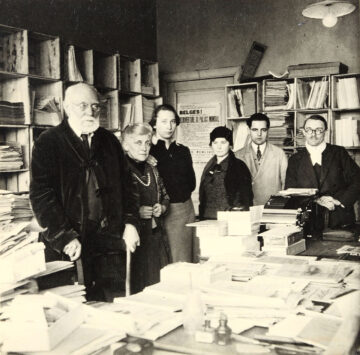
Writer Joseph Roth noted that the period after World War I thrived on “the ability to forget quickly and emphatically.” This was just as true for people. People who had great, popular dreams about the future before the war were thrown into obscurity afterward. One such person was author and lawyer Paul Otlet.
Otlet was definitely an idealist. In 1910, him and lawyer Henri La Fontaine sought to create a “city of knowledge” which they called Mendaneum. Housed in Brussels, Belgium, it would store and categorize all the world’s information into nine categories with tens of thousands of subdivisions. Otlet hoped that someday it would be accessible in the comfort of one’s home.
In what eerily resembles today’s internet, he wrote:
Everything in the universe, and everything of man, would be registered at a distance as it was produced. In this way a moving image of the world will be established, a true mirror of [its] memory. From a distance, everyone will be able to read text, enlarged and limited to the desired subject, projected on an individual screen. In this way, everyone from his armchair will be able to contemplate creation, in whole or in certain parts.
The idea began in 1895 by developing what is arguably the world’s first “search engine.” Rather than organize information by books, cards would mark bits of information which would be easily indexable. Users could “search” by asking questions to assistants (for a fee) and then be given query responses of up to fifty.
The entire bibliography of searchable information eventually consisted of over fifteen million entries. However, being all on paper, it was tedious to transport and largely stayed put in Brussels. Even worse, the labor took a painstakingly long amount of time. Workers would sometimes take days to complete just one query.
Otlet’s approach is considered one of the first, workable network-based knowledge systems. It was thought it could someday approach something of a “global brain.” The idea also pioneered the hyperlink—and Otlet went even further, envisioning bonds between documents by how they conceptually relate to one another and their disagreements. Not even today’s internet has fully realized this kind of semantic web yet.
Otlet and La Fontaine saw their efforts as an extension of their peace activism. It was thought that a universal system of knowledge would create a global consciousness. In truth, the idea was thwarted by World War I. After the war, Otlet’s ideas progressively became more and more grandiose. He believed that someday inventions would advance so that feel, taste, smell, and other sensory experiences could be captured and documented. Anything and everything would be part of this universally-accessible web of knowledge.
Of course, the internet took a very different turn. Rather than top-down, systemized organization by experts like Otlet imagined, the internet is instead modeled on bottom-up distribution and emergent order. It’s unlikely many of the early internet pioneers even knew of Otlet.
But what became of the Mendaneum? Otlet wished to see it as an extension of the League of Nations which was never accepted. The Palais Mondial, which housed all the documents, was often under threat of closure after WWI. In 1934, it finally was cut off of all funding. In the months before the Nazi invasion of Belgium in 1940, Otlet pled to U.S. President Roosevelt twice to save the Mendaneum, and even tried persuading the Nazi inspectors themselves to preserve it. The situation was nothing short of a total, abject catastrophe for his life’s work.
Yet, neither listened, the Nazis would go on to destroy some 63 tonnes of indexed material. Otlet himself did not live to see the end of the war—and, in his mind, one must imagine he died sadly believing the world and any possibility for peace was at its terminal end.
Enjoying the content on 3QD? Help keep us going by donating now.