
by Christopher Hall
The problem with teleological thinking as far as authoritarianism goes is that we can delude ourselves into believing that, given that we are not in an Orwellian State, and it looks unlikely that we’re going to get there, some of the current kvetching about the current situation may appear to be overblown. Trump, in other words, at some point is going to go away. He is not likely to succeed in cancelling the midterms (although plenty of denial of voters’ rights is probable), and a third term for him seems equally unlikely. When I look at the future, I do envision some kind of American Restoration is a likely scenario, since it seems that there is no one with Trump’s mastery of a bizarre sort of charisma standing on the deck to take his place (J. D. Vance certainly doesn’t have it). A moderate will take over, there will be much reference to norms and standards and, perhaps, if that moderate is a Democrat, some desultory prosecutions. But that restoration will not be, cannot ever be, complete. We know something has permanently changed. The question for us is where that leaves us, and Liberal Capitalist Democracies, now.
As Orwell’s quote – ““The Party told you to reject the evidence of your eyes and ears. It was their final, most essential command.” – floated around the internet (including this site) in the days and weeks after the murders of Renee Good and Alex Pretti, I did worry a bit that, if we were adopting Orwell as our model of political disaster, we may be a bit off the mark. The “command” issued from the Trump administration to “unsee” what we all clearly saw in the videos of the murders was shambolic in a way no directive from the Ministry of Truth could ever be. But that may have been the point; don’t worry that people are going to mock your attempt to control the narrative. Controlling what people see and say isn’t the point – flooding the zone with shit is. Trump’s Ministry of Bullshit is not concerned that many, perhaps most, see through everything he does. He is concerned that enough do not or will not. I’ve written before that there is a difference between control by enforcing silence and control by encouraging noise. What if the hybrid model is the actual goal – to empty out the core of democracy just enough so that the day-to-day experience of it is not substantially changed – and yet, everything is irrevocably different? Our dystopian visions tend to be of the absolute sort, but absolutism is not particularly helpful at the present moment – and we should hope it doesn’t become so.
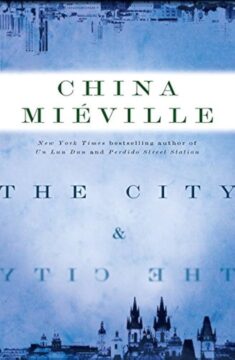
The Orwellian directive to unsee is a top-down phenomenon, and the penalties for disobedience severe. An alternative of sorts can be found in China Miéville’s 2009 speculative fiction novel, The City & The City. Miéville is perhaps known best for his novel Perdido Street Station, often seen as the inaugural work of the “New Weird” genre. Miéville is also a socialist activist, but his novels do not feel programmatic. Instead, they investigate what might be called an ur-politics, the set of impulses out of which all politics evolves. Setting these impulses somewhere outside of a realist frame allows them to come back to us anew, to be recognised in their moment of estrangement. Borders form the particular focus of The City & The City, not merely in the sense of physical barriers, but in the mental structures which enforce them.
The City & The City takes place in two cities that occupy the exact same geographical space. Due to some mysterious catastrophe in the distant past, the cities of Besźel and Ul Qoma merged; now the territory is occupied by spaces that are either purely Besźel, purely Ul Qoma, or “crosshatched” – a mixture of the two. The citizens of each city are bound to “unsee” the existence of the other one; you may only live, and see, one of the cities. The novel – which is also a police procedural about the murder of a foreign student and a conspiracy involving a supposed “third city” – contains many instances in which the characters must navigate the difficult territory of “unseeing” some of the space they are living in:
An elderly woman was walking slowly away from me in a shambling sway. She turned her head and looked at me. I was struck by her motion, and I met her eyes. I wondered if she wanted to tell me something. In my glance I took in her clothes, her way of walking, of holding herself, and looking
With a hard start, I realised that she was not on GunterStrasz at all, and that I should not have seen her.
Immediately and flustered I looked away, and she did the same, with the same speed. I raised my head, towards an aircraft on its final descent. When after some seconds I looked back up, unnoticing the old woman stepping heavily away, I looked carefully instead of at her in her foreign street at the facades of the nearby and local GunterStrasz, that depressed zone.
Unseeing in The City & The City does not involve a single narrative which is imposed from the authoritarian voice. It is transactional, and a matter of mutual social practice. The only demand is that the cities be kept separate, and every citizen of each must fully enact this separation. There is an authority – Breach – which polices violations of this protocol, but there is no overarching state apparatus which dictates what is seen – it only insists when it is appropriate to see what. It is quite possible to travel between locations – the main character, Inspector Tyador Borlú from Besźel, at one point in his investigation travels to Ul Qoma (there is a border crossing), where he must consequently unsee his home city.
This impermeability of perspectives is an apt metaphor for the current malaise. Miéville is coy about the exact political nature of each city: Besźel resembles in some ways a post-Soviet state, while Ul Qomo leans towards the theocratic. Neither of these modes of state are as important to the novel, and the characters within it, as the fact that they exist more or less on top of one another, and yet they must never touch. The mental border between them is enforced less by actual force than by a “practice of everyday living” which does not question overmuch the need for such a separation and is willing to modify behaviour accordingly.
It’s become something clichéd to note, and bemoan, the current siloization of perspectives created by any number of culprits: social media, modern alienation, capitalist segmentation, etc. But the problem isn’t merely that we’ve stopped speaking to one another; we’ve stopped seeing what other people see. I cannot see what J.D. Vance say he saw in those videos; I cannot envision a perspective that says that Renee Good and Alex Pretti were in any way complicit in their own deaths. I cannot see the slaughtering of scores of Palestinians having anything resembling justification. My failures here result from a belief that my beliefs best reflect reality – but in that respect I’m not much different from anybody else. What concerns me is that this mode of unseeing has become less of a matter of reason and more an autonomic reaction, a “practice” which is drawing politics out of the realm of discussion and into the realm of mutually incompatible diktats. The characters in the novel are able to tell when somebody is living in the other city through subtle cues of social practice – movement, appearance, how they “hold themselves.” As political identities have now become quasi-religious, even if I still identify primarily as a member of the “reality-based community,” I can regret its consequences. “Political identity” shouldn’t exist, any more than “scientific identity” does, or any form of “identity” in areas where one might need to change one’s view – to see again what you’ve been unseeing. But the bind is inescapable – I frankly don’t want to reach a place where I can see the police murder two people and think there’s nothing wrong with that.
That this is a lamentable situation is obvious. But what tends to be assumed, I think, is that one perspective will eventually triumph over the other. At some point, either the illiberal forces are going to make a breakthrough and take us to the territory Orwell envisioned, or liberalism is going to reassert itself. And that reassertion will in and of itself solve the problem. Liberalism is about the free interchange of ideas, right? There can be no “unseeing” in a truly liberal state, as it is incumbent upon democratic citizens to engage and debate. (This assumes the untenable idea that “liberalism” itself as a neutral ground absent of ideological content. But it will do for the moment.) But what if the triumph of one city over the other is not where we are headed? The “merged” state in which the cities, many more than two, live in the same space but with impenetrable borders between them, is to my mind the more likely outcome of the current situation. What’s required for the demise of democracy is not the dominance of a single authoritarian perspective, but the rise of techniques of unseeing which make a mockery of any idea of “common ground.” Your political opponents are worse than wrong: they’re foreigners.
We do not yet feel ourselves to be living under authoritarian circumstances because the ability to dissent has not been outlawed. In fact, the recent withdrawal of ICE from Minneapolis might be a sign of just how effective protest can still be. I am not suggesting that the authoritarian takeover may have already happened; I am suggesting that a new state we don’t quite have a name for yet has emerged. Maybe illiberalism doesn’t actually need to be fully enacted in order to triumph. People like Stephen Miller, Pam Bondi, and of course Trump himself would like to crush all of the forms of pluralism that a democratic state ought to engender and certainly requires. But once they disappear back into their internet cubbyholes and corporate sponsored think-tanks and tacky golf courses, the change they have enacted will likely remain. The problem I think goes deeper than the age-old question of what to do with citizens who, tacitly or not, live within a democratic system but want to see that system destroyed, want their perspective and only their perspective to govern. (Wait – isn’t that more or less what we all want?) A multiplicity of perspectives, supposedly democracy’s strength, becomes a crippling weakness when those perspectives stop seeing each other. There is no need for a single voice to triumph. Do we have an imaginative framework for this form of desiccated, dystopian democracy? By the end of The City & The City, the status quo remains undisturbed; we are left with an odd kind of pluralist state where the particalized monads of ideology never interact. That makes the novel prescient, as the best weird novels are.
In 1984 the citizens of Oceania are commanded to see only what the State wants them to see, and if that happens to be that 2 + 2= 5, so be it. The citizens of Besźel and Ul Qoma are merely enjoined to fail to see each other. Imagine the two novels themselves merging; Oceania, Eurasia and Eastasia coexisting in the same space, one where the equation equals 5 and another where it equals 3 – and perhaps one where it equals 4. In that interlaying of realities, would it really matter that one was right?
***
Enjoying the content on 3QD? Help keep us going by donating now.