
From PBS:
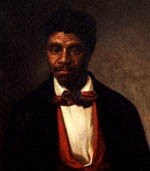 Dred Scott first went to trial to sue for his freedom in 1847. Ten years later, after a decade of appeals and court reversals, his case was finally brought before the United States Supreme Court. In what is perhaps the most infamous case in its history, the court decided that all people of African ancestry — slaves as well as those who were free — could never become citizens of the United States and therefore could not sue in federal court. The court also ruled that the federal government did not have the power to prohibit slavery in its territories. Scott, needless to say, remained a slave.
Born around 1800, Scott migrated westward with his master, Peter Blow. They travelled from Scott’s home state of Virginia to Alabama and then, in 1830, to St. Louis, Missouri. Two years later Peter Blow died; Scott was subsequently bought by army surgeon Dr. John Emerson, who later took Scott to the free state of Illinois. In the spring of 1836, after a stay of two and a half years, Emerson moved to a fort in the Wisconsin Territory, taking Scott along. While there, Scott met and married Harriet Robinson, a slave owned by a local justice of the peace. Ownership of Harriet was transferred to Emerson.
More here. (Note: Throughout February, at least one post will be devoted to Black History Month: A century of Black History Commemorations)
Enjoying the content on 3QD? Help keep us going by donating now.