
Kathryn Murphy at Literary Review:
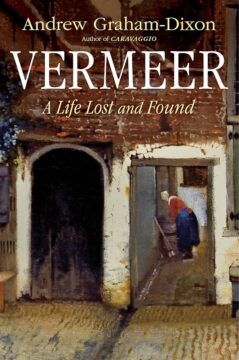 From the sparse scatter of documents testifying to the life of Vermeer, many of them forbiddingly brief or boring or purely legal, Graham-Dixon constructs a compelling story. But it is a story – like those fictions which Vermeer’s paintings, with that mysterious charge of meaningfulness, have frequently inspired. Here, narrative drive is supplied by Vermeer’s supposed enmity with his mother-in-law, Maria Thins, a Catholic woman who, though she at first refused to condone her daughter’s marriage to a Protestant, thawed sufficiently to allow him and his family to live in her house. Facts which suggest Vermeer accommodated himself to the Catholic faith, an assumption which has informed much recent scholarship, are explained away as the triumphs of Maria. Two of the Vermeers’ many children were called Ignatius and Franciscus and another sent away to train for the priesthood – Graham-Dixon sees this as ‘a resounding victory’ for Maria’s ‘militant Catholicism’ over Vermeer’s Collegiant will. The accoutrements of a Catholic household chapel which appear in the inventory of his goods drawn up after his death were only acquired ‘through gritted teeth’. Early modern confessional hostilities are still being fought in the book’s prose: the Catholics ‘were all in it together’; Vermeer was ‘living in a nest of Jesuits’.
more here.
Enjoying the content on 3QD? Help keep us going by donating now.