
by Akim Reinhardt
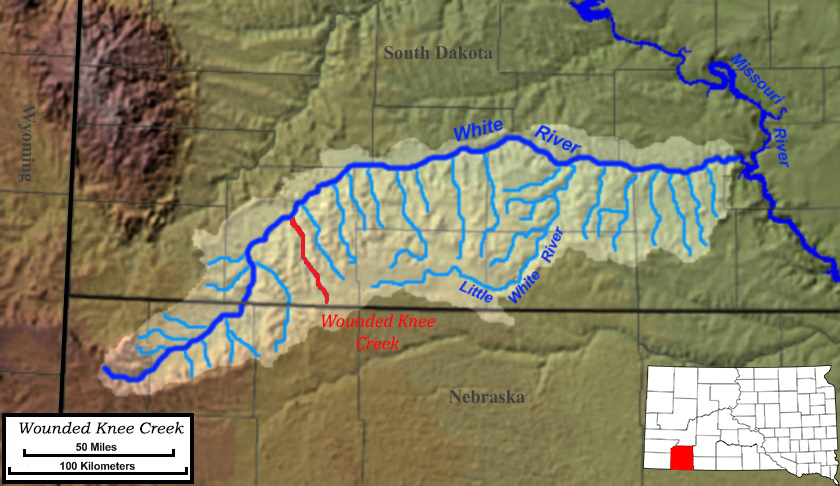 The Lakota name for Wounded Knee Creek is Čaŋkpe Opi Wakpala. The first letter is a -ch sound. The ŋ signifies not an n, but nasalization as when you say unh-unh to mean no.
*
When I teach Indigenous history, at the beginning of the semester I tell my students they’re going to have unlearn things they think they know. By the end of the semester, they are often astounded at how much they didn’t know.
*
Wounded Knee Creek begins in southwestern South Dakota, near the Nebraska state line. It flows mostly north and a little west for about a hundred miles before joining the White River. The White River, which originates northwestern Nebraska, continues mostly east and a little north until it reaches the Missouri River. The Missouri starts in the Rocky Mountains of Montana and runs for nearly 1,500 miles before joining the Mississippi River near modern day St. Louis. The Mississippi empties into the Gulf of Mexico south of Louisiana.
*
On December 28, 1890, the U.S. Army, specifically the 7th Cavalry, slaughtered an unknown number of Lakota (sometimes called Sioux) people near Wounded Knee Creek. The exact number is unknown because the corpses were buried in a mass grave without being counted. However, no one disputes that the majority of murder victims were women, children, and the elderly.
*
I teach my students about settler colonialism. White ethnonationalists and some other right wing extremists get upset when teachers and scholars teach and discuss settler colonialism. But it is a real and ongoing process, just like capitalism and cultures. Like capitalism and cultures, settler colonialism is a system, not an event, though like other systems, it produces many, many events.
*
After the massacre at Wounded Knee, Congress award Medals of Honor to 19 soldiers for actions that included “dislodging Sioux Indians from ravines.” This was settler-speak for, among other things, hunting down women and children and murdering them. The murders took place upwards of two miles from the “battle” site.
Another dozen Medals of Honor were awarded to U.S. soldiers for their work in the “larger campaign” of persecuting practitioners of Indigenous religion on Lakota reservations.
*
Wounded Knee Creek is located within the boundaries of the Pine Ridge Reservation. Pine Ridge was originally part of a larger, single reservation called the Great Sioux Reservation. The United States first recognized the Great Sioux Reservation, along with additional Lakota lands, in the Ft. Laramie Treaty of 1868. But despite treaty promises to the contrary, the federal government broke up the Great Sioux Reservation in 1889. This coincided with the creation of North and South Dakota; much of the Great Sioux Reservation’s land was assigned to these two new states and its settlers. What remained was five smaller Lakota reservations: Standing Rock, Cheyenne River, Pine Ridge, Rosebud, and Lower Brule. The massacre at Wounded Knee occurred just over a year after the breakup of the Great Sioux Reservation, amid the grinding poverty, cultural persecution, political destabilization, and massive land theft of settler colonial invasion.
*
As a system, settler colonialism has common processes, goals, and outcomes. One of the common processes is erasure. The settler colonial system erases Indigenous people, both their history and their modern presence from the settler consciousness. If you are a settler, odds are you know very little about the Indigenous past or present. That is not an accident. That’s how the system works. But perhaps you’ve heard of Wounded Knee.
*
Pine Ridge Reservation was carved out of the Great Sioux Reservation for a subdivision of the Lakota Oyate (nation) called Oglala. But relatively few of the Wounded Knee massacre victims were Oglala. Most were from a different Lakota subdivision called Mnikowoju (often spelled Miniconjou), who had recently come down to Pine Ridge from Standing Rock Reservation.
*
My students are like any Americans under the age of 50 or so. They are primed to understand the United States in partisan terms. The era of consensus politics that began during WWII and did not begin substantially eroding until after the Cold War, is a foreign concept to them. They’ve known only rank political divisions through lenses like Democrat-Republican and Liberal-Conservative. Stances on most political issues, it seems to them, can be neatly filtered through such lenses. But not settler colonialism, I tell them. Remember, it’s not a single issue, but rather a complex system that benefits all the settlers, whether Democrat, Republican, or Independent, whether liberal, conservative, or moderate. No matter what you think about politics, or even if you never think about politics at all, the settler colonial system benefits you if you are a settler.
*
Another number that is also probably impossible to determine is the number of massacres Europeans and their descendants perpetrated against the Indigenous peoples of the Americas from 1492 and into the 20th century. There were, without question, at least thousands of massacres if not tens of thousands. Perhaps the best numerical descriptor is countless. Among countless massacres settler perpetrated against Indigenous peoples, Wounded Knee is the best known in the United States, the most infamous.
*
In late September, Secretary of Defense Pete Hesgeth, who now goes by the title Secretary of War, emphatically insisted that the long movement to have the Medals of Honor revoked was over. “We’re making it clear that (the soldiers of the 7th Cavalry) deserve those medals,” he said. “Their place in our nation’s history is no longer up for debate.” He also said “the era of politically correct, overly sensitive, ‘don’t-hurt-anyone’s-feelings’ leadership ends right now at every level,”
*
Indigenous Americans are a minority in the United States, about 3% of the national population. Aren’t the Democrats more supportive minority issues? Aren’t they better on Native affairs than Republicans? Sometimes. Sometimes not. Here’s an example of not.
The Liberal Lion of the Supreme Court, the late Justice Ruth Bader Ginsberg, was for the most part, horrible on Indigenous affairs. Her opinion in the infamous Sherrill v. Oneida Nation not only dismisses a ratified treaty, the U.S. Constitution, federal and state laws, and several earlier court decisions to side with the town of Sherrill, NY over the Oneida, but it largely rests on the judicial logic of tough shit, you lost. My words, not hers. Hers were gussied up: “ The principle that the passage of time can preclude relief has deep roots in our law, and this Court has recognized this prescription in various guises.” She also said that righting prior wrongs the United States has committed against Indigenous nations was “impractical.” You know. Might makes right.
Meanwhile, Trump appointee Neil Gorsuch is probably the best Supreme Court justice on Indigenous affairs of the 21st century, and perhaps even going back a bit further.
Settler colonialism is a complex system, not a this-or-that partisan issue.
*
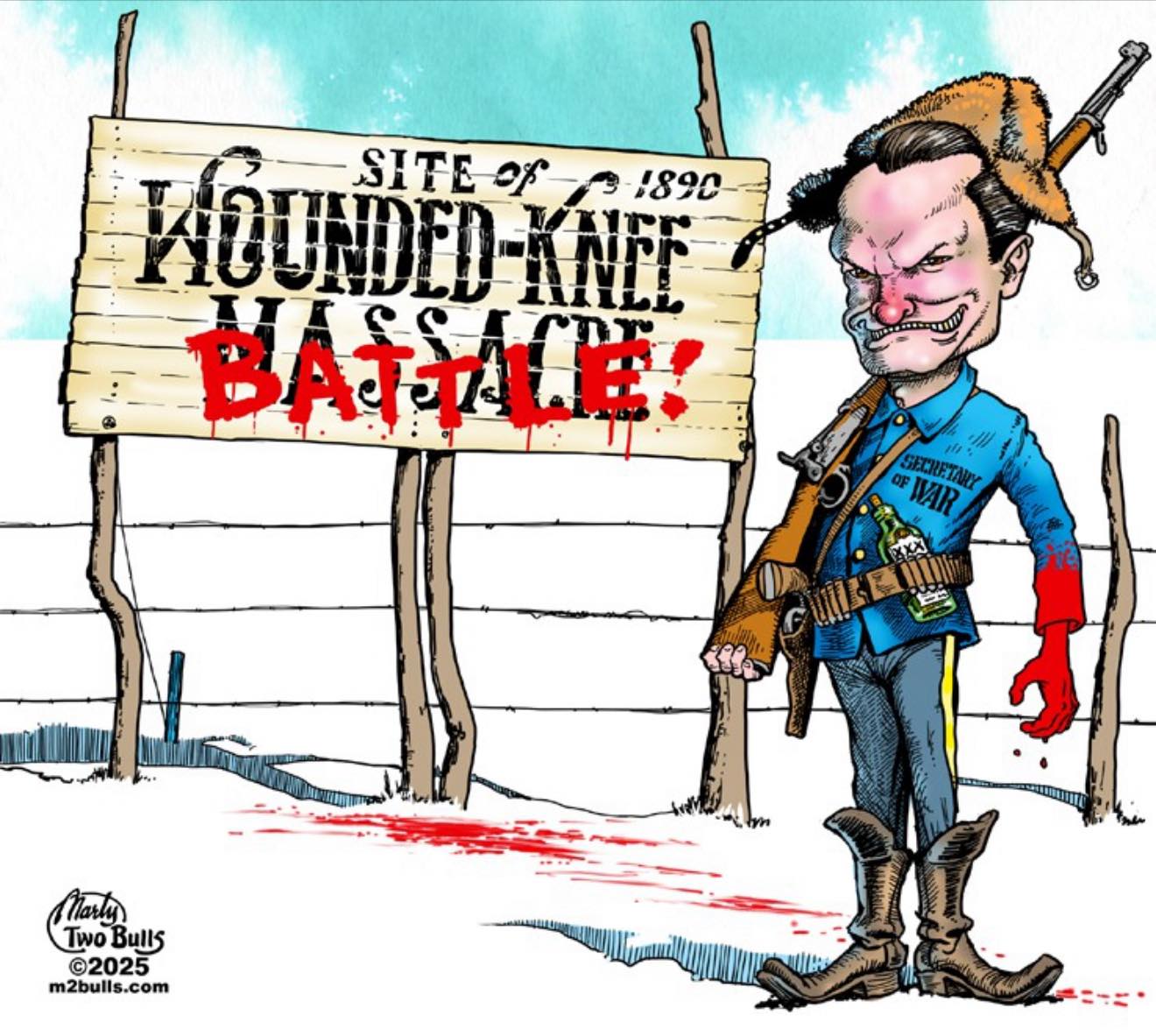
At the Wounded Knee massacre, 25 U.S. soldiers were killed and another 39 injured. This was not the excuse the U.S. military needed to mislabel the event a Battle instead of a Massacre. The U.S. army had a simple formula for settler-Indigenous violence back then: every time the United States lost, it was a massacre. No matter if U.S. forces were trying to sneak up on a sleeping village, as was the case at the Little Big Horn in 1876 when Brigadier General George Custer led the 7th Cavalry (yes, that 7th Cavalry) to defeat at the hands of Lakota, Cheyenne, and Arapaho soldiers. That was officially a “massacre.” And every time the United States “won,” it was a “battle.” Like at Wounded Knee.Congress waited a hundred years, until 1990, to finally stop insisting that what happened at Wounded Knee was a “battle.” That it was indeed a massacre.
*
Most of the U.S. soldiers’ deaths and injuries at Wounded Knee came from friendly fire. The soldiers surrounded the Lakota people and began firing across the circle they’d formed, shooting each other. Plus, U.S. artillery fire from a nearby hill rained down on everyone below.
*
While the colonial system dutifully erases the memory of nearly all massacres from the collective settler consciousness, not so Wounded Knee. Perhaps you’ve heard of it. It is one of the few, often the only massacre that many Americans have heard of. Wounded Knee quickly became the exception that proves the settler rule of erasure, a stand-in for all the other erased U.S. settler colonial massacres. It wasn’t just a “battle,” it was the “last battle” of the so-called “Indian wars.” “Indian wars” is a common settler term for the settler violence that was crucial to the ethnic cleansing and genocide of Indigenous peoples.
*
The Oglala Sioux Tribe issued a statement calling Hsegeth’s actions and words “despicable, untruthful and insulting to the Great Sioux Nation. To call Wounded Knee a ‘battle’ dishonors the truth, desecrates the memory of our relatives,”
*
The Wounded Knee massacre victims were practitioners of an Indigenous religion that settlers called the Ghost Dance. The federal government had banned the practice of this religion. Indigenous people were being arrested for practicing their religion. The Ghost Dance religion incorporated elements of Indigenous religious practices with elements of Christianity.
*
Hundreds, perhaps thousands of books have been written about the Wounded Knee massacre. Many of them are not good. Some of them are excellent.
*
A few days before the massacre, a colonial official had ordered deputized Lakota policemen to arrest the Lakota leader Tataŋka Iyotaka (Sitting Bull) in the middle of the night. He had committed no crime. The colonial official just didn’t like him. He thought Tataŋka Iyotaka was a “trouble maker.” The arrest turned violent and Tataŋka Iyotaka was shot in the back of the head. The Mnikowoju victims of the Wounded Knee massacre had fled to Pine Ridge because they were running away from colonial persecution and violence.
*
Is U.S. Warrior Chief Hesgeth’s refusal to overturn the 19 Medals of Honor a sign that he and/or his president and/or his party are worse than other U.S. Warrior Chiefs and/or presidents and/or parties?
No prior U.S. warrior chief or president or party had overturned the 19 Medals of Honor. Warrior Chief Hesgeth’s tone and emotion are a fair bit nastier than those of most recent high ranking observers, a rhetorical step backwards. However, his decision to not overturn the Medals of Honor is perfectly consistent with the decisions of all prior U.S. warrior chiefs, presidents, and parties not to overturn the medals. Some of them considered it, or held investigations, or said respectful things. But none of them overturned the medals.
The medals of honor were all awarded in the 1890s.
*
Settler colonialism is not an event. It is a system.
Akim Reinhardt’s wesbite is ThePublicProfessor.com