
by Steve Szilagyi
Henry James once observed that Robert Louis Stevenson “wrote with a kind of gallantry — as if language were a pretty woman.”
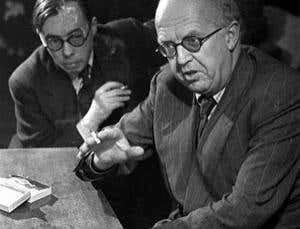
C.P. Snow (1905–1980) did not write like that. Pretty did not seem to enter any area of his work. The author of the famous essay The Two Cultures and the Scientific Revolution (1959) and the eleven-book cycle of novels known as Strangers and Brothers was, in his physical person, emphatically not pretty. As he approached the end of his life, he came more and more to resemble a pink, pointy-headed Patrick Star from SpongeBob SquarePants—decidedly dour, with National Health panto glasses somehow attached to his face.
If Snow wrote with any kind of gallantry, it was the solemn courtesy you would show a group of serious men seated around a table in an oak-paneled boardroom. His prose was careful, deliberate, and capable of discovering fine distinctions in faces, morals, and motives. His essays and novels were best sellers in Great Britain and the United States, and he won awards and honors for his writing. The BBC even made Strangers and Brothers into a thirteen-part series that no one liked.
In the 1960s, The New York Times referred to him as “the most eminent living English author” at a time when no less than Evelyn Waugh, Iris Murdoch, and Graham Greene were all busily writing away. Yet no author of similar stature in the 20th century has been more thoroughly and publicly excoriated for being slow, dull, and unreadable. Not even Gertrude Stein!
The price of immortality. Of course, Snow is best known for his lecture and essay The Two Cultures—to which his name has become permanently welded, like Oswald Spengler and The Decline of the West, or Francis Fukuyama and The End of History. The price for such immortality is that the world becomes blind to anything else you’ve done.
The Two Cultures, just to refresh your memory, takes literary intellectuals to task for their lack of scientific knowledge—particularly the Second Law of Thermodynamics. Snow scolds his literary peers for standing by while science tackles the problems of the Cold War and global poverty. The essay made him famous on both sides of the Atlantic and guaranteed him a lifetime of lecture engagements and think pieces. Though very much a product of its time, The Two Cultures continues to be cited—more than 8,000 times in recent years. Nobody reads it, but everybody knows about it, and it’s a convenient tag for any essay deploring the gap between humanistic types and techies (or “wordcels” and “shape rotators,” as they’re now known in internet slang).
While The Two Cultures has ossified into a journalistic cliché, Snow’s real life’s work—the eleven novels of Strangers and Brothers—has fallen off the literary map. None of his books appear on Time magazine’s or the Modern Library’s lists of the 100 best books of the 20th century. Or anybody else’s, for that matter.
 Slow rise from the bottom. Born in Leicester in 1905, the son of a poor clerk, Snow won scholarships that took him to Leicester University and then to Cambridge, where he pursued physics and became a fellow of Christ’s College. During World War II he worked in senior government positions related to scientific research and recruitment, and after the war he held important posts in the civil service, including roles in science and technology policy.
He did his novel writing outside day jobs, beginning with a mystery, Death Under Sail (1932), and finding his real subject in a bildungsroman, George Passant, later re-titled Strangers and Brothers—also the title of the full eleven-novel cycle.
The Strangers and Brothers series is impossible to summarize in a few sentences. Set over the course of the 20th century, it is narrated by Lewis Eliot, Snow’s fictional stand-in, and follows his personal and professional life in and out of the worlds of science, academia, law, and government. He has a tragic first marriage to a mentally troubled wife, who dies young (suicide is implied); a brilliant, cynical, and burdensome brother; and close friends and colleagues who draw him into their worlds and dilemmas.
Sadistic torture-murder. The range of the series can be seen in its later volumes. In the second-to-last book, The Sleep of Reason, the niece of one of Eliot’s oldest friends is accused of a heinous murder. The 20-year-old niece and her female lover are put on trial for the abduction and sadistic torture-murder of a randomly chosen young boy. Of course, Snow treats the gruesome subject quite a bit differently from, say, Thomas Harris’s Silence of the Lambs.
By contrast, The Masters, one of the most celebrated novels in the series, takes place almost entirely within the walls of a fictionalized Christ College, Cambridge. Seven fellows are called upon to elect one of themselves as the new master—even as the current master lies dying of cancer. The college becomes a pressure-cooker, where characters clash, old failures are relived, and large emotions are expressed in majestically civilized dialogue. In short, not like the cheerful campus romps of David Lodge.
Taken together, The Sleep of Reason and The Masters show both the expansiveness and the concentration of Snow’s storytelling. That balance—self-contained dramas feeding into a larger sequence—is precisely what defines a roman à fleuve, a form that includes Honoré de Balzac’s Comédie Humaine and James T. Farrell’s Studs Lonigan novels.
Tradition! Tradition. If I were to recommend only one, it would be The Conscience of the Rich, which takes narrator Eliot inside the home and lives of a wealthy London Jewish family. It’s a kind of Fiddler on the Roof story, where the Tevye character is Leonard March, a powerful financier and one of Snow’s most vividly drawn creations. A religious and social conservative, March stands in the way of his children having marriages and careers outside their constrained social and professional circle. Technically, he is the villain, since he blocks the young people’s happiness, but Snow makes him as so marvelously verbal, vital, and innocently self-revealing that you can’t help but love him.
As a roman à fleuve, Strangers and Brothers is most often compared to Anthony Powell’s twelve-book A Dance to the Music of Time, written and published almost simultaneously. As Snow’s reputation has declined, Powell’s continues to rise, and there is no question that A Dance to the Music of Time is the “sexier” of the two novel cycles – not in any explicit sense, but because it is written with more flair and ventures more into bohemian and artistic circles.
I encountered A Dance to the Music of Time in my early twenties and have lived long enough to have read through it twice. Most unfortunately, I only encountered Strangers and Brothers late in life and am unlikely to get to much more of it than I have.
Lot of book for two bits. My personal experience with Strangers and Brothers began with picking up a tattered copy of The Conscience of the Rich at a used book sale for 25 cents. Just one of those random purchases. I was vaguely aware of Snow’s name since it was attached to the phrase The Two Cultures, but no more. The book sat on my shelf for months before I pulled it down in an idle moment and began reading with low expectations. I was only a few chapters in when I realized it was exactly the sort of thing I like.

I read several others of Snow’s books with great pleasure and had no inkling that other readers were not as enthralled until I came across Confessions: A Life of Failed Promises, the 2022 autobiography of A. N. Wilson. There, Wilson—an author I admire—offhandedly dismisses Snow’s novels as “extraordinarily boring.”
I reacted with something like shock—as when my younger brother described Shakespeare’s plays as “a lot of jabber.” Well, yes, Shakespeare can be challenging, but you power through it for the reward. Wilson—and, as I soon found out, many others—did not have the patience for Snow’s majestic pace, his careful observation of character, and his precise descriptions of faces, clothing, and interior furnishings. They did not care that Snow wrote as he did in the service of taking the full measure of his people and their actions in the context of their relationships and their world.
I was shocked to learn that the American critic Edmund Wilson (Patriotic Gore) found Snow’s novels “almost completely unreadable” (Wilson committed a few dull novels himself). Another critic, Bernard Bergonzi, described Snow’s prose as “being so arid as to be unreadable” and “frequently so inexpressive that the reader has difficulty in being convinced of the emotional reality of what is described.”
“Embarrassing vulgarity.” But the absolute worst came in 1962 from Cambridge scholar F. R. Leavis—the most distinguished literary critic of the day and passionate defender of what he called “The Great Tradition” of English literature. Leavis seems to have had a smoldering dislike of Snow—possibly because Snow was an establishment sort of figure. When The Two Cultures became a media sensation, Leavis went berserk.
From a lecture platform in Cambridge, and later in The Spectator, Leavis attacked The Two Cultures and its author with a savagery that shocked the literary world. He began by calling out “the preposterous and menacing absurdity of C. P. Snow’s consecrated public standing,” and mocked his “embarrassing vulgarity of style.” As he built up steam, he sputtered: “Snow is, of course, a—no, I can’t say that; he isn’t: Snow thinks of himself as a novelist” though “his incapacity as a novelist is . . . total—as a novelist he doesn’t exist; he doesn’t begin to exist. He can’t be said to know what a novel is.”
Snow, he went on, is “utterly without a glimmer of what creative literature is, or why it matters.” Appalled that some called Snow a genius, Leavis declared that “he is intellectually as undistinguished as it is possible to be.”
The whole affair is brilliantly described by Roger Kimball in “The Two Cultures Today,” an article in the February 1994 issue of The New Criterion. There, Kimball finishes the job Leavis started, leaving not a shred of whatever reputation Snow had left intact.
Naturally, I disagree. I think Snow’s novels are quite good and repay the attention they call for—just as the films of Yasujirō Ozu (Tokyo Story), Rainer Werner Fassbinder (Berlin Alexanderplatz), or even Stanley Kubrick’s Barry Lyndon owe much of their impact to the time and patience we give them. I would recommend Snow to readers who enjoy Anthony Trollope, E. M. Forster, Anthony Powell, Iris Murdoch, Arnold Bennett, and others in the English social novel tradition. Readers who have the patience to derive the considerable pleasures to be found in the novels of Ivy Compton-Burnett will find Snow easy work.
As for The Two Cultures, despite the best efforts of F. R. Leavis, it continues to be cited thousands of times across the fields of science, philosophy, and the humanities by people who never read it. But the battle between techies and literary types may soon become moot. The rise of large language model AIs has begun to break up those categories and reassemble them in ways we are all still trying to figure out.
Identifying the real enemy. So much water has passed under the bridge since 1962 that the Snow–Leavis clash now looks less like a battle of opposites than a family quarrel. Both men, however fiercely they sparred, shared an allegiance to a tradition of literature that was realistic, morally serious, and attentive to human character. Snow practiced it in his institutional panoramas, Leavis defended it in his “Great Tradition,” but both assumed that the true business of the novel was to grapple with lived experience. Today, the real enemy of literature is not science at all, but science fiction.
Set against a cultural landscape dominated at both high and low ends by intergalactic battles, dystopian sequels, and multiverse spinoffs, Snow and Leavis appear not as antagonists but as allies, united in defending the hard-won territory of the realistic novel against the avalanche of fantasy, where nothing is real and nothing matters.
Enjoying the content on 3QD? Help keep us going by donating now.