
by Richard Farr
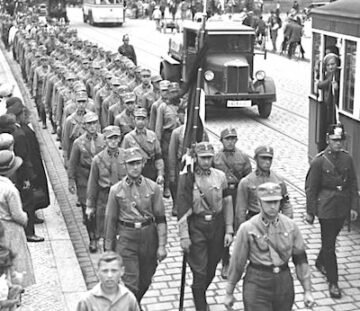
Terrified people from ethnic minorities being threatened, rounded up, and beaten by heavily armed men in uniforms or not-quite-uniforms: we have seen these images before. In the US, the theory endlessly parroted to us over the decades has been that the Founders’ exceptional wisdom meant American institutions would protect us from such uncivilized nastiness. (Such characteristically European nastiness: Jefferson himself put it this way, looking down his nose at the old systems he thought he had transcended.) Well, well. Now that the shiny new system has failed — now that Blackshirt Theater is playing in our streets and on our farms and in our parking lots, to entertain the Führer — we have to make the best of one small silver lining, which is that you hear the customary smug nonsense about exceptionalism less and less. America’s institutions are not in danger of failing, as they were in 1972 or 2016 for example. Now, under the weight of 2025, they have failed, and the only question is whether they can be rebuilt one day. We are in the midst of existential catastrophe, waking up to the fact that the checks and the balances never were uniquely wise, or uniquely well-protected against failure, and that for now they are part of history.
The upper echelons of the chatterati, paid to wear ties and sound sober, will scoff at this. The air of finality is grossly premature, they will say. We’ve weathered crises before — and maybe the Dems will win the mid-terms and “restore democracy.”
Piffle.
Consider Gavin Newsom’s current brinksmanship over gerrymandering — and bear in mind that this practice, to which we have become inured, is impossible in most actually functioning democracies because independent commissions draw electoral boundaries and interference with that process by political parties is scarcely imaginable and anyway illegal.
So back to Texas, where the Party of Lincoln finds that with respect to the assassination of democracy it is in blood / Stepped in so far, that, should we wade no more / Returning were as tedious as go o’er. Egged on from the far side of perdition by those masters of dark comedy Abbot and Trumpello, the Texas Republicans have now dismantled the last vestiges of any claim that Texas has a system of government run by, for, or in the interests of its citizens. The whole point of the new redistricting is to circle the wagons so tightly around Bigly’s Poodles so that they and their owner are safe once and for all from the threat posed by the practice of voting.
In California, Governor Newsom has decided to fight fire with fire. Maybe that’s the right decision, because there really is no alternative, and maybe it isn’t: I offer no judgement. I only note that dismantling any last vestiges of democracy in California too will probably result in a chain reaction from sea to shining sea; if so, regardless of who wins the midterms the resulting salted wasteland will be almost impossible to coax to an honest harvest again. The biggest problem of all being to get the Democratic Party to admit that the status quo ante, which we have no plausible path back to, was already undemocratic in myriad ways. “A republic, if you can keep it”: Franklin knew better than most of his descendants that it always was a fragile, flawed, Rube Goldberg contraption — one easily smashed by, say, a single evil creep with the right skills.
Which brings me to the topic of evil creeps with the right skills.
Hobbes famously warns us that living without a central state authority can be a bummer, but he was no Pollyanna about living in a badly-managed or corrupt state either. You could be living with a well-meaning incompetent in the wheelhouse — not ideal. Or with a klatch of competent or incompetent weasels who want to entrench their control while syphoning off a nest-egg — never lovely. Or with a well-meaning competent — often worse, because the road to hell etc. etc. But an equally common fate, driving so much of our collective misery in this and all past ages, is getting stuck with the kind of man — almost invariably a man — who combines great political ability with a truly psychotic, unhinged, unrelated-to-any-other-purpose lust for power and (yet more) wealth.
Hobbes loved the old metaphor of a body politic, and it can be useful here to think in terms of that body’s sickening. If you like ornate labels, you might call our current condition kratopathocracy. For some reason I prefer the term Lukashenko.
Lukashenko is a complex condition and its etiology is unclear, but poor education, widespread gullibility and a willingness to fear the wrong things are almost always present before other symptoms emerge. A bewildering number of these symptoms mark the first infection, and each alas is easy to dismiss as a minor, temporary ailment. Otherwise healthy patients may suddenly exhibit shriveled Orbans. Calcification of the Erdogan is very common too, or a bloated Xi. The Posterior Isaias and Lesser Kim may emit a foul-smelling pus; as the disease develops, the lungs fill with multiple Sauds and the patient begins to cough up bloody clots of Netanyahu. An eye exam will reveal the onset of acute Mbasogo, often with inoperable Kamenei, and at the same time the entire skin develops a pink Ortega — which later turns a surprising black, and erupts in clusters of scaly, suppurating Tatmadaws. Even at this stage some of the worst symptoms may miraculously vanish, like a generalized Assad that wracks the whole skeleton with terrible pain before vanishing. But by then it’s often too late. The urine turns a milky shade of Putin. The breathing becomes audibly Museveni. For the patient, death is imminent. Alas, the symptoms always survive, mutate, and find a new host.
Research indicates that an XY chromosome is almost invariably a factor in the disease’s progression — but let’s head off some potential misunderstanding about this. Scarce one “Y-Chrom” in ten million has any interest in gaining control of the body politic, much less the ability to do so. Of those few, again only a tiny fraction have the sociopathic form of irrationality that drives them to defend their acquisition of power and money without limit. It’s a rare man indeed who combines the necessary factors.
But a few rare men are all you need to ruin a world.
*
Teaching courses on critical thinking, I’ve sometimes asked students to brainstorm examples of plain falsehoods that were once generally accepted. Four common suggestions are geocentrism, the reality of magic, disease understood as divine punishment, and disease understood as an imbalance of the bodily humours. Each of these, I try to nudge them into noting, is less a belief in a single fact than a commitment to a general explanatory theory — a bad theory, but one the attraction of which is intelligible in the absence of competition. Most will agree that it’s wrong to dismiss people in the past as stupid for having believed these things.
A fifth bad theory, interesting in a different way, is that women are less rational than men. This is not just false and now known to be false. That some still seem to believe it now boggles the mind, but it’s also different from the other theories in that it’s also hard to make sense of people genuinely believing it even in the past. Surely its falsehood should have been obvious then too? To confront it and think about it, and still believe it, really did require a special and carefully learned stupidity — even among the Greeks, even among the Church Fathers, even among the Victorians. I’d say it’s a plausible candidate for Most Obviously Stupid Generally Accepted Belief of All Time.
There’s a lot to consider here, but let’s stick with bar fights, murders and wars. What percentage have been the fault of women? One per cent, you say? I’ll raise you: one per cent of one percent. And what explanation for this stares us in the face? Sure, you could chip away at the numbers by noting that women, being less powerful socially and politically, have had less opportunity to exercise their lust for domination, cruelty, and both the encouragement and unleashing of irrational but cathartic violence. But the obvious remains obvious, does it not, if only we can raise our eyes from our beer paunches and look at it? Overwhelmingly, the evidence of history and common psychology is that it is men, not women, whose behavior is best explained by their fragility and instability and egomania, their persistent itch to strut and control. Their hormones! And more generally: their inability to rationally control their own emotions.
The old calumny by which this is stood on its head can be found everywhere, but it’s especially sobering to see it at work in philosophy, which of all history’s bro-clubs has been the one most keen to profess some special authority in the matter of right reasoning. The excellent Stanford Encyclopedia of Philosophy could I think be improved with the addition of a full-dress article — 20,000 words should cover it — on Transparently Irrational Sexism About Women in Male Philosophers. But perhaps that would be overkill: all you really need to do is read a bit of Hegel, who thinks men are Reason and Women are Emotion (I use the word “thinks” only loosely here), or better yet read Schopenhauer’s mercifully short essay ‘On Women.’ No denying that these two mutual despisers are intelligent; all the more impressive then how utterly, catastrophically, cringe-inducingly their intelligence throws in the towel and runs for the exit in the face of their schoolboy ignorance, their inchoate anger, their cartoonish prejudice.
(I’ve heard Schopenhauer defended on the grounds that he had a bad relationship with his mother. She was either (a) a shrieking harpy out of Hades or else (b) merely a woman exasperated beyond endurance by her exasperating son; delete as preferred. Far from exonerating the son, this only underlines the point that apparently a bit of family drama is enough to drown like a sickly kitten the reasoning power of even the most talented male thinkers. Schopenhauer’s trajectory shows not that women are “weak and irrational” but that he needs to buy a mirror.)
Leaving enraged little Arthur behind for now, why in general is the Big Lie about women believed? As so often with persistent false beliefs (see under Divine Right, aristocracy, “natural” slavery, the threat posed by immigrants, and the stupidity of sheep and chickens): not because of the evidence, but because of the convenience. Men say what they say about women because believing it makes them feel superior, important, in control, the need for which is itself a big fat lapel badge advertising emotion-driven irrationality.
*
Bar fights rank low among our problems, wars not so much. But I want to come back to that great underlying cause of war (and so much else) already mentioned: Lukashenko. And I offer you the following fun after-dinner topic for lively conversation: “Who is currently the worst leader in the world?”
I don’t mean “most evil” exactly. Cruelty tends to go hand in hand with the unrestrained craving for power but isn’t identical with it. Not every bad leader is an Idi Amin, who personally beheaded opponents with a machete, or Pinochet, who had them dropped into the sea from airplanes, or Assad, who built industrial-scale torture centers at which the mass graves are only now being uncovered. And “most irrational” isn’t it either, since the problem with our most truly awful men is always that their ungovernable rage to dominate is combined with intelligence and skill in the pursuit.
Rather, I’m thinking of the question: who is doing the most damage? As a Brit, I can say with confidence that no living person has done my country more damage than Boris Johnson — but he’s a small potato. Like T1 after 2016, he was contemptible and ridiculous — and showed great talent both in duping hoi poloi and in nurturing corruption in his servitors. But like T1 his buffoonery and fecklessness limited the damage.
T2 is a different matter entirely. The white heat of his personal vileness is now backed by a dedicated ideological machine, the very machine he claimed to have little knowledge of and nothing to do with. And, though “his” policies are mostly not his (how could they be, when he couldn’t tell Iran from Iraq on a map?) he does have one Big Idea gifted to him by his bestie Vlad the Invader. This is to think of politics in terms of personal fiefdoms, the way Caligula, Alexander, Ivan, Napoleon, Mao and Mugabe did, to name a few. It’s this inextricable link between a fairy tale of national or ethnic glorification and the actual project of one man’s personal glorification — plus that one man’s genius for destroying the self-respect and common decency of the people closest to him — that drives so much destruction.
I was taught to be dismissive of the Great Man view of history. The truth lay in technological change, or the longue durée, or the class struggle; to think it all hinged on a few charismatic leaders was simplistic and naïve. But contemplating the worst men we have now, and appreciating how rare, how similar, and how disastrous they are, has made me suspect that the boot might be on the other historiographical foot.
At certain points in the modern world — after 1789, obviously, and again for example after 1918 and 1945 and 1989, we have been able to indulge the thought that our institutions have at last allowed us to neutralize the threat of such men, and escape their influence. Yet this disease, which seems to consist in nothing more than the existence of a particular type of man, continues to infect us over and over.
It makes me wonder: is there some far future in which we might get on with the project of civilization without this constant sickening? A future in which far more of our leaders are women perhaps, and in fuller control of their emotions — or in which at any rate Lukashenko, like smallpox, has been eradicated at last?
Perhaps we could genetically identify in utero each of those one in half a billion men who are destined to be Bad Boys, and assign them to lifetime jobs in the Sanitation Department on a remote island?
Or maybe the CDC cold come up with a vaccine?
OK, sorry, I forgot. Not that, not any more.
Maybe castration would help?
Just brainstorming.