
by Richard Farr
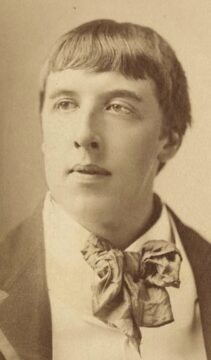
On February 14 1895, The Importance of Being Earnest opened at London’s St. James’s Theatre. There was mild consternation over the lack of a moral, but most people let this pass — as well they might, having been treated to a first view of the funniest play ever written. Only four days later, Oscar Wilde’s feud with the Marquess of Queensberry came to a boil and his epic fall began. Wilde made the fateful decision to sue Queensberry for libel; what followed was public humiliation, criminal prosecution, prison, ill-health and exile. I was reminded of this story recently while listening to David Runciman’s excellent podcast Present Past Future. It’s always a Proustian experience for me. I am immediately taken back to being ten years old. And sixteen.
Ten because of my mother. A passionate lover of theatre all her life, she helped found a local company that put on Importance. She was cast as Algernon’s terrifyingly formidable aunt, Lady Bracknell; as a result I can hear those famous pronouncements only in her voice:
Well, I must say, Algernon, that I think it is high time that Mr. Bunbury made up his mind whether he was going to live or to die. This shilly-shallying with the question is absurd.
JACK: I have lost both my parents. LADY BRACKNELL: To lose one parent, Mr. Worthing, may be regarded as a misfortune; to lose both looks like carelessness.
I’m reminded of being sixteen because Tom Stoppard collated some scraps of historical fact into an absurd idea for an Absurdist play. In 1917 James Joyce, Lenin, and the Dadaist artist Tristan Tzara could all be found working in the Zürich public library — Joyce on Ulysses, Lenin on Imperialism, and Tzara on, for example, cutting up other people’s poems and then rearranging the words by picking them out of a hat. Joyce had also become the business manager of an amateur theatrical company, The English Players, whose first production was to be Importance. Joyce had a nasty, petty financial run-in with the man cast as Algernon, a British consular official named Henry Carr.
It took a writer of Stoppard’s talent to present these facts through Old Carr’s garbled memory, and to do so in part by lifting many of the best lines and plot elements directly from Importance. The garbled memory and the purloined drama are only two of many reasons the play is called Travesties.
Its first production, in the summer of 1974, was at London’s Aldwych Theatre, not far across Trafalgar Square from where the St. James’s Theatre had stood. Two years later some friends and I chose it for our annual school play, and I landed the part of Joyce. My Irish accent was another travesty, but that worked well enough because in many scenes I was not supposed to be the historical Joyce but rather the insufferably condescending Irish “prig” who haunts Old Carr’s highly prejudiced recollections.
Joyce’s finest moment comes when Tristan Tzara goes into full rant about the worthlessness of bourgeois art:
By God, you supercilious streak of Irish puke! You four-eyed, bog-ignorant, potato-eating ponce! Your art has failed. You’ve turned art into a religion and it’s as dead as all the rest. [And so on, and so on]…
Our production had a breathless Tzara finish by kicking over and smashing a china tea set before slumping disgusted onto a couch. As Joyce, I would observe this from a doorway stage left, languidly examine my cheroot, then launch into an Olympian declamation on the real meaning and value of art. The speech begins (oooh how I revelled in this bit):
Yoo. Are an over-excoited. Little mon. With a need for self-expression faaaar beyond the sco-ope of ye natural gufts.
Joyce proceeds to a passionate defense of his métier. (“What now of the Trojan War if it had been passed over by the artist’s touch? Dust. A forgotten expedition prompted by Greek merchants looking for new markets. A minor redistribution of broken pots.”) As a teenage artist-wannabe I naturally sided with his views — not so much against Tzara, whose gleeful, anti-establishment craziness was also pretty appealing, but definitely against Carr, who is represented as a stolid unimaginative functionary. But Stoppard gives even Carr a point of view about how art fits into the world that’s worthy of some respect, in part because it admits of doubt:
[CARR]: My dear Tristan, to be an artist at all is like living in Switzerland during a world war. To be an artist in Zurich, in 1917, implies a degree of self-absorption that would have glazed over the eyes of Narcissus.
[CARR]: When I was at school, on certain afternoons we had to do what was called Labour — weeding, sweeping, sawing logs for the boiler room, that kind of thing; but if you had a chit from Matron you were let off to spend the afternoon messing about in the Art Room. Labour or Art. And you’ve got a chit for life? Where did you get it?
[OLD CARR]: … and I flung at him “And what did you do in the Great War?” “I wrote Ulysses,” he said. “What did you do?’ Bloody nerve.
Stoppard is a master of using the Absurd to help us think more clearly, or anyway more expansively, about these questions of how the intellectual or aesthetic life and what we might call practical life fit together. Lenin and his wife Nadya provide another part of this theme in the play, as the news breaks that there has been a revolution in Russia; that theme results in a wonderful scene towards the end that retains a further personal significance for me.
The librarian, the attractive and forceful young Cecily, has become a sort of amanuensis to Lenin, and has been radicalized by him. She gets into a political argument with Carr, who is every bit as impatient with dangerous radicals as he is with ungrateful aesthetes. As the tension and the volume rise we switch suddenly into Old Carr’s memory. Lights begin to flash. We hear the thumping trombones of David Rose’s “The Stripper.” Cecily climbs onto the Reference desk and starts to take her clothes off, gyrating wildly as she declaims:
The only way is the way of Marx, and of Lenin, the enemy of all revisionism — of economism — opportunism — liberalism — of bourgeois anarchist individualism …
I adored Importance and I adored what Stoppard had done with it. Watching that scene in rehearsal, I found myself thinking: This is it! This is brilliant! When I grow up I’m going to become a writer. And marry a beautiful librarian.
Reader, I did.
***
Enjoying the content on 3QD? Help keep us going by donating now.