
Marcia Bjornerud at Noema Magazine:
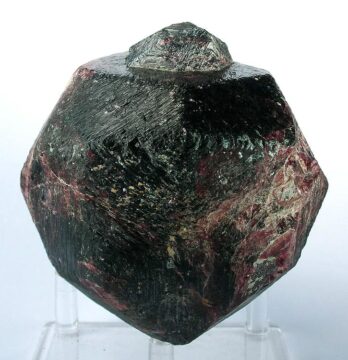 Garnets, however, are the true fruit of the underworld. They occur in a variety of colors, not just red, and all of them have colorful properties and histories. Calcium-aluminum garnet is called grossular, from the Latin name for gooseberry, a reference to its translucent pink to pale green hue. Calcium-chromium garnet is a rare grass-green variety named uvarovite, after Count Sergey Uvarov (1786-1855), who, when not busy with his duties as a statesman under Russian Emperor Nicholas I, spent his time collecting unusual minerals. These calcium-rich varieties of garnet are most commonly found in marbles and “skarns” — rocks formed by the metamorphism of limestones interbedded with shale and sandstone.
Iron-aluminum garnets, whose red shades toward purple, are called almandine, a reference to Alabanda, an ancient city in Turkey. (I prefer almandine to an older term, “carbuncle,” used by the Roman natural philosopher Pliny the Elder, whose geologic curiosity led to his death in the eruption of Vesuvius in 79.) Almandine garnets are the most common type in schists — the metamorphic equivalent of shales, clay-rich sedimentary rocks.
more here.
Enjoying the content on 3QD? Help keep us going by donating now.