
Erin O’Donnell in Harvard Magazine:
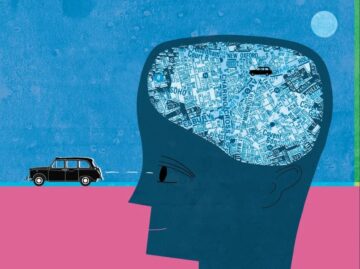 London cabbies are famous for knowing their way around their city’s maze of streets. To obtain a taxi license in London, drivers must pass a legendary test requiring them to memorize the names and locations of 25,000 streets, as well as landmarks and businesses. Passing the exam demands years of intensive study.
This knowledge appears to affect the drivers’ brains, enlarging the hippocampus, an area responsible for spatial memory and navigation. According to a small brain-imaging study published in 2000, London cab drivers had unusually large hippocampi. This part of the brain also happens to degrade in people with Alzheimer’s disease. With those findings in mind, four Harvard researchers recently conducted a new study, published in the BMJ (formerly known as the British Medical Journal), which explored rates of Alzheimer’s-related deaths among almost nine million people across 443 different occupations between 2020 and 2022.
“The two occupations with the lowest Alzheimer’s mortality are ambulance drivers and taxi drivers, jobs that very heavily use the hippocampus as a function of their everyday work,” explains Newhouse professor of healthcare policy Anupam Jena. He and his colleagues were startled by the strength of their results: ambulance drivers and taxi drivers were less than half as likely to die of Alzheimer’s disease than the general population.
More here.
Enjoying the content on 3QD? Help keep us going by donating now.