
Jim Baggott at Aeon Magazine:
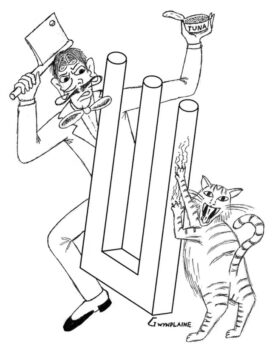 To understand the point Schrödinger was making, we need to do a little unpacking. The nature of Schrödinger’s ‘diabolical device’ is not actually important to his argument. Its purpose is simply to amplify an atomic-scale event – the decay of a radioactive atom – and bring it up to the more familiar scale of a living cat, trapped inside a steel box. The theory that describes objects and events taking place at the scale of atoms and subatomic particles like electrons is quantum mechanics. But in this theory, atoms and subatomic particles are described not as tiny, self-contained objects moving through space. They are instead described in terms of quantum wavefunctions, which capture an utterly weird aspect of their observed behaviour. Under certain circumstances, these particles may also behave like waves.
These contrasting behaviours could not be starker, or more seemingly incompatible. Particles have mass. By their nature, they are ‘here’: they are localised in space and remain localised as they move from here to there. Throw many particles into a small space and, like marbles, they will collide, bouncing off each other in different directions. Waves, on the other hand, are spread out through space – they are ‘non-local’. Squeeze them through a narrow slit and, like waves in the sea passing through a gap in a harbour wall, they will spread out beyond.
more here.
Enjoying the content on 3QD? Help keep us going by donating now.