
by O. Del Fabbro
 Why do we fight? That question has been asked by so many in the history of mankind: philosophers, psychologists, anthropologists, historians, sociologists, political theorists have come up over and over again with explanations as to why humans fight.
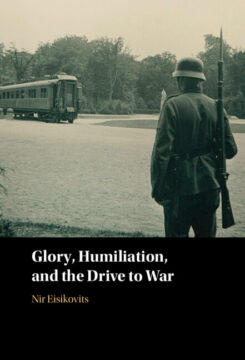
Nir Eisikovits, Professor of Philosophy at the University Massachusetts Boston, and founding director of the Applied Ethics Center, has in his recent book publication tried to answer that question in his specific, and very unique way: Glory, Humiliation, and the Drive to War.[1] Eisikovits’ main claim is that glory and humiliation are similar to a “two-stroke engine”, that is they are in “conjunction with each other”. To put it more simply: being subject to humiliation is so injurious that ending or reversing that state results in obtaining glory. The cycle of the two-stroke mechanism between glory and humiliation is what keeps the war machine running.
Until recently the German political scientist Herfried Münkler would have disagreed with Eisikovits. Especially Westerners live in post-heroic times according to Münkler. Drone warfare and more generally hybrid warfare allow societies to wage war without being explicit about it, and more importantly, there is no need for heroes anymore, if battles are fought remotely. Only lately, with the integration of drone warfare in classical warfare in Ukraine, has Münkler taken a step back and self-criticized his earlier statements. Eisikovits for his part is spot on, when he highlights how psychologically challenging remote drone warfare is for the pilots, and how they suffer from Post Traumatic Stress Disorder (PTSD).[2] Münkler believed that times had changed, that because wars in the 21st century are fought with new technologies and societies are more peaceful now, heroes are no longer needed and glory is of no importance anymore. Eisikovits proceeds the other way around. Wars might have changed technologically, but the drive to war has not changed.
Take for example Homeric glory. Achilles was made to fight and die a glorious death.[3] Skill, danger and courage, that’s what Achilles has to prove. His glory is immoral, it is about performance. Modern asymmetric warfare has often been characterized as lacking this specific form of glory, because it lacks the character of the duel – contrarily to Achilles and Hector. Eisikovits, however, shows that this is not true. Physical skill, cunning and sophistication are very important to guerilla fighters for example, and glorious are the names of successful guerilla leaders such as Che Guevara or more recently Qasem Soleimani.[4]
But Achilles does not care about political achievements and honor for the Achaeans. In this sense, he thinks and acts completely different than Pericles, Thucydides’ hero of the Peloponnesian War. Periclean glory is a sacrifice for a greater cause, that is the well-being and survival of the city state Athens.[5] Not only is he glorious, who defends and dies for Athens, the city itself is glorious and its institutions and civic way of life. If the asymmetric fighting guerilla thus fights for a higher political (or even religious) cause – and that’s what Che Guevara and his companions did for example – then Periclean glory can also be found in asymmetric warfare.
Starting from these examples, that is Achillean and Periclean glory, Eiskovits discusses more theories such as Cicero, Machiavelli, Hobbes, Hannah Arendt in order to come up with a theory of glory. What is glory then? Eisikovits defines it as “a particularly elevated form of honor, esteem, or regard, that is, a supercharged form of recognition.”[6] Glory is about immortality.
But what about the other phase of the two-stroke engine? What about humiliation?
Humiliation, similarly to glory, exists in real world examples: the Islamic State (ISIS) uses the humiliation Sunnis have faced at the hands of Shiites and Westerners in order to recruit new members.[7] The Egyptian-Syrian attack on Israel 1973 was justified by Egypt’s president Anwar Sadat, that the humiliation Israel had inflicted on the Arab armies in the Six-Day War of 1967 ought to be reversed. Similarly China: its rise in international relations, its projects in economic and infrastructure projects, such as the One Belt Road initiative, are best understood through a desire to let the past, the so-called “century of humiliation”, behind. And lastly, also Russia’s aggressive foreign policy – the annexation of Crimea, the destabilization of Western political systems and the war in Ukraine – is a response to Russia’s relegation to a second-rate power status after the collapse of the Soviet Union.
For all of them, Russia, ISIS and China, Eisikovits highlights that humiliation is bound to a feeling of lost status, a perception of lost ascendancy, of being removed of importance, a denied entitlement, the feeling of being replaced and a desire to take the lost status back. Russian and Chinese nationalism, ISIS leaders are in this sense ultra-conservative, nostalgic, and also reactionary.[8] Their revolutionary ideas are not about gradual reform, but trying to re-establish the status of the elite, to return to a mythically pure and innocent past. Turn back time, return to Eden, go back to how things were before. For Eisikovits, a more prudent conservatism, in the form of Edmund Burke, would be open to moderate change by making sure that key traditions survive. Humiliation is in this sense, according to Eisikovits, a feature of autocrats.[9] Democratic leaders do not depend on their image, but on their legitimacy of having been elected and the fact that they received a public mandate. Of course, a democratic leader can be humiliated in public as well, but his confidence lies in his democratic legitimacy. Autocrats do not have that, hence, they need to enforce a clean and pure image of themselves and defend it at all costs.
Let’s stick with Russia for a while, as Eisikovits does, to showcase how a humiliated autocracy like Russia thinks and operates. For example, immediately after becoming president, Putin writes in the newspaper Nezavisimaya Gazeta: “[F]or the first time in the past 200-300 years, Russia faces the real danger of being demoted to the second, or even the third tier of global powers. To prevent this from happening, we as a nation are to pull all our intellectual, physical, and normative resources together, thus ensuring that ours remains a first-tier nation. Our efforts must be united, coherent and constructive, for no one else would do this work for us.”[10] Shortly after, in February 2000, he writes: “Our priority is to restore the personal dignity of the people in the name of the dignity of the nation… Russia has long ceased to be just a reduced map of the Soviet Union; it is a confident power with a great future and great people… The past decade has brought dramatic changes to the consciousness of the people. Our citizens are not yet rich, but they are independent and self-confident… Our army is emerging from a prolonged crisis with honor and is becoming ever more efficient and professional… True, Russia has ceased to be an empire, but it has not wasted its potential as a great power… It is unreasonable to be afraid of a strong Russia, but it should be reckoned with. Insulting us is counterproductive.”[11] Grievance over a lost empire, phantom-limb pain. In this sense, Ukraine is betraying Russia, because Russia in fact was treating Ukraine respectfully, even though, in truth, according to Putin, Lenin created the nation of Ukraine, that did not exist before. Ethnic Russians in Donetsk and Luhansk needed to be protected from ethnic cleansing and humiliation. Humiliated Russia needs to protect those who are similarly humiliated. The special operation in Ukraine brings glory to Russia, in self-defence against the West and NATO. The two-stroke engine at work. For Putin, Peter the Great was not a conqueror and occupier, but returning and strengthening Slavic territories. In the same sense, Ukraine has to return to Russia and be strengthened. Ukraine has no identity, no history, no push for nationhood. Russia has not only been humiliated, now it needs to humiliate others.
Eisikovits does not critically reflect on the historical accuracy of Putin’s narrative, rather he remains on a descriptive level of how humiliation and glory are expressed, and lead to war. Nevertheless, his distinction between moderate and radical conservatism helps to better understand the aggressiveness of Russia. For, what the Ukrainians wanted, and still do, is not so much to become Westerners, rather they want to live a democratic free life – a life that is not possible under Russian rule or influence, but by being part of the European Union and NATO as a security warrant. Ukraine’s will for independence and self-determination is about agency. Anybody who is proud to live in a democracy, and believes in democratic principles, but thinks that Putin is right, is depriving himself of his own agency. In this sense, Ukraine’s case is no different than the one of Belarus or Georgia. Putin’s story of humiliation is that of an autocrat, a self-image of strength and power. Somebody who wants to nostalgically go back in time, and regain lost glory. Similarly, Mark Galeotti writes that Putin “is a gut-level patriot who believes that Russia should be considered a great power not because of its military strength, its economy or for any other specific index, but because it’s Russia.”[12] It is about security, yes, “but it is also about respect and honour. Outsiders ought to treat Russia right, treat it better than they have previously.”[13] Eisikovits is right: humiliation leads to the desire of gaining glory, war is the result. Putin’s war in Ukraine might be justified from his personal subjective point of view, but in the end it is nothing but a clash between democracy and autocracy.
I have focused mainly on Russia, Achilles and Pericles, but as already highlighted Eisikovits discusses in his book much more topics (just war theory, commerce and peace, women) and thinkers and examples of conflicts (Churchill, Machiavelli, Cicero, Clinton, Jefferson, Merkel, Jünger, Hemingway, Levi, Montesquieu, Hitler and many more)
Nir Eisikovits’ book is not normative. He does not give a remedy that could free us from the two-stroke engine of humiliation and glory that leads to the atrocities in war. It is a good thing he has not done so. Too many have tried and failed. War is a very old human endeavour. What we learn from Eisikovits is: before trying to get rid of war, let us first understand its roots, its psychological, social and political dimension. Those of us, who thought that glory and humiliation are long gone, old-fashioned principles of war, are proven wrong.
[1] Nir Eisikovits 2025. Glory, Humiliation, and the Drive to War. Cambridge University Press, Cambridge.
[2] Eisikovits 2025, 63.
[3] Eisikovits 2025, 10.
[4] Eisikovits 2025, 67.
[5] Eisikovits 2025, 13.
[6] Eisikovits 2025, 32.
[7] Eisikovits 2025, 73-74.
[8] Eisikovits 2025, 112.
[9] Eisikovits 2025, 114.
[10] Eisikovits 2025, 169-170.
[11] Eisikovits 2025, 170.
[12] Mark Galeotti 2019. We Need to Talk about Putin, Penguin Random House, London, 72.
[13] Galeotti 2019, 72.
Enjoying the content on 3QD? Help keep us going by donating now.