
Alex Tan at Words Without Borders:
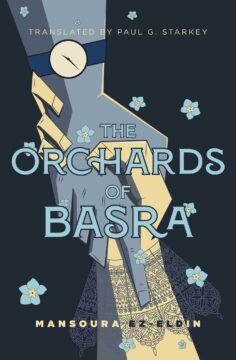 A chronicler of the chimeric, the Egyptian writer Mansoura Ez Eldin has been celebrated in the Arab world for her feverish, fanciful plots. To read her feels like opening one’s eyes into a fugue state, a landscape in which the parameters of reality seem just slightly off-kilter. The air, in her universe, is always abuzz with ethereal presences and diaphanous bodies, anticipating the propitious moment for revelation. For someone so tuned to the monstrous and the ghostly, it’s unsurprising that Ez Eldin’s range of references encompasses everything from Arab-Islamic folklore and A Thousand and One Nights to Franz Kafka and Italo Calvino. Born in the Nile Delta and trained as a journalist, she now works as an editor at the cultural weekly Akhbar al-Adab—a background that has perhaps primed her for the dizzying hall-of-mirror densities of intertextual allusion that characterize her inventive oeuvre.
The Orchards of Basra, which was longlisted for the International Prize for Arabic Fiction in 2021, pursues the surreal and the hallucinatory with obsessive intensity. Though numerous stories of Ez Eldin’s have been published in online journals and anthologized, this is only the second of her novels to be rendered into English. Now available in Paul Starkey’s smooth and accessible translation, the book takes as its premise a recurring dream that hounds the modern-day protagonist, Hisham Khattab, as if it possesses a demonic, vengeful animacy.
More here.
Enjoying the content on 3QD? Help keep us going by donating now.