Indiana Jones and the Cultural Patrimony of Doom

When I was in college, one of my favorite discoveries was How to Read Donald Duck, a clever, if heavy-handed, cultural critique of Disney´s comic book adventures. According to the authors, Dorfman and Mattelart, writing in 1971, all those wonderful stories where Uncle Scrooge, Donald and the triplets claimed floating islands in the Pacific, rescued golden crowns from Mayan cenotes, and thwarted revolutionary “dogs” that looked suspiciously like Che and Castro were pure American Cold War capitalist propaganda. I’d like to say I’m not so easy now (I’d love the authors to back up their take with an intercepted memo from Disney to his artists reading, “Boys, Kissinger called. How soon can Huey, Dewey and Louie make Chile scream?”), but I have a soft spot for this kind of pop-culture-as-politics criticism.

MovieposterindianajonesandthethelastcrusWhich is why I was a little disappointed that no one brought up Indiana Jones earlier this year, when Greece and Italy finally forced the Met and the Getty to admit that their collections contained looted and smuggled artifacts. I couldn’t help but think that that fight in Indiana Jones and the Last Crusade, between Indy and the looter over the Cross of Coronado, might really set us straight on the finer points of the debate over cultural patrimony and museums.

          
Looter: This is the second time I’ve had to reclaim my property from you.

Indy: That belongs in a museum

Looter: So do you.


The thought of a permanent exhibit on Indiana Jones at the
American Museum of Natural History is appealing, but who does deserve to keep it? The looter who dug it out of a cave in the U.S.? The archaeologist? (Apparently not Coronado or his ancestors.) Happily, McSweeney’s halfway took on Indy’s credibility on the subject this month with a wry mock letter titled, “Back From Yet Another Globetrotting Adventure, Indiana Jones Checks His Mail and Discovers That His Bid for Tenure Has Been Denied”: “Criticisms of Dr. Jones ranged from ‘possessing a perceptible methodological deficiency’ to ‘practicing archaeology with a complete lack of, disregard for, and colossal ignorance of current methodology, theory, and ethics’ to ‘unabashed grave-robbing’. Given such appraisals, perhaps it isn’t surprising to learn that several Central and South American countries recently assembled to enact legislation aimed at permanently prohibiting his entry.”


In honor of Harrison Ford’s recent
boast that he’s fit enough for a planned fourth Indiana Jones movie, maybe it’s time to take a stab at “How to Watch Indiana Jones.” Unless I’m mistaken, no one’s really tackled the narrative of archaeological collection and patrimony politics in the Indiana Jones movies. That’s a shame, as I believe that what’s most salient about Indy—and what prompts lazy reporters to dub people everything from “the Indiana Jones of Tomatoes” to “the Indiana Jones of Finance” (I just Goggled “Indiana Jones of” and got 40,800 hits)—is that he makes archaeology look like the perfect mix of scientific brain and globe-trotting brawn. Indy can take back one kaddam from the Staff of Ra “to honor the Hebrew God whose Ark this is”, and lay a smack-down on the Nazis.


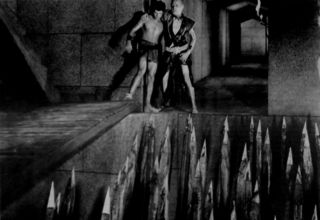
Except that, as the McSweeney’s satire suggests, his archaeological ethics and skills leave a lot to be desired. As an archaeologist, he makes Heinrich Schliemann look good. Take that justly famous first scene in Raiders of the Lost Ark. Indiana Jones is in the jungle of the eastern slopes of the
Andes, searching for a hidden temple. After getting abandoned by his native guides (the Indy movies’ portrayal of native peoples is a rabbit-hole of its own), and betrayed by a young Alfred Molina, Indy literally brings down the house—the entire trap-laden death temple—to get that horrific golden fertility idol. He apparently left his plumb-bob and dentist’s brush at home.


Thankfully, his French nemesis Belloq  is waiting outside, with a coterie of armed “Hovitos” natives to help set Indy straight on why “Finders Keepers” just isn’t going to cut it this time.


Jones: Too bad the Hovitos don’t know you the way I do, Belloq.

Belloq: Yes, too bad. You could warn them… if only you spoke Hovitos.


So the American archaeologist destroys a temple and loses the artifact—to a French archaeologist, no less—because he failed to enlist the local peoples in the protection of their patrimony. Right? Had Indy gotten an advance copy of Patrick Tierney’s controversial Darkness in
El Dorado he might have pointed out that Belloq’s presence would likely destroy the Hovitos’ traditional political and economic organization (and give them measles, natch). We should cut Indy a little slack, though. As Raiders of the Lost Ark and Indiana Jones and the Last Crusade made abundantly clear, everyone else in archaeology in the 1930s was a murderous Nazi! In the face of this obviously irrefutable fact, can we really get mad at American museums’ collecting practices?


Indiana Jones and the Temple of Doom
ditches the Nazi angle, but sharpens the specious critique—very much implied in “pro-museum” arguments this year—that “culture-rich” countries´ laws and protests are disingenuous political pander, and don’t represent the countries´actual will, or ability, to protect their monuments and artifacts.
Granted, Temple of Doom makes our great American hero a little seedier from the start, when Indy trades the ashes of a Chinese emperor to a Hong Kong gangster for a diamond. The real critique, however, starts when Indy gets to “India”. (I put “India” in quotes because when the Indian government read Temple of Doom’s script, it supposedly wanted to remove the word “Maharajah” and asked that their citizens not all be cast as, well, members of a Thuggee Death Cult. Thankfully, Lucas and Spielberg stayed true to their artistic vision and filmed in Sri Lanka instead.) Indy, his wince-worthy Chinese sidekick and whining girlfriend discover that an Indian village has lost not only its ancient “Shankara” stone, but also all its children to the predations of a great nearby palace. It turns out that the English-educated Mola Ram’s Thuggee Death Cult has brainwashed the boy maharajah, and co-opted the Shankara stone for bloody rituals!


As always, Indy is victorious, and returns the children and the stone to the Indian village.  What does it all mean? Sadly, I can’t meet my own aforementioned standards and produce a letter from Lucas to Spielberg reading, “Steve, what if in the next Indiana Jones movie, he intervened in another country’s struggle over the meaning of the past (some sort of stone thing) for the sake of the future (some starving kids) and rescued both from a hypocritical anti-imperial cultural elite (I´m thinking Thuggees)?” That letter does not exist.


But Secret of the Incas does. In 1953 Paramount Pictures flew Charlton Heston to
Cuzco, Peru to play the Ur/Indy, AKA Harry Steele, a square-jawed, unshaven explorer, complete with fedora and bomber jacket. As a few movie buffs have pointed out on-line, Paramount may never release Secret of the Incas on DVD, given the physical similarities shared by Steele and Indy, and a few lifted gimmicks. (Spielberg and Lucas’s explorer cannibalism was hardly unique: Secret of the Incas itself came from a producer who had read about explorer Hiram Bingham’s rediscovery of Machu Picchu, and Bingham’s right-hand man in Peru was the movie’s technical adviser). Which is really too bad, as Secret of the Incas is quite the mash-up of pulp exploring and archaeological ethics.


In a nutshell, Steele is a handsome rogue who’s been holed up in Cuzco, Peru for a few years, playing gigolo for visiting female tourists for money (“It’s the best kind,” he tells one. “It’s the hardest to get. It always smells sooo good.”), and waiting for “a line on that Incan treasure” everyone keeps talking about. He finally gets a clue, and with a beautiful Romanian blonde in tow (Indy, cover your heart, indeed!), he steals a plane, and flies to that famous lost city of the Incas,
Machu Picchu. Once there, however, he gets a rude surprise in the ruins. There’s a joint American-Peruvian-Mexican excavation going on, and local Andeans—along with the 1950s exotica singing sensation Yma Sumac—are dancing in the temples. Steele sneers. “Nobody comes here without a reason,” he growls. “The only reason is to dig. I don’t like the competition.”


Steele wants to find and steal the “Golden sunburst” of the Incan emperor Manco. His resolve falters, however, when he meets “Pachacutec,” a graduate of the
University of Cuzco fluent in English, Spanish and Quechua. Pachacutec tells Steele they are hoping to find “the tomb of our last Incan chief.” When the sunburst “is taken back to the Temple of the Sun, only then will the people of the Inca be great again.” Steele finds the sunburst, of course, but he guiltily returns it to the archaeologists and Pachacutec, admitting “I guess finding it meant more to me than keeping it.”


Incredibly, the film is loaded with asides on cultural patrimony (an American archaeologist on his Peruvian military escort: “His job is to see that we don’t appropriate any souvenirs.”) and references to what we might call “archaeological self-determination.” By the film’s logic, Steele doesn’t suffer a crisis of conscience because he realizes stealing is wrong; he gives the sunburst back because the treasure’s cultural value to the Andean peoples outweighs its monetary and scientific value.

If it sounds a little preachy, that’s because it is, as any argument over the idea of cultural patrimony must be. But in a “funny” last twist that shines a mirror on America’s ambivalence about those sorts of arguments, the producers show that our Ur-Indy is still the bad-boy explorer we want to root for. In the movie’s final minute, Pachacutec restores the sunburst to the Temple of the Sun and Yma Sumac caterwauls in the background. Steele turns to go. Before he does, though, he hands his Romanian blonde girlfriend a golden Inca shawl pin. “Must have fallen into my pocket while I was in the tomb,” he says with a wink. 

The music swells, ‘The End’ flashes on the screen, and we’re remindend once again that our favorite guy in a hat and his big-picture archaeological ethics are just fiction. Right?

Teaser Appetizer: Dalai Lama Becomes the President of the USA

George Bush, in his last year of office, finally got the comprehensive immigration reform law passed. He signed the law in a ceremony in the White House on 10 Oct 08.  Two events compelled a bipartisan approach: the looming election fiasco and the intense lobbying by Arnold Schwarznegger

With election only a few weeks away, no one wanted to be the president to clean up the global Bush mess. No Republican. No democrat. No candidate. Period.

Iraq was the dilemma; while the republicans simply had no desire to withdraw, the democrats did not know how.

Arnold, aware, this was his only chance to be the president, garnered the support of democrats, republicans, free lancers, independents, dependents, deal makers, fence sitters, border crossers and lobbied successfully to change the law. The new immigration law said:

“In the absence of any candidates for the post of the president, the congress and the senate may appoint a person — including a foreigner – as the president of the USA, but on a temporary work permit, named POS-4: presidency outsourced for four years.”

The congress considered many candidates and finally selected The Dalai Lama because he had traveled through the USA more than he had done in Tibet and in a recent Nobel peace prize winners rally he was not critical of the US.

Next morning a benign smile replaced a silly smirk on TV screens while emasculated Arnold sulked in his gym.

In his inaugural speech president Dalai Lama declared, “We will launch novel initiatives in foreign, domestic and economic fronts; we will follow the doctrine of TLC: terrorism, liberation and consumption.

TERRORISM shall be our foreign policy. (Hillary’s jaw dropped, Kerry’s eyes popped, Kennedy’s heart stopped.) But we will give a new definition to TERRORISM: To Engage Rivals in Redirecting Our Resources In Serving Mankind (Hillary-Kerry-Kennedy body parts relaxed.)

On the domestic front, we will not only ensure life and liberty but seek liberation of the intellect from the clutches of the ego. Then and only then we will achieve true freedom. (Richard Gere smiled)

Our constitution ensures separation of religion and state. As a natural evolution of this cherished principle, I propose, we now separate religion from God because religion has lately become a major impediment in understanding God.” (Buchanan and Gingrich cringed)

Our economic policy shall be to cut our consumption. Our avarice for plundering the earth has exceeded its ability to sustain us.”(Cheney got pensive)

The Dalai Lama received inaudible applause in the house but thunderous appreciation in Venezuela, Bolivia, and Iran.

Next day he appointed three eminent persons as his close advisers. Donald Rumsfeld, Joseph Stiglitz and Arundathi Roy.

He chose Donald Rumsfeld as the chief adviser. When the nation protested, he calmed the fear. ”He is the single most valuable asset in my administration. If we do exactly the opposite of what he recommends, we will not go wrong.”

He invited the Nobel laureate economist, Joseph Stiglitz and said,” You have an image of a person who opposes globalization.”

“But I don’t” Joseph protested, “I am only against the machinations of the world bank and IMF. I have written about it in my book — Globalization and its Discontent”.

Dalai Lama winked,” It doesn’t matter what you write. The street protestors don’t read. They follow the slogans. Look here, we can pursue the globalization of non violence with you leading it. With your image no one will suspect.”

  He selected Arundhati Roy – a writer gifted by her small god – with talent to oppose anything: dams, nukes, dictators, democracy, judges, foreign policies, wars, Saddam, Bush, corporations, globalization, free markets, long hair – almost anything. She could write expert opinions simultaneously with both hands; the left hand hurling invectives to the right and the right splashing sarcasm on the right. Her stunning looks, incisive intellect and strident criticism of the USA gave her credibility with its enemies. She had thundered in Turkey, “We are here to examine a vast spectrum of evidence about the motivations and consequences of the US invasion and occupation, evidence that has been deliberately marginalized or suppressed. Every aspect of the war will be examined – its legality, the role of international institutions and major corporations in the occupation, the role of the media, the impact of weapons such as depleted uranium munitions, napalm, and cluster bombs, the use of and legitimation of torture, the ecological impacts of the war, the responsibility of Arab governments, the impact of Iraq’s occupation on Palestine, and the history of US and British military interventions in Iraq.”

At their first cabinet meeting, Joseph Stiglitz gave an overview of the state of the economy. He told that our priorities were skewed and we could easily afford to improve the condition of the world. He cited from the Human Development Report, 1998, the comparison between the total cost for health and education of the world and other frivolous expenditure the world was indulging in:

Cost of basic education for all $6 billion (Cosmetics in the USA $8 billion)

Cost of water and sanitation for all $9 billion (Ice Cream in Europe $11 billion)

Reproductive health for all women $12 billion (Perfumes in Europe and the USA $12 billion)

Basic health and nutrition $13 billion for all (Pet foods in Europe and USA $17 billion)

Business entertainment in Japan $35 billion

Cigarettes in Europe $50 billion

Alcohol in Europe $105 billion

Narcotics in the world $400 billion

Military spending in the world $780 billion

It was not any better in 2005 Human development Report:

Annual income of the richest 500 people exceeded that of the poorest 416 million

Cost of ending extreme poverty – $300 billion – less than 2% of the income of the richest 10% of the world’s population

Joseph also quoted from a report on health by Jeffrey Sachs and associates:

“8 million lives could be saved per year in low income countries by intervention in nutritional and infectious diseases. These countries need additional grants of 22 to 31 billion dollars per year by 2015 from donor countries. The USA gave only 0.012 percent of its GNP, an average of 920 million dollars between 1997 and 1999 as development assistance for health and population programs.

The Dalai Lama asked Joseph Stiglitz, “How much will the Iraq war cost?” Joseph replied,” I estimate, it will be at least 1.1 trillion dollars by 2016.”

The Dalai Lama said, “If we stop the war now and spend some money instead on health and education, do you think that will be a better foreign policy? Do you think we will make more friends? Do you think that is the right action?”  Rumsfeld disagreed,” First we need democracy in Iraq to ensure our national security. We can not cut our defense expenditure and our war effort”.

Dalai Lama had chosen the right path instinctively and Rumsfeld’s objection validated it. He asked Rumsfeld,” When should we withdraw from Iraq?”

Rumsfeld said,” Not for five years or may be ten.”

Taking Rumsfeld’s advice seriously he ordered the US army to withdraw immediately.

He asked Arundhati to go Iraq, publicize the new US foreign policy, convince them of our sincerity and embrace them with friendship and love. She hesitated,” Since I can not be guaranteed security I would rather not travel. Instead I would just write angry articles and persuasive letters.” 
Rumsfeld chuckled,” In New York she needed only a podium but in Baghdad she also needs courage.” Arundhati, livid and challenged, defied Rumsfeld and left for Iraq.

Dalai Lama blessed her with parting advice,” Mr. Bush had used WMD – words of mass deception — to fabricate excuses to attack Iraq but now it is your responsibility to use the right speech. And don’t practice in Iraq what you may have picked up from the communists in Kerala. Freedom of speech does not legitimize the freedom to shriek.”

Arundhati was a big hit in Iraq with her passionate persuasion.

The Dalai Lama then set out on an earnest campaign to convince Americans to cut consumption.

He cited from a report, that 20% of the world population living in the highest-income countries indulges in 86% of total private consumption. They also:

Eat 45% of all meat and fish

Use 58% of total energy

Own74% of all telephones

Use 84% of all paper

Own 87% of the world’s vehicles

The president pleaded,” We in the USA are the profligate market for the world. The whole world sells to us and we buy a disproportionate share of world’s production of goods and services. That makes us vulnerable and insecure. We should cut our consumption and lead simpler lives.”
When Americans finally decided to live without compulsive shopping, the imports decreased, trade deficit narrowed, national debt plummeted, credit card debts vanished, inflation leveled off and the need for Valium and Prozac abated.

The shopping outlet of the world, the USA, had pulled its shutters down. Main mart of the world was closed!

The experiment seemed to be work for two years.

But, by the third year of his presidency global effects of this policy sprouted. The Chinese had lost their outlet store for manufactured trinkets, the Indians who had facilitated the lives of Americans with their software (while neglecting their own poor people) had no users, the French and Italians had to keep their luxury frills at home, the Japanese inventory of cars escalated, the Korean electronics had no buyers.

In the US, as sales plunged, government revenues plummeted, unemployment escalated, bankruptcies multiplied, discontent simmered. And the Mexicans stopped crossing the border.

But Cuba insulated and hardened by decades of US blockade, was the only country unaffected by the global depression. Cuba had also recently hosted the Non Aligned Movement summit where they had decided to drop the word “Aligned” from the title and call it (appropriately) ‘Non Movement’ and Fidel Castro, whose guts had been surgically removed, became the president.

Fidel rose from the hospital bed and startled the comrades, who seduced by the promise of free markets had slumbered for half a century. The ‘Non Movement’, they figured, was a hint from Fidel to revolt.

The workers of the world united and threatened, “Either the US reopen its free market or now face the terrorist wrath of the Cubans, Chinese, Indians, South Americans, East Europeans, Koreans, Africans – all combined.”

The Dalai Lama was sad. The magnitude of global depression was worse than the world had seen before. That night, Dalai Lama had a dream —– Cubans had invaded the USA. He advisers told him to flee the country. He groaned, “Oh not again.” And then he reluctantly encouraged his followers to trek to Canada. “It is a flat land, an easier trek compared to my first one.”

In the background he heard Rumsfeld taunt, “Ha, Communists need free markets to feed them and pacifists need an army to protect them.”

Bush sniggered from his ranch and praised Rumsfeld with Bushism, “What a clever and apt simile!” Arundhati swiftly opposed the Bush metaphor and retorted, “No, it is called an irony.”

Monday, October 30, 2006

Monday Musing: Milosz v. Gombrowicz

I’m tempted to make the rather bold assertion that the most interesting duo in Western literature of the 20th century is Czeslaw Milosz and Witold Gombrowicz. I say duo because you really have to take the two of them together. When Milosz zigs, Gombrowicz zags, when you’re feeling one way, Milosz expresses it for you, and when the mood shifts, there is Gombrowicz waiting in the wings with a change of pace.

The twentieth century was insane. We forget to remember that. For us, it’s what made us what we are and therefore it has taken on a sense of inevitability, even naturalness. But looking at it from the other way around, from the perspective of those who were going through it and for whom its twists and turns were anything but a foregone conclusion, the century is filled with so many shocks and amazements it is difficult to comprehend. And that, of course, was one of the great, if not the great, themes of literature from the collapse of the Austro-Hungarian empire and the outbreak of WWI to the effective finale to the 20th century in the breakup of the Soviet Union and the reuniting of Western and Eastern Europe.

Through it all, the challenge to the coherence and sustainability of human experience was relentless. If tradition was disrupted and broken down here and there in the 19th century, it was upended completely, remade from the insight out, and sometimes obliterated during the 20th. Again, we don’t often bother to stop and consider how extraordinary that process was. It was by turns exhilarating and terrifying and sometimes both simultaneously. And perhaps the horrors of the twentieth century were all the more horrifying given that the century continuously produced strains of hope that things could possibly be otherwise. Suffering is that much worse the degree to which it is perceived to have been avoidable.

Czeslaw Milosz was as sensitive to these issues as anyone. This is a man who picked his way through the rubble of Warsaw when its ruins were still steaming, when the place was just an open wound. That experience, and the knowledge gained from it, is shot through everything that Milosz ever wrote. For Milosz, man is guaranteed nothing. That’s it. Nothing. And man can be reduced, or reduce himself, to nothing, at any moment.

Gombrowicz too experienced such things. As Milosz says of him, “Gombrowicz lived in an epoch which neither quantitatively nor qualitatively brings to mind any of the previous epochs and which distinguishes itself through ubiquitous cases of ‘infection’ with mass and individual madness.” Man, as Aristotle once mentioned, needs a world, a complicated arrangement of social interactions, in order actually to be man. But that same ordering of complicated social arrangements can also be the vehicle by which human beings destroy themselves and one another.

But Gombrowicz chose flight, literally and metaphorically. From his exile in Argentina he conjured up an absurd mental universe that spins out the problems of experience in countless ‘as if’ scenarios that are so powerful exactly insofar as they make sense despite their insanity. Gombrowicz took flight into the endless malleability of human experience in order to keep a step ahead of the world as it is. That is his particular freedom. It is the freedom of Socrates as Kierkegaard describes him in The Concept of Irony, the freedom that escapes from every possible determination.

Truth be told, this version of freedom annoys Milosz. Because for Milosz, the possibility of meaning in human affairs is dependent on commitment. If nothing else, it is founded on the capacity for human beings to hold experience together even as forces from within and without work to tear it apart. How one does this is not entirely clear but Milosz’s entire oeuvre is the sustained attempt to do so even as he lacks a blueprint. That is a pretty brave literary task to set in front of oneself. From Milosz’s standpoint, Gombrowicz has retreated into his own consciousness instead of forcing himself constantly to confront the problems of the world as it is encountered. Milosz has said that, “what fascinates me is the apple: the principle of the apple, appleness in and of itself. In Gombrowicz, on the other hand, the emphasis is placed on the apple as a ‘mental fact’, on the reflection of the apple in consciousness.”

But then the two come together again, in Milosz’s mind, because Gombrowicz never falls into the trap of those intellectuals who have lost track of the root problems of experience, actual experience, that have been thrown up by the 20th century. Milosz writes that, “A comparison of Gombrowicz with western writers, with Sartre, for example, would reveal, in the case of the latter, a deficiency of a certain type of experience connected with history and specific cultural traditions, a deficiency that is compensated for by theory.”

I think we’re still working this stuff through. And I’ll make one more rash claim. The future right now is in the past. Sometimes it is in the past, the immediate past, where things get clear again. For those of us whose lives stretch from the era of the 20th century into the next one, the most important thing for taking the future seriously is doing work on the things that have recently past. Only now is it becoming even vaguely possible to understand how important are the tentative thoughts put forward by people like Milosz and Gombrowicz. And there are others, back there, waiting for us. We simply have to take seriously the idea that turning our backs on the future is a way of renewing it.

The Future of Science is Open, Part 1: Open Access.

I’ve never had an idea that couldn’t be improved by sharing it with as many people as possible — and I don’t think anyone else has, either.  That’s why I have become interested in the various “Open” movements making increasing inroads into the practice of modern science.  Here I will try to give a brief introduction to Open Access to research literature; in the second instalment I will look at ways in which the same concept of “openness” is being extended to encompass data as well as publications, and beyond that, what a fully Open practice of science might look like.

The original paradigm: Open Source
Although the underlying concept of information as a public good goes back at least to the invention of the printing press and the end of the aristocratic/theocratic duopoly on literacy, programmers were the first people I know of to popularize this sort of “openness” in an academic setting.   Richard Stallman started the GNU Project in 1983/4 as a reaction against the rising influence of proprietary software, and a year or so later founded the Free Software Foundation, which “is dedicated to promoting computer users’ rights to use, study, copy, modify, and redistribute computer programs.”  What Stallman and the FSF mean by “free software” is famously summed up by the dictum, “free as in speech, not free as in beer”; more precisely, they mean “free” as in:   

  •      The freedom to run the program, for any purpose   
  •      The freedom to study how the program works, and adapt it to your needs   
  •      The freedom to redistribute copies   
  •      The freedom to improve the program and release your improvements to the public

Access to the source code is a precondition for these freedoms, and many advocates prefer that the “four fundamental freedoms” also be combined with some form of copyleft (basically a licence which explicitly disallows use of the original resource in any way that restricts the four freedoms for anyone else).  About a decade later the Open Source Initiative appeared, offering itself as a “more pragmatic” approach to free software.  The two definitions are pretty similar, though the OSI version allows some licencing that the FSF considers too restrictive of end users.  Today, both the FSF and the OSI are powerhouse advocates for non-proprietary software, code that you can get your hands on and hack to your heart’s content.  There is a wealth of free software freely available for scientific purposes: for instance, the OpenScience Project maintains a list, as do (inter many alia) the NCEAS, the CBS and Indiana University.  The NIH and EBI both maintain extensive services, there’s an entire Linux distribution for science, SourceForge lists over 350 projects under “scientific”, and a simple google search finds dozens of free applications for molecular biology.

Open Access
By analogy with Open Source, Open Access to the research literature entails the freedom to read, use and redistribute the published results of scholarly research and derivative works based on those publications.  What follows is a version of Peter Suber’s very brief introduction to OA; for more details, see his full Open Access Overview and Timeline of the OA Movement.  The bottom line is this:

Open-access (OA) literature is digital, online, free of charge, and free of most copyright and licensing restrictions. What makes it possible is the internet and the consent of the author or copyright-holder.

Most scholarly journals do not pay authors, who therefore do not lose revenue by publishing under OA conditions.  Thus the controversies about OA to music and film (was Napster “piracy”?  did it cost any actual musicians any money?) do not apply to the scholarly literature, the authors of which are clearly better off if access to their work is not restricted.  Online publishing is much less expensive than its print-only ancestor, but it is not free; the big question of OA is how to pay the bills that do remain without charging access fees.  Nearly all current OA models reduce to one of two basic blueprints: OA archives/repositories, and OA journals.

OA archives or repositories simply make their contents freely available to the world. They may contain preprints (the author’s version prior to peer review), refereed postprints, or both. Archiving preprints does not require any form of permission, and a majority of journals already permit authors to archive their postprints. Archives which comply with the metadata harvesting protocol of the Open Archives Initiative are interoperative and can be searched as though they comprised a single (enormous, virtual) database, using high-level services such as OAIster. There are a number of open-source software packages available for building and maintaining OAI-compliant archives; Peter Suber maintains a list of lists of such archives, and SHERPA maintains a database of journal policies regarding pre/post-print archiving.  Archives cost very little to set up and maintain, and increasing numbers of universities and research institutions are building their own.  PubMed Central, maintained by the NIH, is probably the largest and best-known in biomedical science.  ArXiv, run by Cornell University, is the principal means of transfer of research results for many (if not most) mathematicians and physicists.  Stevan Harnad, a leading advocate of self-archiving, maintains a comprehensive self-archiving FAQ file.

OA journals are in most respects the same sorts of entities as traditional paid-access journals, but without the access fees.  They perform peer review, and make the refereed articles available free to all comers.  They pay the bills in a number of different ways.  About half charge author-side fees, though who actually pays these is widely variable (author, author’s institution, funding body, etc.).  Publishing in an OA journal is obviously 100% compatible with self-archiving.  The DOAJ currently lists nearly 2500 peer-reviewed OA journals, of which more than 700 are searchable at the article level; for larger lists of OA journals which may or may not be peer-reviewed, see JournalSeek or Yahoo’s Free Full Text.  Three of the most prominent OA journal publishers are the Public Library of Science, Hindawi Publishing and BioMed Central, and a number of traditional publishing companies now offer OA options.

A personal example
I have yet to publish any data here in the US, but I published a dozen or so articles while I was at the University of Queensland.  More than half of these are not freely available from the journals in which they were published (J Clin Virol, Virology, Biochim Biophys Acta, Mol Biochem Parasitol, Acta Tropica — all Elsevier journals, pfui! — and Rev Med Virol from Wiley InterScience).  I couldn’t find any full-text copies online using Google Scholar or PubMed, either.  You cannot read these seven papers of mine without paying a fee (usually around $30) or physically going to a library which carries (and has therefore paid for) the journal and issue in question.  Neither can my professional colleagues, unless their institution happens to subscribe to the journal or some package which includes it; these subscription fees are commonly extortionate (Elsevier being a particularly egregious offender).

For you as a taxpayer, this means that you are denied access to information you’ve already paid for (since I’ve always been funded by government grants).  For me as a scientist, it means that more than half of my life’s work to date is, while not useless, certainly of much less use to the world than it might be.  Given that a large part of why I do what I do is that I want to leave the world a better place than I found it, that is simply not acceptable to me.  Fortunately, according to RoMEO, all of the journals concerned allow postprint archiving by authors, so I might be able to rescue it.  Searching for “queensland” in DOAR (one of a number of such directories) leads me to ePrints UQ, so there is a relevant archive for me to use, but there’s a catch: you have to be a current UQ staff member to deposit.  I can (and will) talk to David Harrich, my boss at the time, about archiving all of our HIV papers, since Dave is still at UQ.  My schistosomiasis papers, though, have no one on the author lists who could deposit them, so I’ll have to contact the staff at ePrints UQ and see whether there’s a way for ex-staff to deposit articles.  If there isn’t, I’ll have to either find another repository that will take the articles, or make one of my own.  Since my current employers don’t have an institutional repository, I’m going to have to make that choice anyway for upcoming papers.  Both arXiv and Cogprints will take biology papers, although mine don’t seem to fit into any of their categories, and Peter Suber has mentioned building a Universal Repository in collaboration with the Internet Archive, but I’m not sure if anything has come of that endeavour.  That leaves me with the option of building my own archive, for the purposes of which there are numerous open-source software packages available.  Alternatively, at least as a first step, I could simply upload the papers to my own webspace somewhere and try to make sure the the Internet Archive and Google Scholar know about them, so that they would be available though not interoperable with other repositories.  Finally, there’s one last catch: Elsevier won’t let me use their pdf versions, and I don’t have the original files in most instances.  So whatever I do, I’m going to have to track down the published versions and then reverse-engineer an “unofficial” version.

Why would I go to all this trouble?  Because OA offers significant benefits and advantages to a variety of stakeholders:

Benefits of Open Access
1. Maximal research efficiency.  The usual version of Linus’ Law says that given enough eyeballs, all bugs are shallow — meaning that with enough people co-operating on a development process, nearly every problem will be rapidly discovered and solved.   The same is clearly true of complex research problems. and OA provides a powerful framework for co-operation.  For instance, Brody et al. showed that, for articles in the high-energy physics section of arXiv (one of the oldest archives available for such study), the time between deposit and citation has been decreasing steadily since 1991, and dropped by about half between 1999 and 2003.   Alma Swan  explains: “the research cycle in high energy physics is approaching maximum efficiency as a result of the early and free availability of articles that scientists in the field can use and build upon rapidly”. 

Moreover, the machine readability of a properly formatted body of open access literature opens up immense new possibilities.  Paul Ginsparg, founder of arXiv, observes:

True open access permits any third party to aggregate and data mine the articles, themselves treated as computable objects, linkable and interoperable with associated databases. We are still just scratching the surface of what can be done with large and comprehensive full-text aggregations.

Swan again:

…exciting new developments in text-mining and data-mining are beginning to show what can be done to create new, meaningful scientific information from existing, dispersed information using computer technologies. Research articles and accompanying data files can be searched, indexed and mined using semantic technologies to put together pieces of hitherto unrelated information that will further science and scholarship in ways that we have yet to begin imagining. These technologies are just in their infancy at the moment. Real scientific advances will be made using them but the technologies can only be applied effectively to the open access corpus: literature and data hidden behind journal or databank access restrictions are invisible to the computer tools that can do this work…

Examples of such precocious infants include cheminformatics.org and the family of utilities and tools available through the NIH/NLM’s PubMed interface.

2. Maximal return on public investment.  Just as OA is, at least for now, primarily (though not exclusively) aimed at literature for which the authors are not paid any kind of royalty, so one obvious focus of attention is government-funded research.  Why should taxpayers pay twice, once to support the research and then again when the scientists they are funding need access to the literature?  More importantly, open access to a body of knowledge makes that knowledge more available and useful to researchers, physicians, manufacturers, inventors and others who make of it the various socially desirable outcomes, such as advances in health care, that government funding of research is intended to produce.  Peter Suber has gone over this intuitive position in some detail here.

3. Advantages for authors.  There are well over 20,000 scholarly journals, and even the best-funded libraries can afford subscriptions to only a fraction of them.  OA offers authors a virtually unlimited, worldwide audience: the only access barrier is internet access (which is, of course, cheaper to provide in poorer nations than comprehensive libraries of print journals would be!).  There is a large and steadily growing body of evidence showing that OA measurably increases citation indices (that is, the number of times other papers refer to a given article).  For instance, of the papers published in the Astrophysical Journal in 2003, 75% are also available in the OA arXiv database; the latter papers account for 90% of the citations to any 2003 Astrophysical Journal article, a 250% citation advantage for OA.  Repeating the exercise with other journals returns similar results.

Not only is this of vital importance to academics when it comes to applying for funding or competing for tenure, it’s more or less the whole damn point of publishing research in the first place: so that other people can read and use it!

4. Advantages for publishers: the benefits that accrue to authors of OA works also work to the advantage of publishers: more widely read, used and cited articles translates to more submissions and a wider audience for advertising, paid editorials and other value-add schemes.

5. Advantages for administrators.  One of the best available proxy measures for research impact is citation counting: how many times has a given paper been cited by other researchers in their published work?  This idea led to the development of the impact factor, a measure of a particular journal’s importance within its own field.  These sorts of bibliometric indicators are relied upon heavily by science administrators making decisions about funding, by faculties making decisions about tenure cases, and so on.  Open access, by removing the subscription barriers that splinter the research literature into inaccessible proprietary islands, raises the possibility of vast improvements in our ability to measure and manage scientific productivity.

6. Scalability.  Peter Suber has pointed out that, because it reduces production, distribution, storage and access costs so dramatically, OA “accommodates growth on a gigantic scale and, best of all, supports more effective tools for searching, sorting, indexing, filtering, mining, and alerting –the tools for coping with information overload.”  Online distribution is necessary but not sufficient for scalability, because subscribers to paid-access journals do not have unlimited budgets even if they are enormous institutional libraries.  For end users to keep pace with the explosive growth of available information, the cost of access has to be kept down to the cost of getting online.

Tune in Next Time
In the second instalment, I will look at open access to raw experimental data, cooperation over competition as a research model and the ever-expanding role of the Web in science.  In the meantime, if this has piqued anyone’s interest in OA (and I hope it has!), here are my Simpy collections of open access and open science  links.

One Last Thing
This is an immense topic, and anyone who knows anything much about it will certainly see things I’ve missed or got wrong. That’s what the comments are for! Blogs are conversation tools, and I’d appreciate your feedback.

Update: part 2 is here, part 3 is here.

….

Creative Commons License
This work is licensed under a Creative Commons Attribution 3.0 License.

Dispatches: On The Shining

It is the greatest scary movie and the scariest great movie there is.  From its first foreboding shots of a car on mountain roads, The Shining tends to unmoor me completely from my critical faculties.  It’s a cliche that it only gets scarier with each viewing, but I’ll reassert it: I am more scared and compelled when watching today, maybe for the twentieth time, than ever.  Since it’s more a dreamlife than a movie, and depends on no shocks for its disturbing power, it only lodges deeper within me each time.  The problem is that in addition to being disturbing, The Shining also produces such pleasure that one has to watch it periodically anyway.  It creates a world of such photographic perfection and precise beauty that the idea of, say, a serif typeface in the credits would deface it utterly.  Yet it’s really, really funny.  It’s weird, but its austere beauty contributes to its scariness: if it had aged badly, it would much easier to laugh at and dismiss.  You could look away.

A number of memorable films were released in 1980: Raging Bull, The Elephant Man, Gloria, Ordinary People, The Empire Strikes Back, Private Benjamin.  The first three are great movies; seen today, however, none of them possess the strangeness of The Shining.  For example, to watch Raging Bull today is to enjoy a excellent and movingly acted biopic.  To watch The Elephant Man is to recall David Lynch in his embryonic period, with glimpses of the full-blown uncanny paranoia that emerges later.  In both cases, we are the master of our viewing experience – after several viewings, we comfortably comprehend and analyze the movies’ goals and the degree of success which with they reach them.  They are movies.  Nothing like this is the case upon re-viewing The Shining today.  It doesn’t even seem like a movie.  It fits into the category “films of 1980” in a much more confounding way, when it does at all.

A profound uneasiness surrounds The Shining, enveloping it so thoroughly that it seems some sort of unclassifiable formal object, so freshly does it continue to impress itself.  One way to put this would be to say that the other 1980 movies I mentioned are examples of different cinematic tones; The Shining‘s tone somehow stands apart and escapes the category of “movie” altogether.  This strangeness expresses itself by the camera’s action as well as the actors, who seem not so much to be professionals acting as the denizens of an archetypal reality.  Both the setups and the action occur at a very deliberate speed, giving you time to register (and interpret) everything that happens, every authoritative cut and koan-like speech.  In the very first sequence, when Jack Torrance is interviewed for the job of caretaker, the manager begins to explain the case of the previous caretaker, Grady.  As he introduces the topic, he stumbles, then makes a forced laugh.  There is an inexplicably pregnant cut towards his assistant, who sits in a chair, absolutely motionless – he’s wondering how the boss is going to broach this particular delicate subject.  That cut does everything to establish the mood of wrongness, yet it’s unmotivated on first view, like a lot of other bits.  That’s why the movie feels at an angle to the horror genre – as everyone notices, it completely eschews the usual scare tactics: sudden music cues come at the “wrong” times, our expectation of scary shocks is mostly thwarted, and the compositions are balanced and photographic instead of aslant and “weird.”

An odd thing: The Shining retains its tonal freshness even though much of it has entered pop culture.  Jack chopping down the door, the two murdered girls holding hands, Danny scrawling “redrum” on the mirror, the deluge of blood from the elevator: that these are celebrated and iconic images has not dulled their talismanic power.  Seeing them again, the movie’s technique of preparing you for a disturbing sight, making you anticipate it, becomes more and more terrifying.  (I’ll confess here that I can’t even watch the sequence in room 237 with the woman in the bathtub anymore – I worry so much for Danny I just can’t watch it.)  Even many secondary moments have entered the collective memory.  I remember first watching Jurassic Park and grinning at Spielberg’s allusion to The Shining as that movie’s children hide in the stainless steel cabinet of a professional kitchen.   Those pursuing velociraptors, though, did nothing to dislodge from memory the far more potent scene to which they alludes, of Danny hiding from his father. 

It’s Danny Lloyd’s presence in the film, I think, that makes it so perfectly disturbing – any complicity the audience might have with Jack Nicholson’s charismatic psychosis rebounds viciously whenever Danny is onscreen.  His face is so beautiful and his manner so painfully innocent that he personifies the vulnerability of childhood.  This splits us against ourselves, since the film has taken pains to help us identify with Jack’s contemptuous antics.  If Shelly Duvall’s shrill Wendy Torrance makes us want to scream in frustration with Jack (and Kubrick), Danny makes us desperately protective against our own impulses.  We cower, transfixed, when Jack sadistically explains cannibalism to his young son.  And in a quite brilliant touch, Scatman Crothers plays the hotel’s head chef as the one truly loving, caring (and “shining”) person in the movie.  Naturally he ends up as the victim of the film’s vicious and only murder. 

I don’t mean to raise the ur-scenario of the isolated nuclear family as a suffocating nightmare above others, though.  But the fact remains that The Shining often seems to be an allegory for something without quite enough clues as to its meaning.  The massacre of Native Americans, the numerological significance of the number 12, the doctrine of eternal recurrence, the perils of alcoholism, the sense of human social life as a pathetic delusion, all of these can be supported by the right observer.  What can we glean from this excess of possibility?  Maybe this: the dream, not the real, is the state to which the film aspires, which is why it includes so many irregularities and “mistakes.”  Watch the famous scene of Jack chopping down the bathroom door behind which Wendy cowers.  He chops through the right pane of the door, then sticks his hand through, which Wendy slices with her carving knife.  We cut back to Jack’s face, then to a shot of him in front of the door, where the right pane is splintered, but the left pane is now completely and cleanly removed.  It’s plainly absurd.  This in a film that took a year(!) to edit, with forty or more takes of each shot. 

Perhaps the most lauded innovation of the film is its use of long Steadicam (an apparatus that allows an operator to walk and run with the camera without shaking) shots that track various characters around the hotel.  Among its many vivid employments, you probably particularly remember Danny riding his tricycle through the halls of the Overlook, his wheels alternately humming over the wood floor and being muted over the carpet.  These shots, along with the model of the hedge maze that Jack looks into, give us a clear and masterful spatial knowledge of the hotel’s layout, allying us with the maleficent authority of “the house,” implicating us in the desire to kill.  (“Your money’s no good here, Mr. Torrance.  Orders from the house.”)  As we haunt the hotel, so does Jack in his accelerating derangement.  Kubrick even mirrors this acceleration by speeding up the intertitles, from “ONE MONTH LATER” to “THURSDAY” to “8PM.”  The steadicam, the titles, the pace – these devices combine to remove the film from everyday life.  When you see Vivian Kubrick’s documentary on the movie’s making, the humdrum randomness of life on set (Jack mugging, Shelly whining, Danny running by with… it’s Leon Vitali! “Bullingdon,” from Barry Lyndon!) seems totally bizarre – by contrast, the film itself feels implacable, like it has no wayward elements.  It didn’t include any of the normality it didn’t want.  It never could have been any other way. 

And that, I believe, is the secret to The Shining: the perfect autonomy of its execution.  Shooting fifty takes of Danny running through the maze to get that perfect one starts to make sense: the film is stripped of any inner timeliness, any traces of the reality of 1980.  It’s other-world hangs together so immanently, with such formal unity.  But such unity turns out to be suspect.  At the movie’s center is Jack’s typewriter and the outrageous moment when Wendy discovers what his work consists of: ALL WORK AND NO PLAY MAKES JACK A DULL BOY typed thousands of times, as I hardly need to repeat.  The most chilling of the suggestions the movie makes might be the idea that authorship, and maybe auteurship, are forms of psychosis.  To desire to create and escape into one’s one world is to risk succeeding to a sociopathic detachment.  You get the sense here of an autocritique: after all, it’s Kubrick who so clearly delights in the tiniest of details, like the little toy ax and American flag on the hotel manager’s desk, and it’s us who cheer him on.  Among all filmmakers, the sense of a pure aesthetic, a fully controlled formal world, is never greater than with Kubrick.  But it’s just this escapist impulse that The Shining suggests is murderous, and you can’t escape it if it’s in you too.

See the rest of Dispatches.

Selected Minor Works: A Philosophical Exchange, of Sorts

Justin E. H. Smith

(For an extensive archive of Justin Smith’s writing, please visit www.jehsmith.com)

Many of us in the 3QD community have witnessed a recent assault on our inboxes from Australians with big ideas. It seems the land down under plays host to a vast network of retired insurance adjustors, used-car salesmen, accounts payable clerks, etc., who believe, against all probability, that they have discovered a number of very grand truths about the meaning of life, the right path for humanity’s future, etc. They live off their wives’ paychecks, sit in their pj’s in their basement romper rooms (at least this is how I imagine them), and post grandiose proclamations in tortured English about the decline of civilization, the one true path towards renewal, and (you guessed it) the deplorable takeover of the universities by postmodern feminist leftist brainwashers. They self-publish their ruminations, and declare that the lack of interest on the part of university presses can only have to do with the dangerousness, the epoch-making potency, of what they have to say.

I have long been fascinated with autodidactic self-styled “philosophers.” I always think to myself when I encounter them: it’s not like it takes a genius to be a real philosopher. I got my Ph.D. in the thick of a six-year haze of pointless partying, all-consuming “relationships” with people whose names I’ve since forgotten, and the usual twenty-something bon-vivantism that is at such great odds with the truly committed life of the mind. And here I am some years later, not exactly up there with Habermas in terms of the influence my proclamations carry, but also not down there with the cranky and alienated writers of letters to editors at small-time local newspapers, railing against tax-and-spend liberals, the immodesty of teen pop stars, etc. So why, oh why, would anyone choose the parasitic social role of the self-trained loner philosopher, who enjoys none of the social capital of the professional, and who inevitably will be unable to communicate with anyone whose opinion carries any weight at all in society, never having learned the appropriate behavioral and lexical cues that make communication possible? What are the social factors that make these men (and they are always men) possible?

Intrigued (and procrastinating), I responded to an e-mail sent to me by one Philip Atkinson, who had got in touch after reading a 3QD essay in which I acknowledged, innocently enough, that I do not know what philosophy is. I present to you below an abridged transcript of the correspondence that followed.

**

Dear Sir,

Further to your confession that despite becoming tenured as a professor of philosophy you have no idea what philosophy is. I have spent the last few years challenging professors of philosophy to define or confess they cannot define what philosophy is. None would meet my challenge, so I am delighted to at last discover a university philosopher who confesses the truth. You are unique.

The purpose of my challenge is to demonstrate that philosophy is now unhelpful but demonstrate that this can be repaired by adopting a simple set of beliefs. And as proof of this claim, by using the proposed set of beliefs I recommend, I can explain the nature of civilization: a phenomenon that has defied all previous attempts at explanation.

So would you please read my claim about philosophy (or civilization) and confirm or refute it.

Kind regards,
Philip Atkinson

**

Philip,

I don’t think you quite appreciated the tone or spirit of the essay of mine you are citing. If you had, you would have detected the sense of irony that motivated me to write it, and you also would have understood that my ironic distance from my own discipline is a result of my disappointment with systems of definitions and axioms, such as the one you are promoting.

Yours,
Justin

**

Dear Sir,

Thank you for responding to my letter, your reply is disappointing however. Your confession of ignorance about the nature of philosophy is independent of tone or spirit. No-one knows what philosophy is or what is can be used for; this is the very thing I am trying to repair. It was refreshing to see this simple truth confessed; but now you wish to recant.

You may well feel disappointment with definitions and axioms, but they are an essential part of understanding and everyone uses them, albeit unconsciously. The very meaning of words is axiomatic. The notions I am promoting as axioms of philosophy are easy to understand, and easy to use, unlike the pompous nonsense that generally is expressed by self-declared philosophers. I could sympathise with your disappointment with axioms and premises if I had to listen to the nonsense that now passes for philosophical expression in universities. My work is an attempt to make philosophy useful for everyone. It is an attempt to make the organisation to which we all belong, civilization, understandable.

I have asked you to do what I have asked every self-declared philosopher to do: refute, or confess you cannot refute, my claims. They invariably opt to behave like you and do neither; can’t do one, wont do the other. Please note that your failure to uphold truth is betrayal of your duty, your community, and yourself: but you do keep your job.

Yours sincerely,
Philip Atkinson

**

Philip,

You are not going to get anywhere attempting to communicate with professional philosophers using such a heavy-handed and arrogant approach. Trust me: your website is of absolutely no interest to anyone trained in philosophy. It is not at all surprising that no one has been interested in ‘refuting’ what you have to say. What you have to say seethes with outsider frustration. It is a call for attention, not an invitation to dialogue.

My advice to you –and I mean this sincerely, as advice that will benefit you– is to delete the website, forget everything you think you know, and spend the next 10-15 years of your life reading the great works of philosophy with an unprejudiced spirit: that is, do not read them hoping to confirm what you already think you know. Read them hoping to learn from them. I would recommend starting with Plato’s dialogues. Get back to me then: I will be in my early fifties.

Best wishes,
Justin

**

Dear Sir,

Thank you for again responding to my letter, your reply is dishonest however. You make no attempt to answer my simple claims but merely attack my character with innuendo. You publicly confess you do not know what philosophy is, but when this claim wins my attention you try to tell me you did not mean it. So please tell me what philosophy is so that I can recognise a philosophical claim when I see it.

Please note that the truth or falsity of a claim is independent of the character of the author. A claim is either true or false depending upon the claim. If you can refute a single claim that I make, please do, otherwise I will believe you cannot.

Why do you suggest I destroy a simple theory that you cannot contradict? Especially as it clarifies the very subject that you are a professor in.

Kind regards,
Philip Atkinson

**

Philip,

I’m going to try this one more time, because I continue to believe that all of us are capable of developing intellectually, even the most hard-headed.

I did not use any innuendo in my last message. I stated outright, in no uncertain terms, that your website is not interesting. I stand by that. It is wholly and completely without philosophical interest, not just to anyone who is a career philosopher, but to anyone who values subtlety of mind.

If the project is interesting at all, it is so only as a window into the world of a curious product of our society (and I’ve come across many similar cases (you would get along famously with Ronald Jump of Toledo, Ohio)): the autodidactic outsider who retires from an intellectually undemanding career in which he was never able to cultivate stimulating idea-based relationships, and at some point gets it into his head that he has something far more important to say than he in fact does. You fit this demographic to a tee.

I wrote the essay you cite using stylistic and rhetorical techniques about which you appear to know nothing. But fine, let us suppose I meant, literally and bluntly, that I do not know what philosophy is. That does not entail that I do not know what it is not. And I definitely know it is not what you have posted on your website.

When I move into a more serious rhetorical mode, I am indeed confident enough to proclaim a few things about philosophy: it involves, ineliminably, humility and openness, two traits you appear to lack entirely. Socrates is, for example, a philosopher, and again, I think you could learn from him if you would just get over yourself. I think, indeed, there are plenty of professional philosophers working today who are by no means world-historical figures, but who are smart enough and from whom you could learn a thing or two if you were not so arrogant. I’ve learned from many of them, and I do my best to pass on what I’ve learned to my students.

If you insist, then I am happy enough to indulge you in your little fantasy and confess that I cannot “refute” your claims. Does that give you a little thrill? Have you won? If it does give you a thrill, then you really are a hopeless case, and you are certainly no philosopher. I also cannot refute the claims, such as they are, of the lonely souls I meet on the streets of Montreal promoting the ideas of Lyndon LaRouche, Sun Myung Moon, or Rabbi Schneerson. This does not mean that these are good ideas. Indeed it is often the case that the weaker a claim is, the harder it is to engage it substantively: one cannot get a foothold in shared background assumptions, and communication proves impossible. This is why I cannot “refute” your project. I could pick it apart critically, bit by bit (I could, for example, point out that, whatever reality is, it is certainly not, as you claim, a “criterion” of anything), but that would be a commitment that I would only be willing to make to someone who has proven willing to enter into dialog with me. And you do not seem ready to do this.

If on the other hand you find that a victory like this lacks dignity, then, again, I repeat my advice: go learn from some people who have managed to say some profound and insightful things, and get back to me in a decade or so.

Best wishes,
Justin

**

Dear Sir,

Thank you for again responding to my letter, your reply is silly however. Instead of replying to my simple questions, whose answers are crucial, again you digress.

Whether a subject is interesting to a reader or not is only of concern to that reader; it has no bearing on the truth or falsity, importance or unimportance, of the ideas in question. So why bring up such a claim? You keep using a term whose meaning you do not know, cannot define and therefore cannot understand. This must mean you do not know what you are talking about whenever you use the term philosophy; no statement you make using the word philosophy has a sensible meaning. And when you claim “I definitely know it is not what you have posted on your website” you are lying. Unless you can refute a claim, you cannot know if it is true or false.

The popular opinion that the public have about philosophers is that they are pompous, tiresome, fools who spend their time demonstrating that black is white. My simple theory, that you cannot refute, not only confirms this view but offers a way of making philosophy useful. You can neither refute my simple claims nor answer simple questions; this is evidence of your inadequacy; but you do not have the courage to admit your inadequacy.

I apologise for asking you to do something that is beyond your ability.

Philip Atkinson

**

Philip,

OK: your claims are false (as well as uninteresting). Reality is not a criterion of anything; truth is a relation that obtains between a belief and a state of affairs in the world, and so cannot itself be a belief; philosophy cannot simply be the study of the understanding, because this would leave out other important faculties such as reason, perception, emotion, etc. It would also leave out all areas of philosophy other than epistemology. You might want to collapse all of these faculties into understanding, but the burden is on you to explain how this could be done. You do not do that. If you had read any serious philosophy, you would know about important distinctions such as that between understanding and reason.

“Philosophy” is not a synonym of “civilization” as you indicate in your first message to me. If it were then we would get, by substitution, the odd claim that civilization is the study of understanding, a claim so foolish I don’t think even you would be willing to support it. You say on your “Theory of Civilization” page that “civilization is an understanding”. Well, what is it: is civilization an understanding or is it (by substitution) the study of the understanding?

You say that understanding is the invoking by reason of a set of values, or a morality. But earlier you had said that understanding is the bestowing of meaning. Which is it? If you want to say that these two definitions amount to the same thing, you have to explain how they could. In particular, you would have to explain in what sense the meaning of a word like “the” or “and” has anything to do with morality.

You say that morality (together with knowledge) FORMS truths. That makes you a subjectivist and a relativist about truth (though you probably didn’t intend this). If morality and knowledge form truths, then truth is not an objective state of affairs independent of us, which is something you have been intent on claiming. You are therefore contradicting yourself.

I could go on (and on, and on) explaining all the problems with your claims. But I have rational and thoughtful people to deal with, and that is more rewarding. Your claims are false. They are wrong. And they are the consequence of your apparent total inability to learn from others.

I repeat my advice: if you wish to be a philosopher, you will have to wipe the slate clean and make yourself ready to learn from great philosophical minds. You are not (yet) a great philosophical mind, or even a middling one, but you may have it in you to become one if you are willing to scrap this false and frivolous website of yours and start afresh.

Good luck,
Justin

**

Dear Sir,

Thank you for again responding to my letter, your reply is mistaken however. It is idle merely to state your beliefs as truth, it merely tacitly confirms the notion that all truth is, or is founded upon, a belief or set of beliefs. Hence all reality is the creation of an understanding. And to study understanding is to study the creations of understanding, which includes epistemology – knowledge. As a civilization is an understanding then it is the proper study of philosophy.

You appear to be unable to differentiate between the study of civilization and civilization. Civilization is not philosophy, but the study of civilization is. You again repeat your mistake of using the word philosophy, whose meaning you do not know, to advance an argument. To bestow meaning an understanding has to invoke its values (beliefs), and this process is called reasoning. Reasoning is the manipulation of beliefs.

I explain that morality is the set of values (beliefs) that an understanding uses to recognise right from wrong, which are permanent for the life of the understanding. This is separate from those values an understanding uses to recognise true from false, which are knowledge, and vary depending upon the experience of the understanding.

What is it you cannot understand about this simple explanation of understanding? How do you think you understand, except by using this process?

I can bestow no sensible meaning upon your paragraph claiming I am a subjectivist.

You have failed to refute a single claim; you have only demonstrated an inability to think clearly.

Philip Atkinson

**

Philip,

You have proven me wrong in at least one sense: it turns out that some people really are incapable of improving their intellects. I hope you continue to find your project rewarding, and I hope your wife will be willing to continue sponsoring it. Have you asked her, by the way, if she has any interesting ideas about philosophy?

I wish you many years of blissful, ignorant, self-righteous tranquility.

Justin

**

Monday, October 23, 2006

A Case of the Mondays: Science is Cumulative

Crossposted to Abstract Nonsense

Science is a cumulative process. Although as Thomas Kuhn noted, scientific paradigms overthrow earlier paradigms and bring forth brand new theories, the process remains almost linearly progressive. Facts get tacked onto other facts; new observations falsify theories or prove them more solid; methods improve as scientists’ understanding of measurement and statistics becomes more complete.

In The Structure of Scientific Revolutions, Kuhn explains that there is normal science and revolutionary science. Normal science is completely cumulative, and is based on just one paradigm, or way of viewing things. Physics had Newtonian mechanics, and then General Relativity; chemistry has atomism; biology has the gene-centric view of evolution. The basic paradigm then colors the experiences of scientists, who modify it a little bit whenever a dissonant fact comes up. Revolutionary science occurs when the body of dissonant facts becomes so huge that the paradigm becomes more of a liability than an asset, at which point a new paradigm, which incorporates that body of facts, crops up and replaces the old one.

The above description is nearly trivial. The only observation that would distress a positivist is that initial dissonant facts are incorporated into the theory instead of falsifying it. But in reality, rational people make generalizations all the time, switching to different frameworks only when the body of conflicting facts becomes too massive to ignore. In scientific terms, the modified paradigm is usually still able to make falsifiable predictions. For example, the epicycles that were invented to account for observational discrepancies between the Ptolemaic model and astronomic observations were a perfectly understandable invention, at least before the evidence piled up that the epicycles were centered at the Sun. Paradigms that remain even though they outlive their predictive power tend to be like the theory of the luminiferous ether, which took a few decades to be discarded because it took that long for someone to come up with a better alternative.

But where Kuhn makes a nontrivial statement is when he says that paradigms are in a way incomparable. It’s impossible, he says, to just decide based on evidence, since evidence itself depends on the framework you see it in. If you are a proponent of a deterministic physical theory, in particular classical physics, you will be inclined to ignore statistical mechanics.

However, in reality, classical physicists did consider statistical mechanics, and paradigms are comparable. Even Kuhn admits that given an unordered list of paradigms, it’s always possible for the historian of science to tell the order they appeared in. In that sense, and in several more senses, science is the accumulation of a body of facts and theories, as opposed to the phoenix-like creature Kuhn imagines it as.

At this point, I would like to take a detour and show cumulativity in two other areas of science. Science can be viewed as a body of observed and inferred facts, a body of tested theories strung together to explain the facts and predict future facts, or a body of methods to test theories and discover new facts. I am going to focus on the first and third formulations first, and only then come to the second, the one Kuhn deals with.

In a certain trivial sense, facts are invariably cumulative. Existing facts may be emphasized or deemphasized, but they are only stricken out when they’re discovered to be the result of misunderstanding, experimental error, or fraud, none of which is common. What can change is the body of facts inferred by theory. Evolution, even speciation, is an observed fact, but the large-scale evolution of phyla and kingdoms—including, for example, events like the Cambrian Explosion and the Permian Extinction—is merely inferred from a gigantic body of geological evidence. Advances in technology can promote inferred facts to observed facts, as the discovery of the parallax effect promoted heliocentrism. More rarely, they can overthrow inferred facts that are based on relatively little evidence; in the early 1920s, physicists considered it a fact that the Sun was primarily composed of iron, based on faulty inference. But they cannot overthrow directly observed facts, and have yet to impeach any fact based on overwhelming inference such as the fact of evolution or the existence of black holes.

Similarly, methods may become better or worse than others because of technological improvements, but on their own they never become worse. It may be considered silly to make astronomic observations using tools developed in the 19th century, but modern technology will ensure that even so, the observations will be at least as good as the ones the same tools produced when they were invented. It’s far more common for a new tool to suddenly shed light on a theory—the telescope, the electron microscope, the supercollider—than for a theory to dictate the use of a tool. The standard scientific method, which dictates how to interpret experiments using these tools, doesn’t change when a paradigm changes; the closest thing to a real change it has undergone is the incorporation of observational sciences to a method that was invented for use in experimental sciences.

What is nontrivial is how theories influence the choice of which facts are to be emphasized. But whenever a paradigm is in crisis—that is, whenever it can no longer easily adapt to new evidence while remaining predictively relevant—the deemphasized facts can come into play. Especially when scientists only hang on to a theory because nothing else is available, as in the case of the Standard Model in quantum physics, they look for every possible avenue that will give them a new theory. They may be attached to the old ways of thinking, but they are even more attached to the fame they will get if they are the first to discover the next paradigm. Evidently, quantization did succeed as a method in a continuous world; at first Planck thought it was just a convenient trick, but once that trick became acceptable, it wasn’t hard to realize that it underlay a real phenomenon.

It’s telling that the final arbiter in a scientific crisis tends to come from a new discovery. Heliocentrism would have never gotten anywhere if Kepler hadn’t discovered that planetary orbits were elliptical, disposing of the need for epicycles once and for all. Neo-Darwinian evolution became a lot more powerful once the structure of DNA was discovered; and even the original Neo-Darwinian synthesis came about because biologists had rediscovered Mendel’s laws of inheritance. Darwinian evolution was dominant long before then, but that was because its best competitor, Lamarckian evolution, was a lot more self-evidently flawed than geocentrism was in the 1600s.

What this suggests is that even the succession of theories is cumulative. This is especially true in physics, where new theories don’t so much overthrow their predecessors as expand them: Einstein showed Newtonian mechanics was an approximation valid when speed was negligible compared to the speed of light, Planck and Einstein showed that continuous light emission was a large-scale approximation of a discrete structure, and physicists after them showed that General Relativity was a large-scale approximation and the Standard Model a low-gravity one. But even in other sciences, there is a similar cumulativity of theories. The neo-Darwinian synthesis proved neither Darwin nor Mendel wrong; it only said that Mendel’s genetics was the mechanism of inheritance Darwin had been looking for.

A change in paradigm may make theory an approximation of reality from another angle. But it is nonetheless a better approximation, so in a way science is cumulative, even linearly. Beyond the trivial sense, in which the scientific knowledge of 1960 was clearly better than this of 1900 and this of 1900 was clearly better than this of 1800, both kinds of science only usher in further progress. Normal science is clearly cumulative; and revolutionary science replaces a paradigm that outlived its usefulness with an objectively better one.

Below the Fold: Buddy, Can You Spare a Dime? On Microfinance and a Nobel Prize

11620239Nine days ago, the Nobel Peace Prize was awarded to Muhammad Yunus, Bangladeshi economist and spark plug of the worldwide microcredit movement. In a nutshell, community organizations and non-profit organizations loan poor people bits of money so that they can start or improve their tiny businesses. Microcredit is widespread in poor and not so poor countries. In 2005, 100 million people received loans via 3000 lenders in 130 countries.

Praise for the microcredit movement is well nigh universal. The Nobel committee in awarding the prize noted that “microcredit has proved to be an important liberating force in societies where women in particular have to struggle against repressive social and economic conditions.” (New York Times, October 14, 2006, p.1) The United Nations designated 2005 as the “year of microcredit.” Former President Clinton began funneling development assistance via nongovernmental organization into microcredit, and the present regime devotes the majority of its foreign monies to microcredit lending. Senator Clinton announced on September 22 that Citicorp would lend $100 million to microlenders worldwide. A Swiss investment bank has floated bonds for microcredit institutions based on the securitization of their loan portfolios. Big money managers are not far behind: TIAA-CREF, the pension and annuity people for college teachers, will invest another $100 million in loans to microcredit agencies.

Professor Yunus himself deserves all credit for converting an astonishingly simple observation into an ambitious and extensive self-help scheme. He realized that the homely truth that the essence of poverty is the absence of money, and because banks don’t lend money to people without it, the poor were locked out of credit markets. They were doomed, as Max Weber observed about nineteenth Century Naples, to spend their days trading the same gold piece back and forth, ending each day just as poor as when they started. Yunus in an interview with the Times recounts his eureka experience. In 1976, he emptied his pockets of $27 dollars on the spur of the moment to 42 Bangladeshi villagers who asked for help. To his surprise, the villagers immediately made money on his money, and repaid him as if his charity had been a loan. “If you can make so many people happy with such a small amount of money,” Yunus recalled that day for the Times, ‘why shouldn’t you do more of it?”

And just so, the Grameen Bank in Bangladesh under Professor Yunus’ tutelage, was born. The bank has loaned money to more than 7 million people, and has focused primarily but not exclusively on serving women. The average loan now is $130 dollars. Typically, loans are made to a group of 5 women whose co-involvement provides the bank with additional security that the loan will be repaid. With high repayment rates, investment bankers are seeing banks like the Grameen as a good business risk. As the Swiss banker noted in an interview with the Financial Times: “We believe that although the microfinance sector is small today, it will become an established asset class in the future.”

With Citibank, Swiss bonds and a US pension fund leading the way, it is likely that via your savings and pension and mine, we will be a beneficiary of microcredit, albeit as a lender. What is your money and my money channeling or to be channeled through microcredit doing or not doing for the world’s poor?

Though Yunus has performed a modern version of the loaves the fishes, there is increasing acknowledgement that microcredit is not a panacea for world poverty. The World Bank and even the New York Times in its report on Professor Yunus admits it. But if we press a bit further we find that microcredit is not helping the really poor – the 1.5 billion one dollar a day poor, and it is not clear what good it is doing for the 3 billion two dollar a day poor. Both groups need money, not loans. The International Fund for Agricultural Development in 2001 explains:

Microfinance alone is not a magic bullet for poverty reduction… the claims that microfinance assists ‘the poorest’ and ‘the poorest of the poor’ are unfounded within national contexts. Microfinance institutions virtually never work with the poorest … and many microfinance institutions have high proportions of clients who are non-poor, using national poverty lines.

Who then does it help, and how? It helps people in poor surroundings who are already just a little or more ahead of their fellows. Let’s not exaggerate, but given the universal acclaim accorded microcredit, it is important to note that it mostly enables recipients to do just a tad better than before. Call it the two-rutabaga problem. Suppose you start a little stand in a local market selling the spare rutabaga from your garden. A microcredit loan might help you to acquire another, and you sell that too. You have doubled your income, acquired a debt, and are still caught in what economists call a poverty trap. Most loans are too small to do more. Most environments where loans are made are too poor to support small-business growth. Max Weber’s Naples observation is still too true. You don’t starve, but you don’t gain a little fat either.

But it helps the American saver, or perhaps I should say our surrogate banks, funds, and pensions, and thereby you and me. No one, not even Professor Yunus, makes microcredit loans for free. In fact, despite the benevolent urges of the movement, the microfinance agencies act just like banks. When they have sub-prime customers, and customers in this case without an collateral whatsoever, they do just as sub-prime lenders in the United States do: they charge a premium interest rate for the money. Tim Weiner, an experienced and careful Times reporter who didn’t let his enthusiasm for microcredit blind him to the more uncomfortable facts, reports a 2003 story among Mexican women recipients of microcredit loans. Amidst praise and reassuring quotations from a clay pot maker for whom a loan has allowed her to double her production, Weiner also notes that the non-profit organization making the loan charges an interest rate “five times higher than any United States credit card company could legally charge.”

I imagine every one of us feels a bit ripped off by the interest rates credit card companies charge American users. Multiply those rates by five. Does the concept of usury come to mind? You might say that usury like water seeks its own level. The further down it goes, the worse it gets.

Defenders of microcredit’s high lending rates argue that it beats resort to the local loan shark. Money is money, and if microcredit is cheaper than the local loan shark, so much the better.

But juice is juice. High returns are high returns. Irony of ironies, many microcredit institutions, according to the Economist, have higher rates of profit than Citibank. In 2004, for instance, Citibank made about a 17% profit relative to equity. According to the Economist, seventeen of the largest microcredit institutions made at least as much on their equity as Citibank, the median profit rate among them being 25%. This might explain the enthusiasm of Citibank and others for investing in microcredit institutions. It is one way for international banks to get better profits by serving the poor, heretofore simply bystanders in the game of world finance. They can turn what economists disparagingly call (and blame them for) a “market failure” into a market success, and be better off for it. You and I will be too.

Microcredit activities also do something important to poor communities: they create what Mrs. Thatcher would call “enterprise societies.” No more sodden poor, slacking workers, sullen unions. The poor will be sent on their way, becoming just a buzzing world of fruit stalls, street vendors, and little craft and tourist shops, amidst less edifying hustles of all kinds. A sort of Naples where the gold coin goes round faster and faster, to no greater result perhaps than the growing sensation of envy among those who rub its gleaming surface briefly, but for the first time.

Congratulations to Professor Yunus for a job well done. But the real work of eliminating poverty and increasing economic equality is not yet really begun. In future columns, I will take up discussion of alternatives to microcredit that can eliminate poverty and bring greater economic equality in poor and not-so-poor countries.

Random Walks: The Trouble With Harry

12harrypotter     “Thou shalt not suffer a witch to live.”

    — Exodus 22:18

It’s that time of year again, one short week before Halloween, when a refreshing crispness begins to creep into the air and the leaves begin to turn. It’s also the season when the religious wingnuts raise their usual objections to what they perceive as a Satanic holiday. This year, those objections come on the heels of news that a devout mother of four in Atlanta, Georgia, has asked the local Board of Education to ban all Harry Potter books from the public schools, insisting they are an “evil” attempt to indoctrinate children into the Wicca religion. Fortunately, common sense prevailed, and Harry still has a place in Atlanta public schools, at least for the time being.

This is hardly the first time objections have been raised about J.K. Rowling’s best-selling books, featuring the heroic boy-wizard’s adventures at the fictional Hogwarts School. The recently released film Jesus Camp features a now-notorious scene in which the camp’s director denounces the Harry Potter series as “evil” because it celebrates warlocks and witchcraft, among other cited “sins” — even insisting that the fictional title character deserves to be put to death for his magical practices. But Harry has been embroiled in controversy since at least the second or third book in the series, with calls for its removal from classrooms and school libraries occurring in Minnesota, Michigan, New York, California, and South Carolina, among other states.

The ruckus prompted bestselling author Judy Blume — whose own books have been banned from schools in the past because of their frank treatment of teen sexuality and the onset of puberty — to write an Op-Ed in the New York Times in 1999, mourning what she sees as a disturbing trend extending beyond religious zealots to target any number of other “isms.” (She pointed out, for example, that Mark Twain’s Huckleberry Finn has been targeted by politically-correct would-be censors for promoting racism.) “[S]ome parents believe they have the right to demand immediate removal of any book for any reason from school or classroom libraries,” Blume lamented. “The list of gifted teachers and librarians who find their jobs in jeopardy for defending their students’ right to read, to imagine, to question, grows every year.”

Imagination is a powerful thing, and good stories stoke the imagination, especially in children. Blume recalled reading L. Frank Baum’s Oz books as a child — another series rife with those evil witches and wizards — and dreaming of being able to fly: “I may have been small and powerless in real life, but in my imagination, I was able to soar.” The enduring appeal of good story-telling and its profound effect on imagination — coupled with the need for young girls to feel powerful in a tightly controlled religious environment that frowned upon, and severely punished, any dissenting voice — were among the myriad of factors that converged into a perfect storm of mass hysteria and blood lust in the late 17th century: the infamous Salem Witch Trials.

It’s a particularly dark period in American history, one that has been well documented and carefully studied from every possible angle. Over the course of several months in 1692, nineteen men and women were wrongfully convicted of witchcraft and hanged. Two dogs were executed as accomplices, and hundreds of others were accused and jailed for months without being brought to trial. An 80-year-old man who refused to undergo trial was pressed to death under heavy stones, and the four-year-old daughter of one accused witch was also arrested and jailed for eight months. (Yes. A four-year-old was accused of witchcraft.) The sight of her mother being carted off to the gallows ultimately drove the little girl mad with grief. All this was done in the name of god and the safety and security of the community.

Even before the witch hunt began, that community had its challenges, most notably an ongoing frontier war with Indian tribes a mere 70 miles away, bringing a constant fear of imminent attack to the little town of Salem. It was also becoming increasingly polarized, thanks to (a) a bitter rivalry between two clans vying for social prominence in (and thereby control of) the community; and (b) an economic rift between the rural/agricultural Salem Village and the more mercantile-oriented city of Salem, which was flourishing from a lively sea trade.

Against this backdrop of social tensions, unrest, and discontent, the daughter of the new village minister, Samuel Parris, fell mysteriously ill, diving under furniture, contorting in pain, and complaining of fever. Many theories have been bandied about as to the exact nature of young Betty’s “illness,” but one possibility is that she had read Cotton Mather’s recently published popular book Memorable Providences, which described the “crimes” of an Irish washerwoman suspected of witchcraft in great detail.  Stories fuel the imagination, after all, and six-year-old Betty was at an especially suggestible age. Furthermore, Parris’ household included Tituba, a Caribbean slave from Barbados, who often regaled the local children with voodoo tales from her native folklore. On the advice of a well-meaning neighbor, Mary Sibley, Tituba even baked a rye cake with an unusual ingredient — Betty’s urine — and fed the cake to a dog, believing the dog to be a witch’s agent and the cause of the little girl’s “affliction.”

Young Betty suddenly became the center of attention, so it shouldn’t be surprising that other girls in the village quickly began exhibiting the same mysterious symptoms. Why should Betty have all the fun? As the cause (and cure) of these “illnesses” continued to elude the local doctor, the superstitious town folk fell back on witchcraft as the only likely explanation. Soon, the finger-pointing began: Tituba was accused of witchcraft, along with a local beggar woman, Sarah Good, and a querulous old woman named Sarah Osborn, whose greatest sin (apart from being unpleasant) was that she had not attended church for over a year. The initial judicial “examination” of the accused women was hardly fair, based entirely on hearsay, local gossip, and the suspect testimony of the afflicted girls, who made up wild tales of specters cavorting with devils, and fell into their well-practiced “fits” almost on cue. Anything bad, no matter how minor, that had happened in the village was also attributed to the three accused women: cheese and butter mysteriously going bad, or the birth of deformed livestock. And god forbid if a woman accused had some abnormal birthmark on her body, widely viewed at the time to be a mark of the devil.

One would think that rationality would prevail; surely someone could see the hysteria for what it was. A few people did, including a judge named Nathaniel Saltonstall, who resigned from the court in protest at the way the “trial” of an accused witch named Bridget Bishop had been conducted. Bishop was convicted and hanged anyway — the first victim of the Salem witch trials. Saltonstall managed to escape with his life despite voicing his objections to the proceedings. An outspoken local tavern owner named John Proctor — immortalized in Arthur Miller’s fictionalized account of the events, The Crucible — wasn’t so fortunate: he was summarily accused of witchcraft himself and hanged. (His wife, Elizabeth, was also convicted, but her life was spared because she was pregnant.)

In short, the town was a powder keg; suspicion of witchcraft was the spark that set it off. The accusations multiplied as the hysteria escalated, with more and more women finding themselves targets of the afflicted girls’ dramatic “testimony.” Anyone slightly difficult or different, emotionally disturbed, or independent-minded and outspoken was likely to be accused of witchcraft. Denied such basic rights as legal counsel, witnesses to testify on their behalf, and no formal means of appeal — although they were allowed to speak on their own behalf, produce evidence, and cross-examine their accusers — the alleged witches quickly learned that the best way to avoid being hanged was simply to confess and repent.

CraftscourtEventually cooler heads prevailed, as people began to realize that it was highly unlikely that there were so many previously unsuspected devil worshippers in their midst, masquerading as devout Christians. The execution of a former minister, George Burroughs, caused great consternation, as he refused to recant, professing his innocence and reciting the Lord’s Prayer before he was hanged — something witches weren’t supposed to be able to do. In fact, the assembled crowd might have set Burroughs free if Cotton Mather hadn’t intervened and insisted that the hanging proceed. (If there is an afterlife, Mather had a lot to answer for when he got there.)

Ironically, Mather’s son, Increase, helped spear-head the movement that essentially ended the madness, as more and more of the “intellectual elite” began to speak out against the proceedings and question the truthfulness of the accusers. However, only one of the main players, a judge named Samuel Sewall, publicly apologized for his role in the witch hunt and the innocent lives it claimed. Most sought to shift blame, and the chief justice, William Stoughton, stubbornly stuck to his assertion that his “good work” had been interrupted just as he was on the verge of ridding the land of witches for good. More frightening than Stoughton’s pig-headedness is the fact that he was elected the next governor of Massachusetts.

The Salem Witch Trials were an aberration, but they are not unique. This sort of hysterical mob mentality appears to be inherent in human nature, popping up repeatedly throughout history, in every culture. Miller’s timeless drama was ostensibly about the Salem era, but he also intended it as a criticism of the anti-communist “witch hunts” and hearings led by US Senator Joseph McCarthy in the 1950s — conducted under the aegis of the House Un-American Activities Committee (HUAC). Here, too, the “hearings” were dominated by wild accusations (often motivated by personal antipathy), hearsay, circumstantial evidence, and a shocking disregard for civil liberties — again, all in the name of god and preserving national security. Very few of those accused turned out, in retrospect, to be communists, and many lives and reputations were ruined in the process.

Of course, the self-appointed Thought Police aren’t limited to religious fanatics or xenophobic political conservatives. I recall a conversation one Halloween in a friend’s living room, where another guest — a schoolteacher by trade — ranted at great length about her objections to the Harry Potter books, which she had forbidden her own children from reading. (The irony is that she considered herself to be an ultra-leftist liberal.) Her objections stemmed from her insistence that because Harry is rewarded for defying authority and breaking school rules, Rowling’s books therefore teach children that it’s “okay to break the rules,” undermining the authority of schoolteachers in the real world.

This is, at best, a bit of a stretch, and easily refuted via internal textual evidence. Do Harry and his friends occasionally flout school rules? Absolutely. But note that when they break rules for no good reason, they are summarily punished. How often has Harry suffered detention, been denied certain privileges (like playing in a Quidditch match), or earned demerits for his “house” because of his disregard for the rules? It’s only when they must break rules to save lives — theirs or their fellow students — or when rules are imposed for no good reason, that their “disobedience” is ultimately “rewarded.”

If Rowling is teaching children anything with the Harry Potter books, it’s how to think for themselves and take responsibility for their decisions and actions, thereby fostering critical thought, as opposed to blind obedience. The danger of the latter is aptly illustrated in the film Ella Enchanted, an inventive re-working of the Sleeping Beauty fairy tale. In this case, the princess is cursed with uber-obedience. The fairy who bestows this particular “gift” thinks she’s doing the parents a favor, giving them the world’s perfect child. The problem is, Ella has to do whatever anyone tells her — even when it goes against her own desires, her basic nature, or her own (or others’) best interests. Needless to say, people quickly figure out how to exploit this aspect of her personality — until she is able to break the spell through sheer force of will (and, of course, true love), releasing her long-suffering, independent-minded inner rebel. Compare the plight of poor Ella to that of Harry Potter and crew, who can still choose when and where to disobey, and suffer the consequences (and, occasionally, the rewards) of their decisions.

That’s the real trouble with Harry, and all his free-thinking, independent-minded ilk. There’s a certain type of person for whom “bucking the system” through vocal dissent or civil disobedience is tantamount to being a traitor. (Paging Ann Coulter!) The underlying emotional motivation is fear: fear of those who are different, fear of change, and mostly, fear of losing order and control. Such people exhibit no qualms about crushing the infidels underfoot, and they usually find some noble, patriotic or religious excuse for rationalizing their vicious behavior. This is as true today as it was in 17th century Salem, or during the 1950s McCarthy Era. And it’s true in the world of Harry Potter: the fifth book in the series, Harry Potter and the Order of the Phoenix, was surprisingly unflinching in its depiction of the lengths to which the Ministry of Magic would go to deny the reality of Lord Voldemort’s return and hence the impending threat facing the wizarding world — not to mention the Ministry’s ruthlessness in perfunctorily squelching any voices daring to disagree with them.

Perhaps I found that fifth book so unsettling because there are disturbing signs of a convergence of trends in America today that bear striking parallels to Salem and the McCarthy eras. There is an ongoing war, the threat of imminent attack on American soil, an increasingly partisan and divided populace, economic tension between the “haves” and “have nots,” and a outspokenly zealous religious  sector  that values faith and superstition over provable fact, and considers itself at “war” with “unbelievers.” Our country’s leadership seems intent on revoking some of our most cherished basic human rights — most recently, habeas corpus — ostensibly in the name of god, patriotism, and national security. Those same leaders are also growing more and more desperate, as the war they are waging becomes increasingly unpopular, with no sign of victory in sight. (It’s worth noting that many of the Salem judges played leading roles in the unpopular 17th century frontier war, with a comparable lack of success.)

Fortunately, cooler heads — and common sense — can ultimately prevail. This Halloween, as we gear up for a critical mid-term election that could change or stay the present course of our nation, let us take a moment to reflect on the Salem witch trials and the McCarthyism of the 1950s. From that historical perspective, let us take a long, hard look at the madness of the last five years, and ponder how fear and hysteria have held sway, often to the detriment of our personal freedoms. And let us cast our votes accordingly, each man being true to his conscience, with no fear of ugly reprisals from the self-appointed Thought Police — of any persuasion. For the time being, at least, we are still a democracy. Let us exercise our rights as independent, free-thinking citizens and take steps to preserve those rights for future generations… while we still can.

When not taking random walks at 3 Quarks Daily, Jennifer Ouellette writes about science and culture at Cocktail Party Physics.

Emily Dickinson: The Poem of Ecstasy

Australian poet and author Peter Nicholson writes 3QD‘s Poetry and Culture column (see other columns here). There is an introduction to his work at peternicholson.com.au and at the NLA.

Very occasionally in art comes the miraculous, the words, music or paint that permanently transform the history of culture. On these mountains we slouch below, looking up at the brilliant slopes, the yawning abysses, wondering how such gigantism came about. For surely it would be the ultimate hubris to allow ourselves to think we could be like them, or understand where their greatness came from. It is not dead white male/female stuckism to say a Beethoven, a Goya or a Goethe went where we can not go. And such is Emily Dickinson, one of the most inexplicable examples of genius in the history of Western culture. 

Upstairs, alone in her bedroom, the world turned in Emily Dickinson’s head, the dash-filled poems stitched into packets, lying in wait for their eternity. Which was some time in coming, owing to the world’s usual decrepitude in recognising gifts of this dimension. A few poems, published in botched form, were all the fame she was allowed, and then kidney disease claimed her too early. Now she lies in her Amherst grave. ‘Called back’ reads the gnomic gravestone farewell to the earth, taken from a last letter, brilliantly elliptical to the last. Called back where? To whom? This poet forces you to ask questions about life and art that can leave you nonplussed.

And yet some people don’t see what the fuss is about. Maybe it’s a temperamental thing. Some find Finnegans Wake pretentious and unreadable, others greatness personified. In the gallery one person will go into a posture of awe before a Rothko where another will be scornful. Dickinson is not light reading. She is taking you under the wing of the whirlwind of her feelings, which can be savage indeed. Her metaphysical wit crushes together the most unlikely images. What might appear to be the dullest rhythmic enclosure for psychic swings and roundabouts—hymn tunes—turns out to be something casting forth atom-splitter ecstasies of pain, loneliness, battles with God, the flesh, and desire [texts Johnson]:

             Wild Nights—Wild Nights!
             Were I with thee
             Wild Nights should be
             Our luxury!

             Futile—the Winds—
             To a Heart in port—
             Done with the Compass—
             Done with the Chart!

             Rowing in Eden—
             Ah, the Sea!
             Might I but moor—Tonight—
             In Thee!                            #249

Well, she might be wishing to rendezvous with God, but I somehow doubt it. Yes, as Auden put it in another context, love made her weep her pints like you and me. But everyone weeps their pints. It is her memorability, the yoking together of such disparate elements, the passion leaping off the page, which is so amazing. Of course such a sensibility, with its skin less—or is it one skin more—was bound to get into the most appalling depressions, and the predations on her hypersensitive spirit were cruel. 

Dickinson commits the great literary virtue of taking her emotions seriously, and of taking her future readers’ emotions seriously too. Remember, she imagines her future readers. She only had a few in her lifetime. ‘ “Hope” is the thing with feathers.’ How simply put, and yet how true to human experience. Most poets never get around to writing a simple, memorable line like that. You can huff and puff as much as you like; in art, you cannot, as has been said elsewhere, make a person bigger, or smaller, than they are. Emily was sent to solitary confinement until well after her death, but nothing was going to stop the tidal wave of her influence once the stitched packets had evaded the bonfire that could so easily have claimed those precious manuscripts. One wonders what has been consumed, unknown, in the past, or now. There are bound to be Dickinsons we will never hear of.

How very odd it is that this writer turns out to be the epic voice of wounded Modernism, but with so much more behind it than just a Slough of Despond. Beckett, for example, seems enervated beside Dickinson’s waiting for God knows what. The lyric poems discharged their startling energies along with the New England autumn leaves, Amherst an omphalos as Emily lurched across thresholds of passion and despair. She enjoyed no benefit from the hootenanny critical prognostications that have echoed in her wake. Criticism can neither predict, control nor prevent work of this kind from coming into the world. Indeed it is something wonderful to know that such a thing is possible—to create this memorable expressive world virtually alone. What vision and tenacity! How remarkable the human qualities and character!

There is often an atmosphere of seizure, or rapture, in her poems, where life is held to be at stake. Clothed in a radiant white dress, the poet communes with harsh deities and brutal nature. Intimations of catastrophe are ever present:

              I should not dare to be so sad
              So many Years again—
              A Load is first impossible
              When we have put it down—

              The Superhuman then withdraws
              And we who never saw
              The Giant at the other side
              Begin to perish now.                 #1197

I am one of those strange people who think there is a difference between the Sistine Chapel ceiling and the pile of bricks left on the gallery floor. Dickinson makes short work of most of the claims made by those trying to second-guess literary history. At any rate, good work is going to survive once all the secondary support systems have been put away, isn’t it. With Dickinson the pearl of great price has been recognised as such for a long time now. However, Dickinson does not make it easy on her readers. You have to work to get some of the meaning of her poems. They come without titles, breathless and hard. You can feel the fire off the page, the ice at the window ledge. Just as Dickinson kept strangers at a distance in her household, so she keeps her readers at a distance too. If you put yourself into her work, she rewards with a peculiarly intense aesthetic pleasure.

One has to feel a bit sorry for Thomas Wentworth Higginson, the initial recipient of some of the poems Dickinson first sent forth. It isn’t given to many to stand before a psychic tsunami for the first time. He wasn’t up to the task, but who would have been? Emerson? Thoreau? Wilde, who did meet, and appreciate, Whitman? One can be especially thankful to Mabel Loomis Todd and those who followed after to get Dickinson’s extraordinary work out in printed form. Higginson did his best, but how disappointed the poet must have been with the response. Still, she knew her value:

              Mine—by the Right of the White Election!
              Mine—by the Royal Seal!
              Mine—by the Sign in the Scarlet prison—
              Bars—cannot conceal!

              Mine—here—in Vision—and in Veto!
              Mine—by the Grave’s Repeal—
              Titled—Confirmed—
              Delirious Charter!
              Mine—long as Ages steal!                        #528

Did her poetry live, she asked Higginson (‘Are you too deeply occupied to say if my Verse is alive?’). It lived then, and lives now, and will keep on living through the rest of time.

                                                                  *
                        Emily—

Now the Bride of poetry beckons
From her brutal sleep
With each part of truth protesting
At mortality.

She was lonelier than our suburbs
Yet as true and living
Though the same chimeras beckoned
With the same leave-taking.

On her Amherst springtime forehead
Set with laurel’s fire
She is hymning into being
Dazzled crests of time.

Bird of summer in her hair,
Wing of autumn on her breast,
Wedded to the winter snow
And each joy confessed.

Soldered with transcendences,
In her room a furnace,
Butterfly and bee contriving
Sceptre, crown and chalice.

Now your coronation’s given,
Entrance to imperium,
Veiled with stars and continents,
Your brocade delirium,

Each packet stitched and put away,
Ships of Asian spices,
Harboured to desuetude,
Daguerreotype left over.

For once a passion that will last
Past what rusts and buckles,
There with Walt in double grandeur,
Mystery’s odd couple.

Rushing to the sunlight’s shards,
Toppling to greatness,
Adoration in your nerve
And the bandaged fierceness

We thought closer to our time—
Yours was purer, truer,
With those words that cauterise
The mouthline’s wounded murmur.

There is wonder wide enough
To fold all things within it,
Intoxication offered up
With a goodness granted:

Yours—by right of the burden given,
Yours—by the White Election,
Yours—though centuries steal away,
Yet ours, at the end, your perfection.   

Written 1990 Published A Dwelling Place 1997 65–66
Published in Visiting Emily eds. Sheila Coghill, Thom Tammaro University of Iowa Press 2000 69–70

Monday, October 16, 2006

Dispatches: Keeping It Real

On the day after CBGB’s closed, it seems appropriate to try something new and dance a little jig to architecture – by which I mean, to write about music.  Not that I’m going to expend a lot of sympathy over the closing of a rock club in a neighborhood that is currently dominated by luxury supermarkets, biodynamic wine bars, and breathtaking, gorgeous NYU dormitories.  If anything, it might speed up the realization that the East Village is now mostly the domain of undergraduates and young lawyers; far from possessing the DIY ethos of a marginal area, it’s a place full of pre-affixed brand names, kind of like Whole Foods.  And this is not necessarily a bad thing – but let’s not pretend a punk music scene is gonna spontaneously re-emerge where a studio apartment costs two thousand dollars per month.  Anyway, I don’t want to imply that lamb shank-eating lawyers are any less authentic than heroin-snorting hipsters; they’re not.  It’s just that it feels a little strange for the Times’s front page to eulogize the place.  What’s next?  A new, Renzo Piano-designed CBGB’s, putting the encrusted old space “in dialogue” with a new glass enclosure?  Multimedia exhibits featuring Mike Bloomberg telling the story of New York indie music, from Television to TV on the Radio?  Lou Reed’s Tomb?

Definitely, though, the issue of authenticity is at the heart of contemporary popular music, which, it seems to me, contains two opposing strands, neither of which needs New York particularly.  One tries to restore it, sort of, the other questions its meaning.  The first is the current folk revival, now at least five years old, including your Devendra Banharts, your Will Oldhams, your Iron and Wines, your Decembrists, your José Gonazalezes.  The rough animating principle for a lot of this music is the idea that the dyad of the acoustic guitar and the confessing subject comprise the simplest approach to the self-expression, like the bedrock of identity.  Not that this idea is by any means new, of course.  This music is a descendant of Romanticism; maybe the best possible description of it would be the Wordsworthian “Lyrical Ballads”–lyric here meaning the singing self, ballad here alluding to a tradition of itinerant musicians.  The songs, of course, are about not having love, finding love, and love going wrong.  When the self confesses, it’s so often the ironic confession that you can’t always get what you want. 

The other strand includes records made by DJs who create almost no original music.  It’s a pretty nerdy genre.  I include mash-ups here, probably most notably The Grey Album, the mixture of Beatles White and Jay-Z Black by the guy behind that song “Crazy” that you’ve probably heard ten million times.  But I’m thinking more of music that combines many pieces of music instead of just two, like that of The Avalanches, who probably employ hundreds of East Village lawyers just to clear their samples, or Diplo’s remixes using samples from tracks like “Walk Like an Egyptian” or “Papa Don’t Preach.”  This strand can be represented in state of the art form by the recent Girl Talk (actually a guy from Pittsburgh named Gregg Gillis) record, Night Ripper.  Imagine listening to every notable riff, every memorable drum beat in your memory mixed together.  It’s hard to explain what it’s like to listen to (yeah, sort of like doing the cabbage patch in front of the Seagram Building), but I’m gonna try.

Okay, here’s about fifteen seconds of track 5: you’re hearing a rap vocal over heavy, crunching Nirvana guitar, then suddenly the guitar dies away, and the classic drums from “Scentless Apprentice” (In Utero) kick in.  Four beats of just the drums alone (they’re worth it).  Then, over the top of that drum, comes a “whoooo, whoooo” from The Pharcyde’s Bizarre Ride II the Pharcyde (can’t remember which song).  One measure, and in comes… the piano riff from Elton John’s “Tiny Dancer.”  Nirvana drum is gone, “Tiny Dancer” and the Pharcyde sample trade off one more time, and then, deliciously, “I let my tape rock/ till my tape popped”: the most endearing voice in hip hop, Biggie Smalls, from “Juicy.”  In comes the Pharcyde bassline, now trading with the other sample and the Elton John piano, and now we’re getting a sped-up, chipmunky beatmatched version of the Elton chorus (“Hold me closer tiny dancer/Count the headlights on the highway”), with Biggie presiding over it all:

It was all a dream,
I used to read Word Up magazine:
Salt ‘n Pepa and Heavy D up in a limousine
Hanging pictures on the wall
Every Saturday Rap Attack Mr. Magic, Marley Marl
I let my tape rock, till my tape popped

Not only does Biggie catch up with and repeat the snippet of himself we’ve already heard, but he does it over the nostalgic climax of the Elton John song.  The vocal itself is nostalgic; it’s the story of the boy B.I.G. dreaming of rap stars (Ahhh!  Heavy’s fade! Yellow shirts with giant black circles!), and now remembering clothes circa 1992 or so: “Way back when I had the red and white lumberjack/With the hat to match” (coincidentally the same year Nirvana hit).  So that’s about fifteen seconds of the album.  It’s like eating a one-pound bag of sugar while looking at pictures of yourself from 1985.  It’s so danceable, playing the album in the daytime sounds weird somehow.  And don’t think the moment I picked is uncharacteristic.  The whole record is this way: Neutral Milk Hotel, Beyoncé, M.I.A., The Beatles, Outkast, James Taylor, Naughty by Nature, C+C Music Factory, Panjabi MC, The Verve, 50 Cent, Phil Collins, PM Dawn, Sir Mix-a-lot (“Double Up!”), Rob Base, Michael Jackson, whatever.  It’s in there (did you think of Ragu?).

The cumulative effect is strange, as though someone has colonized your mind: your musical familiarity, your seemingly particular emotional responses to songs, it turns out, are anything but unique.  Instead, thanks to mass distribution, we all share this “inheritance” of cultural material: pop.  Fred Jameson once wrote that pop songs contain nothing but nostalgia for the last time you heard the song.  That seems true here, but in a good way.  When we all have the songbook in our heads (or at least, most Americans of my generation), a DJ can use it as formal material for a weird collective bricolage.  The best thing about this approach is the fact that it leaves no room for snobbery about pop, or arbitrary line-drawing between genres.  The worst thing about it is it can seem slightly too intellectual (even as I challenge you not to bob your head to this record) and, well, inauthentic.  No one plays any instruments.  (This actually brings up a third strand, where people play instruments but in ways that recognize the computerization of music, but no time for that.)  Girl Talk messes with the idea of authenticity, but can’t replace it, and actually, just sets the stage for cyclical revivals of yearning musical simplicity.  And I wouldn’t want to be Gregg Gillis’ lawyer, for any money.

Night Ripper doesn’t respect the distinctions between musical genres, but it treats them differently.  The catchiest or most well-remembered bits (synth, drum, guitar) get used, but over the top is always a rap vocal.  Hip hop is modernity.  The idea that you can retreat to the hills with a guitar and your Self?  Sure, go for it, but from Girl Talk’s vantage, that’s no more real than downloading beats from a suburban cul-de-sac.  (Or Pittsburgh.)  There’s no connection to any landscape here, except the radio.  Late in the album, there is a delicious exchange, starting with 2 Live Crew’s (be warned) vulgar call and response:  “Heeyyyyyyyy!  We want some pusssssy!!!  Heeyyyyyyyy!  We want some pusssssy!!!!!” which gets put into dialogue with this crooning, absurdly sentimental proposition from Paul McCartney:  “I… looooovvvve… youuuuu!”  This repeats a few times, touchingly but hilariously. It’s worth pointing out that the effect isn’t to devalue McCartney’s “sincerity” and value 2 Live Crew for “keeping it real,” but to question the possibility of either being exactly true.  Both are serious stances, both are ironic poses.  You gotta listen to both.  Truth lies somewhere in between.  (Not to sound too much like Stanley Fish.)  I let my tape rock… till my tape popped.

See my other Dispatches.

Lives of the Cannibals: On Courtesy

Judith Martin, better known as Miss Manners, makes a shockingly good living by writing books and newspaper columns about etiquette. She dispenses advice on such things as the best way to discourage troublesome relatives from ruining your wedding, how to acknowledge the embarrassing medical conditions of your friends, and whether or not to invite the male, teenage lover of your sixty year-old father-in-law to Thanksgiving dinner. In an airy, archaic voice, she responds to her dear readers’ questions with light humor and cultured superiority, and whenever I read her I can’t help but think what a shame it is we don’t all live in her world. If only we had progressed to a stage where the finer points of etiquette that she addresses–properties of conduct established in a community, with a stress on ceremony and formal observances–were the main source of our behavioral troubles. Unfortunately, we haven’t. Instead, we continue to struggle with a more fundamental aspect of human interaction, namely courtesy, which can be defined simply as polite behavior. Basic courtesy distinguishes itself from manner of speech, appearance and cultural taste in that it is a social indicator that transcends socioeconomic status, formal education and intelligence; what it describes best is the degree of one’s humanity. Courtesy, at its most fundamental level, is about respect–for the presence of others, for their sensibilities, and for the peaceable working of society as a whole.

It is indicated by something as minor as brief eye-contact, and by substantial personal sacrifice as well, often in the form of the suspension of one’s own satisfaction in favor of another’s. But even in its smallest observance its effect outstrips the effort required to produce it. In New York City, a reasonably sensitive person can move through his day and encounter a hundred instances of basic courtesy, and the same number of violations of it, too, and be psychically crushed or uplifted accordingly. Certainly, there is a great deal of rage here, much crude sexuality, and incessant pressure from sheer sweat-soaked density, but you’d be wrong to imagine that the city’s inhabitants are uniformly rude. In fact, Reader’s Digest found that New Yorkers are the most courteous among the residents of 35 cities around the world (one per country), with a remarkable 80% of them passing a politeness test. It should be said that this test is a blunt tool, measuring only three aspects of behavior–holding doors, helping to pick up papers dropped on the street, and the manners of retail clerks (this last, inexplicably, was tested only at Starbuck’s locations). But still, the point is valid. Just as New York abounds with opportunities to royally screw the next guy, so too does it offer the gentle among us plenty of chances to display our refinement. And, owing to the mercurial nature of human beings, the guy who lets the door slam in your face today may well be the one who holds it open for you tomorrow. We are, none of us, our best selves at every moment, and in this pressurized environment we won’t always pause to assist the smirking Reader’s Digest journalist who has just–oops!–let slide out of her hand a short manuscript (written in fourth grade-level prose) intended for publication in next month’s issue. What’s more, in New York even courtesy is a bottom-line transaction, negotiated with narrow eyes and balled fists, for which the city’s sidewalks are a perfect forum. You will find, as you approach someone walking in the direction opposite yours, that if you make no lateral move to afford him space, he will respond in kind, with (best-case scenario) a tensed brush of shoulders resulting. More often, however, actual cracking physical contact will come of it (and crude words exchanged for good measure): billy goats butting horns on a hillside. But should you feel generous that day, a minor indication of courtesy–the smallest lateral move, or even the suggestion of a lateral move–will inspire the same from your opposition, and you’ll share the sidewalk in relative harmony.

Courtesy is a double-sided behavior, fully loaded with both positive and negative implication: It is forceful in its commission, and equally so in its absence. We communicate primitive dominance as well as refinement through the details of our behavior, and in this respect courtesy is little different from style of dress or vocal timbre. Allowing a door to close behind you is a message and a sentiment no less than is holding it open for the next person; in both cases you express yourself and your respect for those around you. In this sense, courtesy, or lack of it, is a weapon. That most basic of urban prohibitions, spitting, is a fine example of the conscious and violent absence of courtesy. Much as someone can direct his voice to indicate unmistakably its intended receiver, he can spit on the street and manage to communicate, through the intensity of expectoration and the relish with which it is committed, particular and specific contempt. An act of this kind should not be mistaken for anything other than a conscious gesture of discourtesy, just as expressive, if not more so, as its gentle flip-side. And in fact even positive acts of courtesy can be freighted with negative messages. Courteous behavior directed to three out of four people in a group is expressive not so much of respect for those three who received the benefit of the positive act, but of contempt for that fourth who was ignored. The insult is especially weighty when considered in the context of the group dynamic, where the awareness of the other three people involved maximizes the disrespect, both as it is communicated by the committer and as it is understood by the receiver.

America is, paradoxically perhaps, courtesy’s home-base and special flashpoint. Search the word on Google, and in the first two pages you’ll find websites for three car dealerships, a retail aircraft operation, and a motel in Eugene, Oregon. Courtesy is a marketing force in the land of the free, a hallmark of smart commerce, and a bullet point in every revolutionary book on business strategy. America’s most successful retailers (Starbuck’s among them) exhaustively train their employees to demonstrate courtesy in every interaction, and then give them colorful buttons to pin on their aprons in order to redouble the message: we are cheerful and desperate to please you! It’s no coincidence that two out of the three most courteous cities are in North America (the third is Zurich). Toronto, our little northern brother’s most American city, was right up there with New York in the survey. It must be due to America’s history of egalitarianism. We’ve had no regimented class system here, no landed gentry, and no kings to receive our fealty, thus courtesy, which is simply the most basic expression of etiquette, was never associated with abstruse rules of court or relations between nobles and their peasants. In America, every man deserves to be looked in the eye when spoken to, thanked for his patronage, and invited to come back again. We are the smiley-face nation, where everyone, by God, no matter what, should have a nice day.

Old Bev: Bryan Scares Me

Four people live on the 5th floor at 470 Flushing Ave in Brooklyn.  They either walk the stairs or use the freight elevator, and I suspect that based on the amount of freight in their home the elevator gets quite a bit of use.  Two of the residents are production designers and brothers, and they’ve strewn the apartment with power tools, bikes, furniture, mannequins, electronics, and general crap.  They’ve also built (along with all of the rooms in the space) a stage, and it too is crowded, covered in cables and pedals and drums and keys, and that’s where (the third occupant) Bryan Scary and his band rehearse, adjacent to a fifteen foot long painting of a bleeding Christ.  Scary seems unfazed by the mess, though his bedroom is terribly neat.  When I asked him this morning what he does with his days, when his band is at work, he said he gets ready for Halloween.  “The Shredding Tears,” his first record, will be released then.  It includes the single “The Blood Club .”

Bloodclub_1BRYAN SCARY:
I listen to all kinds of stuff.  A lot of it is older, so I couldn’t have seen some important parts of the band, the performance aspect. I listen to music with the mindset of wanting to know about what was going on around it, historically.  With pop music, it’s just as much about the packaging and the world surrounding the music as it is about the music. 

JANE RENAUD: Who got you into music, got you exploring?

BS: My dad and mom.  They would play me music all the time.  My mom forced me to take piano lessons.  She forced me to practice.  She knew I wasn’t very good at tee ball.  There had to be something else. 

JR: Were you good at piano? 

BS: When I was younger I was good.  But then I lost the track of being professional, and now it’s my own style. I’m not that versatile of a player.

JR: The Shredding Tears is very versatile though, in terms of genre.  It really reminds me a little bit of that Jeff Lynne album –

BS: Out of the Blue?

JR: No –

BS: Armchair Theater?

JR: Yeah, Armchair Theater.  Every song is firmly placed in a distinct context.  But with The Shredding Tears there’s more of a melancholy throughline and some consistent jokes, too.

BS: That’s true, but the genre hopping isn’t that intentional. It’s just what happens.  I listen to so much that I can’t write the same stuff over and over again. It incorporates a lot of my favorite sounds and ideas in pop music. Glam rock to prog rock to psychedelic rock to musical theater. There’s some punkier stuff on there, and there’s some straight rock and roll.

JR: You did musical theater?

BS: I never really had any really big roles.  I was always playing a father or some secondary character.  There was the baritone in The Music Man quartet, which we made a quintet that year because there was not enough vocal power.  Agwe, the god of water in Once On This Island.  These were all in high school.  And that was a ridiculous show because we were in a white Jewish suburb.

JR: Did you ever seriously consider doing musical theater, as a profession?

BS: No, never.  But playing a character on stage, of course.

JR: What’s your ideal performance setting?

BS: I would want to play in nice theaters.  I don’t really like concert venues.  It’s like you’re crammed in, you’re standing up, you’re just supposed to be drinking, people are talking.  They can be good for certain purposes if there’s really like an electric energy, but it’s not the greatest way for me to appropriate music.  I’m often distracted.

JR: You mean appreciate?

BS: What’s appropriate mean?

JR: It means take and use for yourself.

BS: Yeah, appreciate.

JR: Maybe you did mean appropriate.

BS: It sounded good at that moment. 

JR: You know, I went to the recent Flaming Lips show here in New York and it was crazy.  It was the only show I’ve ever been to where I felt like I didn’t have to be watching the band to be getting the full experience of the show.  Everyone was in a great mood and there was shit going on all around. 

BS: That’s exactly what I’m talking about.  You go to a show like that and you’re not just going to watch music.  Rock music isn’t just about the music.  It’s a show.  The music’s not really complex enough for you to sit and just watch what the instrumentalists are doing.  Usually it’s not, for me.  But if there’s other stimulus, it’s nice.

JR: I’m always wanting to dance and am annoyed that it’s not really happening at a lot of shows.

BS: Around here it’s not, yeah, it’s not what happens.  It’s a New York thing.

JR: I have a hard time dancing to your record.

BS: Yeah, it’s not really dancey.  We have a dance song in our set though.

JR: You do?

BS: We have some surprises, yeah. You better dance at the show.

JR: I will definitely dance at the show.  [Bryan Scary and his new band, The Shredding Tears, are playing a show along side The Dozens and The Self Righteous Brothers this Halloween at 7pm at 470 Flushing.] What’s that going to be like, by the way?

BS: I have no idea.  It’s an experiment.  This band has never played before in front of people.  So I don’t know what’s going to happen.  But our set is awesome.  There’s lots of surprises.  And we’re playing with two other great bands.

JR: What’s it like to make a whole record in your basement and then suddenly there are all of these other people involved?  A band, a record label…

BS: It was really nerve wracking.  I’d already finished it. Having to put it in other people’s hands is nerve wracking. I originally did the whole thing myself, played all the instruments.  I used keyboard drums, fake drums.  Then I sort of spread that demo around, and I didn’t really want to go back and redo it.  It was more than a demo, because they were full tracks. But then the label [Black & Greene Records] expressed interest in it and I knew that I shouldn’t release it with the drums like that.  So we decided to have Jeremy Black, the drummer from Apollo Sunshine, to go back and redo all the drums.  It was really hard.  It’s like taking the spine out of a person and trying to replace it.  It’s like taking the whole heart out of the song.  We had to do that in like four days and it was really hard.  Non stop.  And it’s still not exactly what I want, but it’s pretty close, and Jeremy did a great job.  But anyway, we remixed it with Brian McTear at Miner Street Studios and mastered it with Paul Hammond and Paul Sinclair at Fat City Studios.

JR: So this record has been in the works for awhile.

BS: Probably three years ago, I wrote the first songs that I really wrote, and they were intended for this concept album.  Other distractions happened and I never finished it the way I wanted to. And then I wrote a bunch of new songs.  The latter half of the album is all the new stuff, or the newer stuff.

JR: Are you already thinking about your next record?

BS: Yes, the second record is totally written.  It’s different.  I’m going to record it soon with this new band.

JR: How do you see The Shredding Tears fitting into the music scene right now?

BS: There’s some acts out there, like The Fiery Furnaces, that are musically similar.  But I think we’re pretty unique.  And we’re lucky in that it’s sort of the Wild West right now in the indie rock scene.  In the sense that there is no real style right now.  There are certain sounds that people are into but I feel like anything is fair game.  There’s often a 2-3 year period where there’s a dominating style, like the garage rock revival.  But right now I think nobody’s really banding around a particular genre or style or innovation, so there’s a lot of room.  The rock press, the major labels, the fans…they aren’t just doing one thing, one scene.  New York City particularly. Obviously it’s a different story on the broader scale.  In the country at large, rock music doesn’t do much. 

Shreddingtears1_2

At this point Jon, resident #4 of 470 Flushing, enters, zips his fly sheepishly, lights a cigarette with a  blow torch and switches on some Creedence Clearwater Revival.

JON: The Shredding Tears is the soundtrack for a twisted backwoods theater.

BS: Why’s everybody listening to Creedence right now?  You’re like the third person this week I’ve found listening to Creedence.

JON: It’s that time of year.  It sounds good.

“The Shredding Tears” hits stores on Oct 31. It’s available for preorder here.  Visit www.bryanscary.com to hear tracks and get more information about the release party.

Album artwork by Hunter Nelson and Albert Thrower.

Monday, October 9, 2006

A Case of the Mondays: Different Forms of Racism

Crossposted to Abstract Nonsense

Americans who talk about racism usually think about anti-black racism in the United States, or perhaps about anti-Hispanic prejudice. So do many Europeans, who find it easier to criticize the treatment of black Americans by white Americans than the treatment of Muslim immigrants in Europe by white Europeans. It’s then a good idea to step back and look at racism from an international angle, examining and classifying the many forms of racism that exist in the world. African-Americans and Chinese-Malaysians are both oppressed minorities, but they’re oppressed in very different ways.

As a side note, it’s controversial whether racism requires merely prejudice, that is an “us and them” view, or also power, that is the ability to inflict harm on “them.” I’m going to deliberately circumvent that controversy. One of the points I will argue is that a prejudiced group without power can later come to power and seriously hurt other groups, often its ex-oppressors. At the same time, all examples I use here include both prejudice and power, and my classification is based both on the form of prejudice and on the form of power it uses.

Whereas Orwell’s Notes on Nationalism focus on nationalism in the academia, I prefer to focus on racism in popular opinion, in government, and in organizations that discriminate against individuals. Although academic racism obviously exists, it tends to either provide intellectual cover for real-world racism, or be so detached from real-world trends that its causes are often completely different from these of the kind of racism that really hurts people.

For example, many racial oppressions are the result of a divide-and-rule policy by a dominant elite. Landowners in colonial North America pitted poor whites against blacks; Saddam Hussein stirred Sunni-Shi’a hatred after the first Gulf War; British colonialism divided Tamils and Sinhalese in Sri Lanka. In all three cases, it’s perfectly possible that longstanding hatred would have erupted on its own, but the deliberate attempt to divide potential enemies of the regime against themselves was a catalyst.

The mention of Sunnis and Shi’as in Iraq should serve as a good example of what racism can operate on. Difference in skin color, facial features, language, religion, and heritage can all become defining features of an in-group, but any of them can be absent, as long as at least one is present. Although the racisms most familiar to Westerners get stronger when more features are present—compare the treatment of white and nonwhite minority groups in the US and Europe—this is not true in general. Serbs, Croats, and Muslims were perfectly capable of slaughtering one another in Bosnia over a difference in religion, a feature that 45 years of communist rule had come close to erasing.

It’s not quite true to say that racism is the lower class’s dignity, but it’s a good first approximation of reality. In multiracial societies with complex racial hierarchies, the groups close to the bottom tend to be the most prejudiced against those right at the bottom. It’s standard for people who feel disenfranchised by the system to vent their frustration at those the system designates as inferior to themselves; hence crude racism is most common among the lower class, just like crude sexism is most common among lower-class men. This is in fact how reversal of racism works: oppressed minorities typically adopt similar attitudes to the lower class, so when they get the opportunity to discriminate against others, they seldom miss it. This process is usually invisible because the upper class’s racism is the one that has the greatest privilege backing it, but when it becomes visible, its consequences range from the systematic anti-Tamil discrimination of Sri Lanka to the genocide of Rwanda.

The first division of different forms of racism is into those practiced by a minority and those practiced by a majority, while the second is into those coming from above, by a traditionally privileged group, and those coming from below, by a traditionally oppressed group.

Minority racism from above tends to come from an affluent minority group that views itself as special, and possibly backed by an external power; it also tends to be closely associated with imperialism. Western imperialism itself falls under that group, as does what was practiced in former settler colonies like apartheid South Africa, where whites failed to exterminate the native groups the way they did in North America. This division also includes Chinese nationalism as practiced by the Chinese diaspora, especially in Southeast Asia, which is influenced by a theory of ethnic superiority no different from Western white supremacy. Although Jews are a majority in Israel, Jewish discrimination against Arabs falls under this category, because of the Jewish self-perception of a perpetually oppressed minority group surrounded by a sea of Arabs. The single adjective that describes this group best is “aristocratic,” with “imperialist” a fairly close second.

That imperialist or supremacist form of minority racism contrasts not only with majority racism, but also with minority racism that comes from below. The Chinese racist in Indonesia is sure of his superiority to the Indonesian by virtue of his superior ethnicity; the Arab nationalist in Israel or Tamil nationalist in Sri Lanka has no such pretenses. This form can be as mild as an excessively radical desire for statehood, or as extreme as a burning desire to out-oppress the oppressor. It includes not only racism directed against the majority, but also racism directed against other groups, often of lower status. The example most familiar to Americans is probably the stereotypical mutual hatreds each immigrant group in the United States felt against the others. The single adjective that best describes this group is perhaps “victimized,” or in certain contexts even “nationalist.”

Majority racism from below is typically populist in character, and usually based on racial reversal. This includes Sinhala discrimination against Tamils, the Hutu slaughter of Tutsi Rwandans, the anti-Chinese and anti-Christian riots in Indonesia, and possibly certain anti-Semitic pogroms. In all of these cases, divide-and-rule policies by an external power—British colonialism, Belgian colonialism, Indonesian fascism, and Austrian or Russian elites respectively—caused a dispossessed majority to direct its anger at a more powerful minority group. As crude racism is most powerful among the weak and oppressed, the situation turned bloody in all cases but Sri Lanka’s, with prejudiced elites inciting the masses to slaughter, rape, and loot. Although Rwanda is the canonical and most dangerous example of this type of racism, there are two additional complications. First, the majority only has to believe that it is oppressed; Jews did not oppress gentiles in Europe, and the Chinese did not oppress Malays or Javanese in Malaysia and Indonesia. Second, at times, several groups can harm one another simultaneously, in which case it is best to classify them here: the Iraqi civil war and the Bosnian genocide are more similar to the other conflicts and discriminations in this group than to those in other groups. Although “genocidal” describes this form of racism relatively well, the most important characteristic is “populist.”

Finally, there is majority racism from above, the racism most familiar in the West. The canonical examples are anti-Semitism in most of European history, discrimination against African-Americans, discrimination against native Americans or Aborigines in North American and Australia, and discrimination against immigrants everywhere. This group is also the most diverse; anti-immigrant sentiments are different from prejudice against longstanding minorities such as European Jews or native Americans, and anti-black racism in the United States seems to be a class of its own. The main difference is that anti-immigrant sentiments largely die within two or three generations, as the immigrants assimilate, whereas the other two forms don’t; then, prejudice against established minorities is likelier to take the form of indifference, as in anti-native racism in North America and Australia, than the form of active hatred. Discrimination against black Americans is then unique because not only are blacks established but still more hated than not cared about, but also there are specific connotations of poverty and crime associated with African-Americans, which are more similar to anti-immigrant racism. All subdivisions in this group are best described as “privileged” or “systemic.”

Obviously, these four classes are not equally powerful. Racism is most hurtful when backed by plenty of power, which can come from high socioeconomic status or majority status; indeed, the most systemically harmful form is systemic racism. On the other hand, in terms of people killed, all hate crimes in the United States put together don’t come close to the death toll of a single outburst of populist racism.

There are many interesting insights one can draw, with this division of racism into four groups. For example, aristocratic and systemic racism produce pseudo-intellectual apologetics similar to apologetics for sexism; conservative intellectuals are often all too happy to construct powerful narratives demonstrating their own groups’ supremacy. White supremacists appeal to skewed studies of IQ; Chinese ones appeal to the longevity of China; Hindu fundamentalists, who are almost invariably prejudiced against India’s Muslim minority, have a nationalist narrative of Indian history that contrasts with Aryan migration theory. In contrast, nationalistic Serbs never bothered popularizing Serbian supremacy—they simply murdered Bosnians at Milosevic’s behest. It’s this observation that firmly places Jewish racism in the aristocratic group. Orwell’s description of academic nationalism fits a certain subset of racisms from above, though never racism from below.

I am not going to list all observations of this form, for space constraints. Explaining all the differences among the four groups will fill a thick book. But it’s instructive to consider the fact that not all racism is the systemic discrimination that Westerners are used to. It’s just as instructive to consider the fact that an underprivileged group can gain privilege by declaring independence and becoming a majority, as happened in Eastern Europe both after World War One and after the Cold War, or by becoming wealthy by chance, as happened to Europe’s Jews.

Finally, every prejudice carries some degree of power. Even if a prejudiced group is not powerful enough to engage in full-scale systemic racism, it always can find opportunities to discriminate, or even to kill in hatred. On the large scale, the most effective anti-racist agitation focuses on equalizing power, which also serves to reduce ethnic tensions and hence weaken the forces of prejudice. But on the individual level, prejudice is always harmful, and even collectively it generally causes more harm than it empowers. Even if the most acute racism is committed by the usual suspects that are privileged groups, every self-conscious group can become prejudiced against any other group.

Monday, October 2, 2006

Lunar Refractions: Excuse Me, You’re Wrong

I’m not quite sure how to start this, how to start writing about wrong. I’ve always had a problem calling people on their mistakes—perhaps out of some attempt at courtesy gone wrong, perhaps because I’ve witnessed so many odiously pompous people take pride in shooting others down, perhaps because I was insecure, perhaps to avoid unnecessary offense. But something in me has snapped, one drop too many has fallen into the bucket, and I think just letting wrongdoers and wrongsayers off the hook may be a thing of my past.

01metcuneiform First, in a recent conversation about text in art, a grad-level professor asked me if I’d seen “the stones at the Metropolitan Museum with triangles and circles carved into them, the oldest writing in the world, that are actually a recipe for beer.” I replied, “Sure, the cuneiform inscriptions 02cunieformfig2 pressed into clay tablets,” as that happens to be one of my favorite galleries in the entire museum. He replied, “No, they’re actually hard little stones with a symbol writing system.” I’ll readily admit that I’m guilty of occasional nitpicking, but that’s just really wrong, especially coming from a sculptor. Anyone who carves stone or has worked with clay should be able to figure out how those marks were made. The crazy part about this exchange is that I didn’t call him on his mistake; beyond a gentle attempt at a more in-depth description of the objects, I didn’t try to prove my point, and didn’t insist when he added emphasis to his error.

03womanonhorseback Second, a translator colleague of mine whose work I’m reading over had rather innocently mistranslated the Italian word sellino as little saddle,04worthwilsonmcny_1  instead of bustle. Granted, sellino can mean both of those things in English, but that’s where context comes in. If an author is describing a scene set in the late nineteenth century, in a well-to-do neighborhood, in the center of an undeniably urban metropolis where the silhouettes of women can be seen against drawn curtains at nightfall, is it more likely that these women’s profiles are distinguished by little saddles, or bustles? Yes, this is worth a good laugh, but it’s also wrong, and by extension it’s wrong of this man to call himself a translator. I’ve seen and respected his work before, but the sellino slip-up is one of too many such mistakes in the text I’m reading now. The original is a beautiful series of stories, I’m honored to be reading it, and I therefore find it dishonorable that anyone would take it on when it’s so clearly beyond his capabilities.

“How categorical of you,” you’re probably thinking. That’s right, categorical indeed. These are two relatively harmless instances—no one’s dying, no one’s even suffering. But these things pain me, and I really think they are important. See, it’s a slippery slope. It could be argued that these aren’t matters of right and wrong, and are instead a question of imprecision. But they’re imprecisions I can’t deal with because, as I see it, these people approach their professions with imprecision, which implies that they neither respect nor love what they’re doing enough to care about getting it right.

05pauli I like how Wikipedia looks at the term: “A wrong is a concept in law, ethics, and science.” The bit about law mentions conscience and morality; the paragraph on ethics names wrong as the opposite of right, and includes the words relativist and behaviour, opening up an enirely different can of worms; and the science entry includes Wolfgang Pauli’s phrase “not even wrong,” a fascinating critique of unfalsifiable hypotheses and experiments if ever I’ve heard one (even better coming from the man who had so much to say about elementary particles). At the bottom of the page are some links that make an interesting little poem of sorts:

See also

Right
Evil
Goodness and value theory
Justice
Victim

Categories: Philosophical terminology | Core issues in ethics | Law | Philosophy of science | Scientific terminology


So I’ve resolved to stop being so inert when I hear such things. In part, it’s just my job; I can’t let mistakes slip by into work I’m responsible for, and I prefer to associate with people who take similar responsibility for what they do. More importantly, though, the accumulation of my passive non-reactions has reached such a level that I can no longer excuse myself as unsure. Of course, I’ll probably still defer to professors and older, wiser folk, but the little voices in my head will be saying what I don’t have the courage to. As soon as I finish typing this I’ll likely revert to being the same old  meek, amenable communicator (or non-communicator, as the case may be), but at least in type, and thanks to your kind patience, I can take issue with these tiny, elementary wrongs.

Previous Lunar Refractions can be seen here; thanks for reading.

Monday, September 25, 2006

A Case of the Mondays: Kingdom Coming is Optimistic

Crossposted to Abstract Nonsense

The account of Dominionism given in Kingdom Coming, featuring a massive umbrella of Christian fundamentalist organizations united in their drive to establish a theocracy in the United States and by extension the world, sounds like a very depressing story. This is at least what every review I’ve found says: the reviewers who agree with Michelle Goldberg call her vision chilling, and the few who do not say she is excessively alarmist.

The truly chilling thing about Kingdom Coming is that it’s actually fairly mild and optimistic. Goldberg pauses every few pages to say that no, the United States will probably not become theocratic, because of the strength of its laws and Constitution and legal system. And she concentrates only on local fundamentalism, without talking about its mutually-reinforcing connections to warmongering and state surveillance, both staples of totalitarianism. She suggests that the gradual discrediting of American neoconservatism will lead to a resurgence of a more populist brand of fundamentalism, complete with Populist-style anti-Semitism. However, apart from that she says nothing about the intersection of neoconservatism and fundamentalism, except for one remark toward the end about a war between Christianity and Islam.

In fact, the most worrying future trends are the ones the book spends little to no time on. The formation of the Dominionist front is crucial to expose, and so is the stealth network of would-be theocrats: Rushdoony and Christian Reconstructionism, Ralph Reed’s comment about painting his face and operating under cover of darkness, the wink to the religious right inherent in Bush’s “compassionate conservative” comment. The book’s greatest success is in documenting that network without lapsing into conspiracy theories.

But at the same time, it is just as important to explore the analogy between Dominionism and other totalitarian ideologies further, and quoting Hannah Arendt’s Origins of Totalitarianism is not enough. The United States has a democratic tradition, but it also has a tradition of ignoring civil liberties whenever it’s at war; now that the view of anti-terrorism as a protracted war has taken root among most of its people, liberal democracy is in especial danger. And while Goldberg is right that most Americans may not want a Christian Taliban, most Germans never wanted the Holocaust, either—most never even voted for the Nazis in free elections.

To look at the prospects of a totalitarian ideology, it’s good to look at the factors that raise one to power, and, separately, the factors that keep one afloat. Economic depression certainly helps extremists come to power, especially if liberal democracy is seen as the source of the problem. The most plausible depression scenario in the United States revolves around defaulting on the debt; this will likely be viewed as the fault of excessive government spending, but the popular solution will likely be gutting social spending rather than raising taxes or curtailing military spending. Alone such a scenario would favor corporatists rather than fundamentalists, but not only are the two groups mutually reinforcing, but also the poverty that will ensue will be a breeding ground for religious evangelism masquerading as charity. Religious charities use poverty to their advantage everywhere in the world; that’s how Hamas and Hezbollah are not right-wing fringe parties in their respective nations.

Goldberg does in fact mention this scenario in passing, although she takes it in a somewhat different direction: she posits a more domestically-minded fundamentalism building on economic populism. This is plausible, but is not how totalitarian governments came to power in countries with strong ties between corporations and conservatives: Germany, Italy, Spain. Her scenario fits a grassroots communist-like movement better, and one of the most important things to realize about American Dominionism is that it’s anything but grassroots.

The other issue, war and its effect on civil liberties, is even more important to any discussion about Christian fundamentalism. Right now, the United States only tortures or imprisons without trial people who it thinks might possibly look like Islamist terrorists. Under an explicitly Dominionist government, this national security apparatus can easily expand to disenfranchise and imprison people of the wrong sexual orientation or active in the wrong political movement.

But when I say Kingdom Coming is optimistic, the single most critical point I’m thinking of is not Goldberg’s neglect of some of the broader angles concerning conservative fundamentalism. Rather, it’s the repeated assertion that no, it cannot be that bad, because the Constitution will still protect freedom. Ironically, the book itself contains ample of evidence why it won’t, documenting the rise of the “Christian nation” myth. And yet, it doesn’t make the requisite conclusion that just like Hitler never abolished the Weimar Constitution, which remained in effect until the end of World War Two with few Nazi amendments, so can American theocrats rise to power without repealing a single word of the Bill of Rights.

In one of the articles I once read about Christian nationalism, I saw a reference to a quote that went roughly, “We can pass unconstitutional laws faster than the courts can overturn them.” Unfortunately, I don’t remember who said it and in what context. But from Kingdom Coming and other articles, I can tell the American right’s sentiments are rarely that explicit; in most cases, it will claim to defend the Constitution, even while it pushes to abolish its self-enforcement mechanisms, especially judicial review. And so far, it has been doing a fairly successful job at that, considering that separation of church and state remains a sham, and the federal courts are still not protecting homosexuals from discrimination.

Indefinite totalitarianism requires three things: a motive, or a suitably totalitarian ideology; a means, or a modern state apparatus able to surveil and thereby oppress its citizens; and an opportunity, or a crisis of democracy abetted by lackluster opposition. Pessimistically, the United States has Dominionism, the national security  state, and the Democratic Party. Kingdom Coming understandably focuses on the motive, which is why it’s so detached from the means and the related issue of warmongering. Its greatest naïve optimism then lies in understating the degree to which the Dominionist movement has the opportunity to advance.

The internationalist note the book finishes on begins with an excerpt from an interview with Iranian secularist Marjane Satrapi, in which she says, “The secular people, we have no country. We the people—all the secular people who are looking for freedom—we have to keep together. We are international, as they are international.” While an international coalition can easily backfire—in Europe, even one-superstate liberalism is ailing, let alone one-world liberalism—an intranational one can be robust.

A good optimistic note to end any discussion of American religious fundamentalism on is this: if it continues advancing, it will reach a tipping point, so that it will be easy for secularists to use its fascism as a wedge issue. The Christian Coalition, Focus on the Family, the American Family Association, and the rest of the Dominionist organizations in the US are strong, but they can’t achieve anything without allies. The smart anti-fascist will deprive them of these allies by using such historical examples as Nazi Germany to drive wedges into the heart of the conservative coalition. The motive and means of totalitarianism will remain, but this active opposition can greatly diminish its opportunity.

Back to School Report 2006

The United States spends 15% of its public monies on education. Yet more of its gross domestic product is spent on providing and consuming private education. It is, in all, a tidy sum.

The overall results, though, are not very consoling. A new report issued this week by the National Center for Public Policy and Higher Education and funded by the Ford Foundation, Pew Trusts, and Atlantic Philanthropies shows that educational progress is stagnating. Here are some of their findings:

  • 14% of people under 25 have no high school degree.
  • 25% of U.S. 15-year-olds score so low on academic skills that they are unlikely to be able to undertake any studies beyond high school.
  • Though 3 in 5 U.S. young adults enter either a junior college or four-year college or university, the number of college graduates in 2003 is equal to only 33% of their generation. Two-thirds of the current young generation, in other words, is not getting a college degree. This proportion grows slightly – to 39% — if one adds in young adults with junior college associate degrees.

The report concludes that the United States no longer leads the world in access to and attainment in higher education. The nation’s overall performance, in a word, is average.

Why? Clearly poor primary and secondary education is a cause. As the report notes, a big chunk of young U.S. adults is effectively eliminated because they drop out of high school or have inadequate skills. Given that many other countries have higher high school and college graduation rates, American youth are not hitting some God-given limits on their educational potential, but are rather under-achieving for reasons of local circumstance.

What are they? Financial need, for one. Another report, this time issued jointly by the Congress and the U.S. Education Department this past Friday, September 22, reports that between 1.4 million and 2.4 million young adults will not earn college degrees in the next decade for lack of funds. These young adults, qualified by the study as academically prepared for college, come almost exclusively from low-income families. Doing a little seat of the pants math, if they went to college, they would increase their generation’s college participation by between 10% and 15%.

Income differences really count. Richard Kahlenberg in the March 10, 2006 issue of Chronicle of Higher Education reports research showing that 1 in 2 students from families making $90,000 a year or more went to college, while only 1 in 17 students from families making $35,000 or less went to school.

As low income in the U.S. is often related to race, many of these potential students are no doubt African-American and Latino. The gap between minority student and white student attendance in four-year colleges suggests this is likely. Consider that 2001 U.S. Education numbers reveal that 37% of eligible white students attend college, in contrast to 26% of African-American and 15% of Latino students. As bad as the figures are for white students, minority students trail much further behind.

Something is going wrong at the colleges too. The proportion of four-year college students who graduate within five years of entry has slid from 55% in 1988 to 51% in 2001. Private schools are holding up this rather dismal percentage, for the graduation rate in public colleges and universities is much worse and has declined noticeably more. In 1988, 48% of public students graduated within 5 years; in 2001, the figure had slipped to 42%. These figures were reported by the American College Testing Service in 2002.

Colleges are expensive, and their costs have risen relentlessly since the seventies, as I reported in “Forget the Pigskin and Follow the Money,” an earlier column here at 3QD. It now costs $11,000 a year for tuition, room, and board at public colleges, and over $25,000 a year at private schools. To be sure, colleges, universities, the federal government, and banks, provide scholarships and loans in apparent abundance. But resources are being out-run by rising costs and student inability to pay the rest of a very large bill. Federal Pell grants that provide actual money instead of loans for students coming from low and moderate income families, cover about 15% of the annual student bill, down from 40% in earlier years.

As colleges have ginned up their little competitiveness race, they have diverted more of their resources into so-called “merit” scholarships. They now put over $7 billion into winning students away from other competitors, up five-fold between 1994 and 2004. Schools still award an enormity of aid based upon financial need – some $39 billion in 2004. Once more, however, Kahlenberg in the Chronicle notes that a Congressional advisory committee estimates that when expenses are balanced against the total financial aid package, a low-income student still faces an annual $3,800 shortfall that must be made up by her efforts or by those of her family. When family income is below $35,000, that can be just enough to discourage college entry.

The final economic clincher is that even as education costs rise, incomes for 2/3 of American workers have not grown since 1973. Here then, in higher education, is another place where the fundamental deficiencies of American economic life are being felt.

There is no gainsaying that the income advantage for the possessors of a college degree continue to grow. The Census Bureau reports that national median earnings for college degree holders was $44,000. College degree holders now make 72% more than persons with high school degrees, up from 68% in 1997. Certainly it pays to go to college, if you can pay for it.

This year’s report card shows that:

  • Dramatic improvements are needed in primary and secondary education to increase college readiness.
  • More resources must be devoted to student aid, and without exception, to those who by virtue of their family income are most in financial need.
  • Colleges need to sort out why their costs run along faster than inflation, and have so for a good quarter century. Could institution-building and “competitiveness” have something to do with it?

Let’s learn from these tough lessons.

Poetry of Lists

Australian poet and author Peter Nicholson writes 3QD‘s Poetry and Culture column (see other columns here). There is an introduction to his work at peternicholson.com.au and at the NLA.

                                                
Aboriginal languages

Aranda, Arrernte, Bundjalung, Dharug, Gindavul, Galmahra, Githavul, Gunditjmara, Kukatja, Lardil, Malyangapa, Ngangiwumirri, Ngunawal, Noonucal, Nyulnyul, Pintupi, Pitjantjatjara, Thungutti, Walmajarri, Weerluval, Wiradjuri, Yankunyttjatjara, Yindjibarndi, Yorta Yorta, Yugambeh

Australian place names

Anglers Paradise, Boggabri, Bullamakanka, Burra Burri, Burrinjuck, Cape Tribulation, Coober Pedy, Dirk Hartog Island, Emu Plains, Glasshouse Mountains, Goondiwindi, Great Barrier Reef, Groote Eylandt, Gulargambone, Kurri Kurri, Mount Kosciuszko, Nurioopta, Orpheus Island, Puckapunyal, Surfers Paradise, Tin Can Bay, Tumbarumba, Wollongong, Yarongobilly Caves

Australian wines

Amberley Margaret River Chimney Brush Chardonnay, d’Arenberg Dead Arm Shiraz, Brokenwood Cricket Pitch, Chain of Ponds Corkscrew Chardonnay, Journey’s End McLaren Vale Arrival Shiraz, Milkwood Yarra Valley Chardonnay, Mount Langhi Ghiran Billi Billi Shiraz, Mount Mary Quintet Cabernet, Punters Corner Spartacus Reserve Shiraz, Tin Shed Melting Pot, West End Eternity Botrytis Semillon, Wirra Wirra Church Block

Bands and singers performing in Sydney

Arctic Monkeys, Death Cab For Cutie, Endless Summer Beach Party, Happy Hate Me Nots, Hooray For Everything, Honduras Milk Shake, Howling Bells, I Killed The Prom Queen, Kamikaze Supermodel, Kisschasy, Lime Spiders, Love Outside Andromeda, Midnight Juggernaut, Mikelangelo and the Black Sea Gentlemen, Psychedlic Furs, Shy Impostors, Soma For Kinda, The Fiery Furnaces, Zombie Ghost Train

International stocks

American Power Conversion, Apollo Group, Auto Nation, Bed Bath & Beyond, Brilliance China, Cavalier Corporation, Commander Communications, Integrated Workforce, Intuitive Surgical, Marathon Oil, Monster Worldwide, Nippon Meat Packers, Oracle, PETsMART, Prudential, Spotless Group, Torchmark, Urban Outfitters

Paint charts colour names

Aged Driftwood, Autumn Bushland, Bare Bracken, Blue Antarctic, Charcoal Dust, Fireclay, Frosted Breath, Last Chance, Light Latte, Maritime Harmony, Mulberry Desire, Papaya Cream, Pale Vellum, Pearl Pink, Persian Plum, Powder Doeskin, Pure Milk, Rock Oyster, Soft Spice, Swansdown, Tanbark, Tea Biscuit, Teal Hedge, Texas Dust, Venetian Sea, Weathered Copper

Poetry magazines and ezines

Angel Exhaust, Barfing Frog, Bohemian Ink, Collage Bricolages, Deluxe Rubber Chicken, Entropy Garden, Freebase Accordion, God Particle, Horror Wood, Ice-Floe, Jumping Cat, Lilies and Cannonballs, Many Moving Mountains, Nerve Cowboy, Otis Rush, Part-time Post-Modern, Quiet Feather, Red Chain, Scissorkicks, Tickled By Thunder, Unpleasant Schedule, Van Gogh’s Ear, Well Nourished Moon, Xconnects, Yankee Pot Roast, Zafusy

Random Walks: Less Than Zero

Thedevilwearsprada_1The much-anticipated film version of The Devil Wears Prada sparked numerous heated debates (and the occasional bloggorific rant) about its underlying themes and the potentially damaging subconscious “messages” it might be conveying to impressionable young girls. But the scene that caused the most howls of outrage was an exchange between Andy Sachs (Anne Hathaway) and Nigel, the deliciously fey fashion editor of the fictional Runway magazine:

Andy: Doesn’t anybody eat around here?

Nigel: Not since [size] two is the new four and zero is the new two.

Andy: Well, I’m a six…

Nigel: Aha! The new fourteen!

This could hardly be welcome news to the average American woman, who generally wears a size 12 or 14 on the unadjusted scale. For many viewers, that scene encapsulated the frustrating disconnect between the fantasy worlds of the glitterrati in fashion and filmdom, and the stark realities of everyday people. But for me, it also answered a nagging question that had been gnawing at the back of my brain for awhile now: why is it so damned difficult to figure out what size I’m supposed to be when buying clothes? I’ve long suspected the fashion industry of practicing a “sliding scale,” shifting their sizing charts downward to accommodate America’s expanding waistlines — and, more importantly, to make women feel better about themselves (“Hey! Suddenly I’m one size smaller!”) so that they buy more clothes.

Apparently, it’s true: women’s clothing sizes in the US are being progressively “down-sized,” so that what was a size 8 in 1990 is now a size 6, and so on. One assumes the strategy works — unless you happen to work in the fashion industry and are hip to the Big Lie. However, I doubt there’s a broad master conspiracy afoot in fashion circles, with a secret cabal of sadistic, fat-loathing-yet-greedy designers reaching a consensus on what the new sizes will be and then foisting them on an unsuspecting public. I think it’s far more complicated than that.

For one thing, there is clearly no consensus. Even in the fashion world, sizing is inconsistent. My closet contains items ranging from extra small to large, and from size 4 to 8. Further complicating matters, I have one of those inverted triangle body types. So I generally wear size 4 jeans (the new 6!), but given the breadth of my back and shoulders, I’ve never worn less than a size 8 on top — which makes buying dresses a bit of challenge, especially since I’m also short-waisted. (Needless to say, I have learned to love the drop waist.) Short of custom tailoring, there is no good way to address this. But it would make things so much easier if the US fashion industry would just agree on a universal sizing standard and stick to it. Then I’d at least have a consistent framework in which to make the necessary adjustments my body type requires.

No doubt some larger people out there read “size 4 jeans” and immediately thought, “Shut up, skinny bitch! Stop complaining! What do you know about our pain?” I deliberately mentioned my specific sizes to elicit just such a reaction, in order to make my next point: I do feel that same kind of pain. The deeper, underlying issue at work here is our society’s unrealistic expectations regarding what a woman’s body “should” look like. Very few of us have the perfectly proportioned “hourglass figure” touted by clothing designers, regardless of what size we wear. Ergo, no woman is free of body image issues and the pressure to be thin, whether said woman is as full-figured as Camryn Mannheim or the same size as uber-waifs Kate Moss and Calista Flockhart — or, like me, somewhere in between.

So it’s something that adversely affects women of all shapes and sizes. The fashion industry’s admittedly ingenious marketing strategy shamelessly exploits the female insecurity and obsession with weight and clothing size: counting calories and minutes on the Stairmaster, measuring inches, assessing body fat percentage, and ruthlessly comparing all those “numbers” to all the other women in one’s social circle.  We agonize over the slightest extra ounce or inch. We beat  up ourselves, and each other, about it on almost a daily basis.

At least a solution to the practical issues concerning clothing sizes might be within reach, with the emergence of 3D full-body scanners that can take very precise body measurements. These are then converted into patterns from which garments are cut, hopefully one day making custom tailoring affordable and accessible to the general populace, not just to the fabulously wealthy. It’s already available to the well-heeled clientele of Brooks Brothers, which has been using a 3D scanner in its stores for the past three years. Lane Bryant stores in malls across the country began featuring body scanners in April 2005, and Levi’s, the Gap, and American Eagle Outfitters are also experimenting with the technology.

As cool as this is on the nifty gadgetry front, and as wonderful as it would be to be able to order custom-fit clothing in the future, the research application of the body scanner technology revealed far more interesting conclusions. Apparel product development specialist Lenda Jo Connell of Auburn University is part of a collaboration that uses 3D body scanners to study the shapes of American women. (The research is sponsored in part by JC Penney, Target and Jockey.) Over the last two years, she has scanned more than 6000 women, and found that only 8.4% of them had the standard hourglass shape. In fact, it’s the shape women are least likely to have. We are far more likely to have bodies in the shape of a rectangle, spoon, or inverted triangle (yours truly). It’s hardly shocking to be told that the fashion industry is out of touch with what “real” woman look like, but now we have some solid scientific data to back us up.

The fact that so many mass-market clothing manufacturers (as opposed to high-end designers) are interested in scanning technology — and are willing to put their money on the line by providing funding — indicates that their primary concern is not on foisting unrealistic standards onto American women, but on bringing the clothing they offer more in line with the fit customers might actually desire. After all, they’re in business to sell clothes and make money, not to start a cultural revolution. So where do the unrealistic expectations come from? Many people like to blame Hollywood and women’s magazines for concealing or air-brushing away the slightest imperfection in the women being portrayed, leading the rest of us to conclude that we, too, should look like that.

It’s hardly the entire story, but I think there’s some truth to that. That’s why I will be eternally grateful to actress Jamie Lee Curtis, who several years ago (at age 43) allowed herself to be photographed both dolled up for the camera in the typical actress-y glam shots, and au naturel. “It’s such a fraud, and I’m the one perpetuating it,” she said at the time of her own perceived perfection, with refreshing candor. She still looked beautiful (I thought) in the natural shots, but she also looked real: uneven skin tone, slim  and healthy but not perfectly shaped and toned, etc. Since then, she’s become equally outspoken about Hollywood’s obsession with cosmetic surgery, making a conscious choice to stop fighting the visible effects of her advancing years and allow herself to age gracefully. (The tragedy is that she also chose to retire from the big screen, depriving filmdom of her considerable talent.)

Curtis’ courage in standing up to the horrendous pressures of her industry came to mind this past week with the news that the organizers of fashion week in Madrid, Spain, had banned too-thin models from their runways, Toothin based on the height-to-weight ratios used by the World Health Organization. Essentially, any model weighing less than 125 pounds would not meet the new Madrid criteria.  The decision caused a media firestorm, and this time the nayersayers weren’t lmited to the usual suspects (women’s health groups, feminist organizations, and the like), but included industry insiders. “What becomes alarming is when you see bones and start counting ribs,” Allure editor Linda Wells told the New York Times, adding later in the article, “Some of the models really are too thin, but that is such a tricky thing to say.” It shouldn’t be a tricky thing to say, which is why the Madrid decision is so significant. Concerns have been raised before about this, most recently with the “heroin chic” look popularized by Kate Moss in the 1990s. But it’s highly unusual for anyone to take the extraordinary steps of the Madrid organizers and address the issue outright.

Whether other fashion show organizers will follow suit, and whether these and other efforts will be sufficient to stem the tide of malnourished underweight models, remains to be seen. But it’s bitterly ironic that an industry whose main focus lies in promoting images of health and beauty is simultaneously fostering all manner of eating disorders and associated health problems behind the scenes. It’s nothing new or surprising, mind you — but it’s still bitterly ironic.  And now everyone is scrambling, once again, to cast blame: Is it “Society”? The designers? The fashion magazines? There are a mind-boggling number of variables contributing to the problem; it’s impossible to isolate any single one as the primary cause.

And to what extent can we lay partial blame on the models themselves, who willingly sacrifice their own long-term health as they strive to reach the industry ideal of a size 0? Yes, these girls literally aspire to be nothing, while many of their petite counterparts in Hollywood are striving to be less than zero. (Paula Abdul is reportedly a size 00, and the frighteningly emaciated Nicole Ritchie should disappear entirely any day now.) Some fashion industry insiders have defended the models being held up as exhibits for the prosecution as being “naturally slender,” but give us a break: no woman is “naturally” so thin that her ribs, hip bones, and shoulder blades jut out. Some of these ultra-thin models have so little body fat or muscle mass, they could be medically described as “wasting.” Small wonder the New York Times article quotes former model turned actress and fashion designer Milla Jovovich that the industry needs more rules and regulations when it comes to ensuring the health of its models.

It’s easy to blame the fashion and entertainment industries, but we must also take some responsibility for propagating negative attitudes toward food and weight ourselves.  We buy into the message, day after day, whether we’re directly involved in those industries or not. Andy Sach’s colleague at Runway magazine in The Devil Wears Prada, Emily, isn’t a model, yet she is perpetually on a diet, and at one point confesses her secret to stayng ultra-thin: “I don’t eat anything, and then when I feel I’m about to faint, I eat a cube of cheese.” Later she exults, “I’m one stomach flu away from reaching my goal weight!” What’s sad is that the intended satire is dangerously close to the truth: how many of us have heard women express envy that a friend’s illness has caused her to lose weight: “I wish I could have a tapeworm (or cancer), too, just for a week or so to get rid of those nagging extra 10 pounds!”

New technologies like the body scanner can help with our difficulties in finding our proper size and fit. And as Katie Couric recently discovered, we can still lie to ourselves and ensure flattering photos with some creative photo-shopping, or via the new “slimcam” digital camera from Hewlett-Packard, which can take away an entire dress size with the flick of a switch. But technology can’t save us from ourselves. So long as we continue to buy into the notion that “one size should fit all,” and punish ourselves accordingly for our failure to measure up to impossible beauty ideals, we will never be able to accept ourselves as we are, and see the beauty inherent in women (and men!) of all shapes and sizes.

When not taking random walks at 3 Quarks Daily, Jennifer Ouellette writes about science and culture on her own blog, Cocktail Party Physics.

Monday, September 18, 2006

Lives of the Cannibals: In Search Of

I am most often described by those who know me as venerable, though I am not particularly old. Sagacious, Solomonic and wise are other frequently used descriptors. Once, a lady who lived above me in a beleaguered section of Oakland, California, and whose business it was to know these things, said that I was a judge of some kind in a previous life. This did not surprise me. I have felt myself, from a very young age, standing just above and a bit to the side, perceiving you in your true form, despite your efforts to conceal the raw nature of your soul. I am regularly called upon to settle disputes of all kinds, ranging from the picayune to the momentous, by those who know me and understand the depth of my comprehension, and by anonymous passers-by as well, who are overcome with sudden knowledge of the rarefied workings of my mind. I would make a fine Senator, Supreme, or delegate to the UN, but I would find the duties gravely limiting–to court the benighted electorate, to interpret a relic, to navigate the shoals of global bureaucracy. None of these interests me. Better to remain aloof, I say, a generalist. Better to be a wizard for the benefit of Everyman.

I am sexually adored by all who lay eyes on me, and frequently by those who do not. The blind make clumsy passes, tossing away their canes and leashes so that their hands may be free to caress. The developmentally disabled and emotionally disturbed suffer spasmodic fits of desire when in my presence. Autistics are especially enamored of my voice, to which they pay unrelenting attention. Gay men queue at my front door, hoping to interest me in their society, and straight men forsake their wives and children in hope of brief union. Lesbians reconfigure their sexual identities when I pass them on the street, rending their clothes and falling to their knees. In fact, women of all ages and descriptions are powerless to withstand my appeal. I have been assaulted by crones, who employ their walkers to cage me, and by prepubescent schoolgirls, whose ceaseless screams of delight fill the streets after 3 pm.

Animals travel great distances to walk at my side. Dogs lunge and tear at those who would approach without permission. Cats submit their kill for approval, exposing their bellies as evidence of their submission. Birds nest below my window to raise their young in close proximity to my benevolence. Wolves cross mountain ranges to stand sentinel at my door, baying in harmonic fifths to mark my comings and goings. Insects, too, pay me their fealty: Ants construct their colonies at the foot of my stoop, and bees renounce the biological imperative of the hive to fly in formation in my wake.

There is a physical genius about me that captivates professional athletes, whose accomplishments become laughable when considered beside the potentials of my own muscle and sinew. I am known for my grace as well as my ferocity, for the force collected in the clutch of my fist, and for the kinetic beauty of my leaping form. Every major professional sport has petitioned me–not to participate, for that would obliterate parity, but for my talismanic presence, as an object of aspiration, an instance of superiority. Olympic teams from no fewer than 16 countries have requested my peak-performance expertise. Lance Armstrong credits me with every one of his Tour de France triumphs.

I have been offered fellowships at scores of major universities in the United States and Western Europe. Deans and Provosts clamber for my advice on organizational psychology, as applied in academic settings. Professors of English beg me to elucidate the subtleties of Beckett and Gaddis; Professors of Astrophysics humbly request my thoughts on the perturbations of orbiting bodies in distant solar systems. Hawking threatened to throw himself from his chair in a fit of pique at the shining light of my intellect.

I am a master thespian, flawlessly embodying the dramatic roles I undertake. Directors, shame-faced and desperate, request critiques of their conceptual frameworks, and feverishly take notes when I humor them with my insight. Actors weep for the sheer transformative power of pathos in my performances. Aesthetes are driven to suicide. Uta Hagen herself once dissolved into tears in the face of my one-man interpretation of A Midsummer Night’s Dream.

I am regularly accosted by mothers who would have their babies touched with grace from my lips. The maimed and deformed claw at one another in their seething masses, to enjoy the restorative powers of my healing hands. Holy men prostrate themselves on my doorstep, to resurrect their flagging faith.

I am 37 years-old, 5’9, with brown, wavy hair, almond-shaped eyes and an aquiline nose. My complexion is clear. My weight fluctuates between 165 and 170 pounds. I work out four times a week at Crunch, on the stationary bicycle, with free weights, and on the elliptical machine. My pectoral muscles are massive and mobile. My abdomen is corrugated.

DWM

ISO

SWF, 19 – 25 years-old, brunette or blonde, who enjoys films, walks in the park, chinese food, and margaritas. Education unimportant. Appearance primary. The surgically enhanced are encouraged to apply. Respond to box #3678. Your pic gets mine.

Thanx!

–Leonard.

[a bloody tip of the scalp to Joe Frank]