Part Two: The Data Deluge
(Link to Part One)
Speed is the elegance of thought, which mocks stupidity, heavy and slow. Intelligence thinks and says the unexpected; it moves with the fly, with its flight. A fool is defined by predictability…
But if life is brief, luckily, thought travels as fast as the speed of light. In earlier times philosophers used the metaphor of light to express the clarity of thought; I would like to use it to express not only brilliance and purity but also speed. In this sense we are inventing right now a new Age of Enlightenment…
A lot of… incomprehension… comes simply from this speed. I am fairly glad to be living in the information age, since in it speed becomes once again a fundamental category of intelligence.
Michel Serres, Conversations on Science, Culture and Time
Human beings are often described as the great imitators:
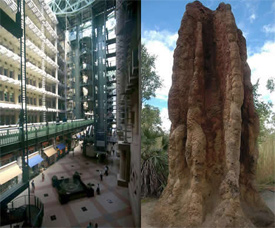
This extraordinary idea is partly responsible for what I referred to in Part One of this article as The Fallacy of Misplaced Concreteness. It leads us to consider not only the human organism as distinct from its surroundings, but it also forces us to separate human nature from its material artefacts. We understand the termite mound as integral to termite nature, but are quick to distinguish the axe, the wheel, the book, the skyscraper and the computer network from the human nature that bore them.
When we act, through art, religion or with the rational structures of science, to interface with the world our imitative (mimetic) capacity has both subjective and objective consequence. Our revelations, our ideas, stories and models have life only insofar as they have a material to become invested through. The religion of the dance, the stone circle and the summer solstice is mimetically different to the religion of the sermon and the scripture because the way it interfaces with the world is different.