by Joy Icayan
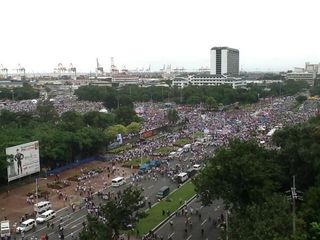
It’s a rainy morning in Manila, where sixty thousand people have converged in Luneta Park to protest against the misuse of the Priority Development Assistance Fund (PDAF), regular allocations to legislators amounting to millions in pesos. The protest, dubbed the Million People March is happening around the country with key rallies in all three major islands. It has materialized following a series of events. Whistleblowers surfaced two months ago accusing a certain Janet Napoles of spearheading the transfer of PDAF money (amounting to P10 billion pesos) over the course of many years towards fake NGOs and fake projects. A friend of Janet Napoles’ daughter leaked pictures of her Instagram account showcasing her lavish lifestyle: luxury cars, bags, shopping trips. Then just a week ago, the country was besieged by monsoon rains which caused intense flooding in the metro and nearby provinces. As always when this happens, residents blamed politicians for lack of flood control mechanisms. But this time, the anger had a new dimension to it – corruption, through the misuse of taxpayers’ money (PDAF) or more commonly called pork barrel, had been allocated not for public projects but to support the lives of the few rich.
Perhaps like any colonialized developing country, the Philippines’ history has been one of protests. From the Spanish colonization, to the American and the Japanese to the protests against our own governments, protests took on a form of slow quiet simmering before finally coming to the fore. During the declaration of Martial Law and its human rights violations, activists trooped to the streets, denouncing the government. The deaths and disappearances of many activists silenced many. It was the death of popular opposition leader Benigno Aquino that rallied everyone to go to EDSA to remove the current dictator in what would be termed People Power 1. They harnessed the same People Power to remove President Joseph Estrada, accused of plunder in 2001.