by Matt McKenna
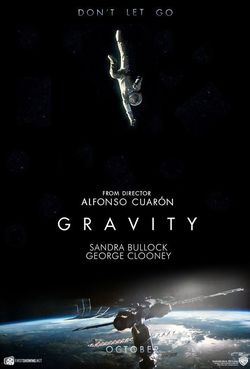
The film begins with light banter amongst astronauts performing repairs on the Hubble telescope until–and this isn't a spoiler if you've seen the trailer that plays out the film's inciting incident sans editing–a cloud of debris crashes into the venerable space structure to which the film's protagonists are unfortunately attached.
And so begins the ninety-one minute exploration of the United States' broken government by way of a floating Sandra Bullock and a jetpack-strapped George Clooney. While it is certainly possible to dismiss Gravity as nothing more than an interesting filmic experiment mixing a minimal cast into a vat of computer generated graphics, this interpretation misses Cuaron's carefully placed parallels (presciently laid out years ago) between Gravity's fictional reality up in space and our actual reality down on Earth.
Most obviously, the hurtling debris that serves the role of Gravity's antagonist-with-impeccable-timing represents the legion of discretionary appropriations that Congress failed to handle in a timely fashion. As the speeding space junk threatens every structure and person in the film, so too does America's unfunded discretionary programs threaten the integrity of the United States federal government and the welfare of the people subject to that government. Indeed, just as a solar panel traveling at tens of thousands of miles per hour will do irreparable damage the human body it slams into, so too will irreparable damage done to the human body that is unable to acquire adequate nourishment due to a lack of funding provided for discretionary programs such as the Supplemental Nutrition Program for Women, Infants, and Children.