by Huw Price
 I’ve known George Musser for many years – he’s one of the best science writers in the business. I’m delighted to have been a transmission vector, getting him thinking about my favourite case of (supposedly) pathological science, so-called cold fusion.
The infection spread like this. In April, George wrote an interesting piece on risk-aversion in science, ‘Risky Business: How Science Plays Things Too Safe’. He posted about it on BlueSky, and I responded with a link to a recent piece of my own. My essay, ‘Gatekeeping: a Partial History of Cold Fusion’, is co-authored with the physicists Jonah Messinger and Florian Metzler. It was intended for a special issue of the philosophy journal Synthese on gatekeeping in science, a topic closely connected to risk-aversion. Good gatekeepers need to be risk-averse – though not too much!
Messinger, Metzler and I described our piece like this.
One of the most public episodes of gatekeeping in modern science was the case of so-called ‘cold fusion’. At a news conference in 1989 the electrochemists Martin Fleischmann and Stanley Pons announced that they had found evidence of nuclear fusion in palladium electrodes loaded with deuterium. There was worldwide interest. Many groups sought to reproduce the results, most unsuccessfully. Within months, the prevailing view became strongly negative. The claims of Fleischmann and Pons came to be regarded as disreputable, as well as false. As the Caltech physicist David Goodstein put it, cold fusion became ‘a pariah field, cast out by the scientific establishment’ (Goodstein 1994). The case would already be interesting for students of gatekeeping if the story had ended at that point. Even more interestingly, however, the field survived and persisted. It has been enjoying a modest renaissance, with recent government funding both in the US and the EU. This piece offers an opinionated introduction to cold fusion as a case study of scientific gatekeeping, discussing both its early and recent history.
George wondered what a nice chap like me was doing in these shonk-infested waters (his attitude, my pun). He emailed me and suggested a chat. As he explains in his piece, I told him that my initial interest in cold fusion stemmed from the fact that it has a similar profile to catastrophic risks. The probability may be small, but the cost of a false negative – of wrongly dismissing the matter in question – could be very high. In this case, we might be missing a much-needed new source of carbon-free energy. Simple prudence gives us a reason to keep an open mind.
More on this prudential principle in a moment. For the case of cold fusion, George didn’t find it very plausible. Here’s his response.
I’m all for open-mindedness, but Price’s argument troubled me. There must be a thousand other anomalous phenomena that are as likely to be real as cold fusion and, if they are, to transform the world. Why focus on this one? The only reason we are talking about cold fusion at all is that we were lied to in 1989. The initial mistruth created a kind of psychological anchoring effect, causing us to entertain a possibility that we otherwise wouldn’t have. It is as if I said I saw Bigfoot in my backyard, then confessed I hadn’t, but people started holding annual cryptozoological conferences nearby anyway. I found it jarring that a deception could conjure an entire academic research program. How is this any different from the antivax movement, which also started with data that turned out to be faked and should have just packed up once that became known?
With this view of the history of cold fusion, it is easy to understand why George was puzzled. George thinks that gatekeeping for cold fusion was straightforward – it just turned out to be a pack of lies. But now it’s my turn to be puzzled. Our views of the history of the field are so different that one of us must know something that the other doesn’t.
At the beginning of our piece, Messinger, Metzler and I draw on the work of a Caltech physicist, the late David Goodstein (1939–2024). As we note, Goodstein was a Vice Provost at Caltech with responsibility for investigations of allegations of scientific fraud. He followed the cold fusion issue closely in its early years, and wrote about it in a wonderful 1994 essay, ‘Whatever Happened to Cold Fusion?’ Goodstein was in the unusual position of having friends and colleagues on both sides of the controversy. The version linked here is illustrated with his own photographs of some of them.
Goodstein’s 1994 essay became a chapter in his 2010 book, On Fact and Fraud: Cautionary Tales from the Front Lines of Science. Messinger, Metzler and I quote from the final paragraph of the chapter, where Goodstein says this:
Many mistakes were made on both sides of the great divide in the course of the cold fusion story, but they were honest errors, not examples of fraud.
Hence my puzzlement. It’s hard to square George’s talk of lies and deception with Goodstein’s verdict of ‘honest errors, not … fraud.’ (To be clear, Goodstein has plenty of other criticisms of Fleischmann and Pons, but he doesn’t think that they were liars or frauds.)
Even more puzzlingly, it is hard to reconcile George’s version of the history with some landmarks in the controversy in 1989. Apart from the original news conference, the most influential single event that year was the release of the report of a Panel convened by the US Department of Energy (DoE). The Panel was established to examine the claims of Fleischmann, Pons, and others, and make recommendations about future funding. Its report was regarded as strongly negative – it was a ‘killer commission’, as one of Fleischmann’s supporters put it.
The report makes three recommendations. The first advises ‘against the establishment of special programs or research centers to develop cold fusion.’ But the second and third are far from negative:
(2) The Panel is sympathetic toward modest support for carefully focused and cooperative experiments within the present funding system.
(3) The Panel recommends that the cold fusion research efforts in the area of heat production focus primarily on confirming or disproving reports of excess heat. Emphasis should be placed on calorimetry with closed systems and total gas recombination, use of alternative calorimetric methods, use of reasonably well characterized materials, exchange of materials between groups, and careful estimation of systematic and random errors. Cooperative experiments are encouraged to resolve some of the claims and counterclaims in calorimetry.
I wonder what’s going on here, in George’s version of the history? Had the DoE Panel not noticed that they had been lied to?
Of course, it is easy to find authors making these kinds of claims about cold fusion. They were also made in reverse. The most striking case of the latter involves another science writer, Dr Eugene Mallove (1947–2004). As Wikipedia tells the story:
Mallove taught science journalism at MIT and Boston University and was chief science writer at MIT’s news office, a position he left as part of a dispute with the school over cold fusion. Mallove resigned from MIT in 1991 because he said MIT was hiding cold fusion data, partly to protect funding for and reputation of traditional fusion research.
But George’s piece isn’t just telling us that such claims were made. It treats them as established fact. If there was good evidence for that view, it seems to have been missed both by Goodstein and the DoE Panel.
Why focus on this one?
This brings me to George’s question for me.
There must be a thousand other anomalous phenomena that are as likely to be real as cold fusion and, if they are, to transform the world. Why focus on this one?
Here are a few reasons, just running up to Fall 1989: a long history of work in this area, prior to Fleischmann and Pons; the reputation of Fleischmann, who was an FRS and one of the leading electrochemists of his day; the fact that physicists such as Schwinger, Lamb, and Teller (two Nobel Prizes and an H-Bomb between them) continued to favour an open mind, even after the events of 1989; and, again, the famously ‘negative’ DoE report itself, in the sense just noted. (All of these factors are discussed in my piece with Messinger and Metzler.)
George imagines ‘a thousand other anomalous phenomena that are as likely to be real as cold fusion’, but I wonder whether he can name even one where there’s this much of a case? If so, and if the potential cost of a false negative is comparable, then I’ll agree – my prudential argument works there, too. We should keep an open mind, and protect scientists willing to work on the issue in question from attacks on their reputation. We need some scientists willing to look for epistemic treasure in unlikely corners, and we should cheer not sneer at their efforts, as I once put it.
Risk and reputation
There are certainly some real-life examples on the other side of the ledger, where the transformative impact is strongly negative, rather than strongly positive. This brings me back to my reason for interest in cold fusion in the first place. As George says, it was linked to concerns about catastrophic risk. In Cambridge in 2012, with Martin Rees and Jaan Tallinn, I founded the Centre for the Study of Existential Risk (CSER). CSER aimed in particular to study possible novel risks of new technologies, such as AI and synthetic biology.
As Rees, Tallinn, and I were well aware, some of these concerns had a poor reputation. They were regarded as ‘a bit flakey’, as we put it at the time. We wanted to use the positive reputation of Cambridge and our distinguished advisors to give them a better image – to push them closer to the mainstream. We called this ‘reputational engineering’, and linked it to the topic of risk-aversion in science that George discusses in his recent piece. This explains how I came to be thinking about reputation in science, and the role it plays in deciding what questions get discussed.
This issue connects to the basic principle of risk management I mentioned earlier. The higher the cost of erroneous dismissal of a risk, the lower the proper threshold for taking it seriously. But epistemic thresholds tend to get policed in reputational terms. There’s an easy slide from improbable, to far-fetched, to crazy, and so on. That’s why we need to think about protecting reputation, where the prudential principle gives us good reason for taking low probabilities seriously.
Big Bang—Low Bar
The prudential principle doesn’t seem to have a catchy, descriptive name. By contrast, many people know the slogan ‘Correlation is not causation’, which can hence be used as a warning flag, alerting people to a common kind of error. The prudential principle needs a familiar, catchy slogan of that sort. Writing recently about some cases in which it is flagrantly disregarded, I called it Big Bang—Low Bar.
My targets in that piece were writers who dismiss claims of existential risk from AI, not by offering counter arguments, but by attacking the motives or reputation of the people making the claims. These writers included the editors of Nature. As I put it:
A recent Nature editorial urges us to ‘[s]top talking about tomorrow’s AI doomsday when AI poses risks today’. The piece concludes: ‘Fearmongering narratives about existential risks are not constructive. Serious discussion about actual risks, and action to contain them, are’.
In this context, ‘fearmongering’ is what philosophers call an epistemic slur. It doesn’t engage with its targets in any reasoned way, but simply insults them. It’s much like “Real men don’t need brakes!”, said to a cautious driver – except that in the AI case we’re all in the vehicle.
Nature should certainly have known better. The scientists they are dismissing include some of the leading experts in the field – including a BBC Reith Lecturer, no less! – and hundreds of others with relevant qualifications and experience. If I may be allowed an epistemic slur myself, dismissing such concerns as ‘fearmongering’, or ‘AI hype’, is simply bonkers – a reckless disregard of the fundamental principle of risk management.
Cold fusion again
 To bring things back to our present case, note that Big Bang—Low Bar is equally applicable to risks of missing something very good, as of encountering something very bad. As I put it in 3QD, in one of my early public pieces on cold fusion: ‘For hungry sailors, missing a passing island can be just as deadly as hitting an iceberg.’ Given the urgent need for carbon-free energy, we’re like those hungry sailors. So we need some sharp-eyed lookouts, and the reputational incentives we offer them need to be positive, not negative.
These issues about risk and reputation not only encouraged my interest in cold fusion. They were also my path to meeting some of its practitioners. CSER had a project called ‘Extreme Risk and the Culture of Science’. In 2017, we ran a workshop with scientists from various fields who felt that they themselves had been adversely affected by such attitudes, as well as philosophers of science interested in issues of gatekeeping and risk-aversion.
We called this meeting our Maverick Workshop. One of our mavericks was the late Alan Smith, a retired chemist with his own little lab in Essex, an hour from Cambridge, just inside the M25. He was well-connected in the cold fusion community, and later introduced me to others. In 2019, when the 30th anniversary of the Fleischmann and Pons news conference was approaching, Smith connected me to Mike McKubre. McKubre was one of the giants of the field, based at SRI in Palo Alto for many years.
By 2019 McKubre was semi-retired in his native New Zealand. I was on leave in my native Sydney, so I arranged to go and meet him. We timed the visit to coincide with the 30th anniversary. There were three meetings that month to mark the event: one at the Russian Academy of Natural Sciences in Moscow, one at MIT, and McKubre and I, with our wives, in a seafood restaurant in Napier, NZ.
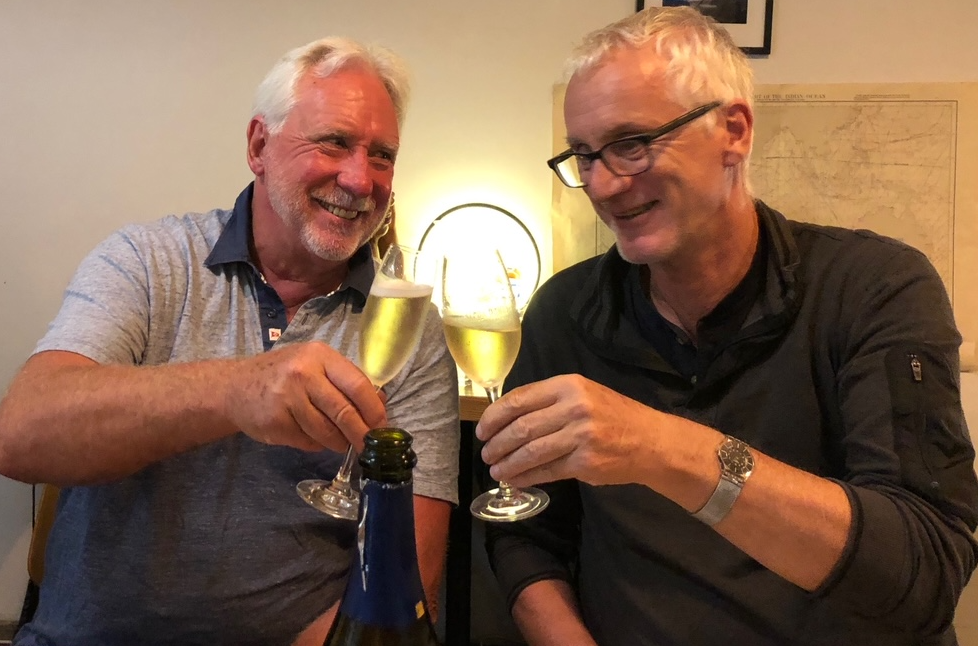
McKubre told me fascinating things about the history and current state of the field, and his own work. Without naming names, he said that several of the big tech companies had quiet programs, and that he himself acted as a scout for a well-known billionaire. I didn’t press him, but I assumed, then and afterwards, that he meant Bill Gates.
Google enters the chat
Some of these comments were dramatically confirmed, a couple of months later, when a now-famous Google program was announced with a paper in Nature. The program had been created by Matt Trevithick, whom George mentions in his piece, along with two Google engineers, David Fork and Ross Koningstein. In 2014 Fork and Koningstein had written about the need for new sources of carbon-free energy, and the program was a deliberate attempt to take a good look in some neglected corners. (McKubre later reported that he had been involved in initial discussions in 2014, but not since then.)
The Google program was a masterly piece of reputational engineering. As George quotes Trevithick as saying, it destigmatized the field. George was a little unfair to Trevithick and his colleagues, in failing to mention a major consequence of their program. In effect, Google provided reputational cover for several later government funding programs, both in the EU and the US. The US programs, first from ARPA-E and now from DARPA, were carefully designed to avoid mistakes of early work. Messinger, Metzler and I describe the ARPA-E program in our piece (the DARPA program being too recent to discuss there). Metzler and Messinger are themselves recipients of some of this funding, from both programs, in a team based at MIT.
The DARPA program is called ‘Mechanisms for Amplification of fusion Reaction Rates in Solids’ (MARRS). Here is some of DARPA’s own description of the justification.
Decades of hype and mismeasurement have resulted in skepticism of the near-term potential for achieving fusion at low temperatures (e.g., the “cold fusion” fiasco in 1989).
However, since 2023, multiple, independent research groups have shared evidence – both theoretical and experimental data … – showing solid state fusion rates radically higher (~1018) than predicted by earlier models. Rates are still very low in absolute terms but point to an area of exploration where meaningful progress may be made.
Concurrently, advances in measurement science now enable precise quantification of fusion rates, making it much easier to accurately assess experimental outcomes.
DARPA is funding MARRS as an opportunity to explore what amplification methods might be used to scale solid state fusion technology to useful rates for future applications of novel radiation sources in materials analysis and for power generation. …
If solid state fusion is successful, it is expected to enable small-scale (kilowatt- or megawatt-scale), small-footprint, distributed, mobile power generation; plasma fusion [‘hot fusion’] is anticipated to be better suited for large (gigawatt-scale), centralized power stations.
George quotes Trevithick’s figure of 28 peer-reviewed papers, downstream from the Google program. I believe that that tally does not include a remarkable recent piece in Nature Communications, a product of the ARPA-E program. This paper is the source of the figure of 1018 enhancement of fusion rates, in the MARRS passage above. Quoting from the abstract:
These results reveal a previously unrecognized regime of low-energy nuclear reactions in solids, demonstrating that materials degrees of freedom can fundamentally renormalize tunneling probabilities and fusion cross-sections.
It is too soon to say how much of early work on cold fusion will turn out to be validated by this new work. As Metzler et al point out, in a survey of possible enhancement mechanisms, much more than 1018 would be needed for measurable excess heat. If nothing else, however, this new work provides strong evidence that many of the dismissers in 1989 were simply wrong. There is interesting new science in this area. Schwinger, Lamb, and Teller turn out to have been right, in wanting to keep an open mind.
Reputational pathology
Finally, back to reputation. In my view, the real pathology in this history is not the science, but a gross over-expression of normal mechanisms of scientific reputation. The effect of this reputational pathology was to lock the topic away, where respectable folk weren’t allowed to think about it – in a ‘reputation trap’, as I once called it. The reputation trap imposes a cost on outsiders, if they talk to the people caught within it. Outsiders put their own reputations at risk, if they show anything less than disdain for the taboo topic. But it’s hard to have a conversation with someone if you feel you have to ask, in effect, ‘Tell me why you believe this crazy stuff?’
I don’t know for certain that George felt this pressure, but I would be surprised if he didn’t. I certainly felt it, at some points in my own connections with the field. George says he is ‘all for open-mindedness’, but he seemed to be wearing his reputational blinkers. He was very specific about the kind of people he wanted to meet – people who were knowledgeable about the field, without being too ‘enthusiastic’. My co-authors didn’t pass this test, apparently.
To be clear, reputation plays an important role in science, and it isn’t all pathological. Far from it, this is an exceptional case. But one of the ways in which it is exceptional turns on Big Bang—Low Bar. Where a lot is at stake, science needs to be especially careful that these reputational factors are properly managed. That’s the test I take to have been failed by some influential actors in 1989, including Nature and the DoE Panel. Properly managed, cold fusion would have become an interesting corner, a perfectly respectable place to dabble. It wouldn’t have needed destigmatizing, and George wouldn’t have felt any reputational pressure, decades later, to avoid its practitioners.
As Messinger, Metzler and I point out, the DoE Panel seems to have been confused about what question needed answering. It asked whether there was convincing evidence for a positive verdict, and concluded that there was not.
[T]he Panel concludes that the experimental results of excess heat from calorimetric cells reported to date do not present convincing evidence that useful sources of energy will result from the phenomena attributed to cold fusion.
But given the potential cost of a false negative, this was the wrong question. The Panel should have asked whether there was convincing evidence for a negative – convincing evidence that the effect was not real. It doesn’t ask that question explicitly, but its answer is implicit in the modestly positive recommendations quoted above. It deliberately leaves the door ajar.
In the light of this, we can imagine a nearby universe in which the DoE report ended in a different way. This is from the conclusion of DARPA’s presentation of the current MARRS program.
The potential benefits of achieving solid state fusion are so high that knowing for sure if there is a “there” there or not is critical to national security.
This statement doesn’t go beyond the two positive recommendations of the DoE report, except that it takes a stand on why the questions matter. If the DoE Panel had had a clearer sense of its own responsibilities, it could have added something like this, using its authority to steer the field towards a middle path. As a first step on that path, it might also have asked, with Schwinger, Lamb, and Teller, whether there are mechanisms that might enhance fusion rates in solids. These were missed opportunities, even without the benefits of hindsight.
We don’t yet know what difference these missed opportunities will turn out to have made, in the long run. If recent results hold up, the options range between (i) delaying some interesting but practically inconsequential new physics, and (ii) delaying a new clean energy technology, when it was critically needed. Either way, the case will be fascinating for students of gatekeeping, as Messinger, Metzler and I explain.
Playing things too safe
George Musser misses much of this story, which would be hard to square with his caricature of the early history of the field. His piece on risk-aversion in science – the one that got us into this – is called ‘Risky Business: How Science Plays Things Too Safe’. In the case of cold fusion, it’s he himself who plays things too safe. Deriding the field as lies and deception, he goes out on a limb in the direction of (seeming) reputational safety. But he talked to the man who chopped that limb off. If he’d talked to my co-authors, too, he could have had an insider’s view of the new growth sprouting in its place.