
by Carlota Figueroa
Hold your thumb up in front of your face (go on, nobody’s watching). In the second it took you to do that, around 65 billion neutrinos flew straight through your thumbnail. If we consider your whole body instead, that number goes up to 100 trillion every second, every hour of the day. Most of these neutrinos come from the core of the Sun, and after sunset they simply come up through the floor, having crossed the entire planet to reach you. I know, that sounds very freaky: there’s a bunch of particles you probably didn’t know about going through you every moment. Don’t worry, they’re harmless. In fact, virtually none of them will even notice you: to have a decent chance of stopping just one, you’d need a wall of lead light-years thick.
No wonder they’re nicknamed ghost particles, or that catching one is so absurdly hard. The attempt that finally worked involved freezing over 5,000 light sensors into a cubic kilometer of Antarctic ice and waiting. On October 6, that idea won Francis Halzen, the Belgian-American physicist who first pitched it with a colleague back in 1988, the 2026 Nobel Prize in Physics, for his role in building the IceCube Neutrino Observatory and “the discovery of high-energy neutrinos of astrophysical origin.”
You might think I’m a couple of months late to the party, but Halzen only receives his prize in Stockholm on December 10, so I’m actually right on time for the ceremony. Besides, I wouldn’t be able to consider myself a respectable physicist if I didn’t talk about this year’s Nobel Prize. On top of this, all of my research experiences so far have focused on calibrating particle physics detectors, so this piece is doubly special.
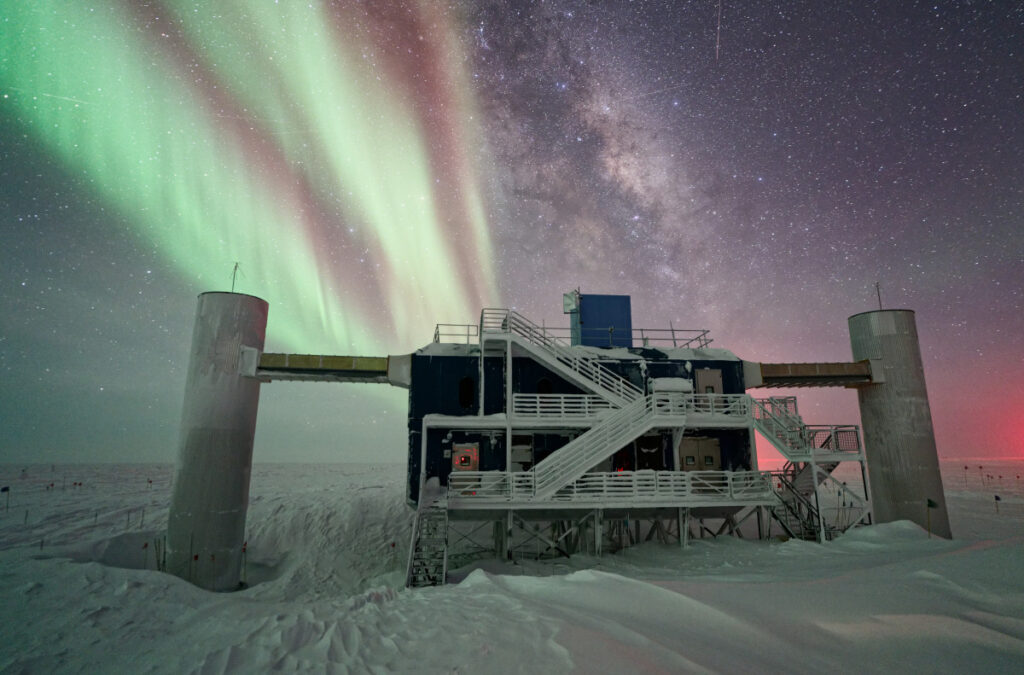
To see why IceCube is such a big deal, let’s follow one of these ghosts from a distant galaxy all the way to the bottom of the world. By the time it lights up the ice, we’ll have met nearly the entire cast of particle physics: it turns out you need almost all of them to explain one single flash of blue light.
Let’s start with something much less elusive: an ice cube. Zoom in far enough and you’ll find water molecules. Zoom into one of their atoms and it turns out to be almost entirely empty space: a cloud of electrons around a nucleus so small that, if the atom were a football stadium, the nucleus would be a pea on the center spot. But we don’t have to stop zooming here: we can go deeper.
Inside the nucleus are protons and neutrons, and for decades that’s where the story ended. Then, in 1964, Murray Gell-Mann and George Zweig independently proposed that protons and neutrons were each made of three smaller particles. Zweig called them aces, and Gell-Mann had a nonsense word in mind, pronounced “kwork,” for which he later found the perfect spelling in a line of James Joyce’s Finnegans Wake that happens to mention three quarks, exactly the number you need to build a proton! You can probably guess which name won (just look at the name of this magazine).
A proton is two up quarks and a down quark, and a neutron is two downs and an up. Up quarks carry an electric charge of +2/3 and down quarks −1/3, adding up to exactly +1 for the proton and 0 for the neutron. Add electrons and that’s the whole recipe: everything you’ve ever touched is made of just these three ingredients. Note that four heavier, short-lived quarks exist too (charm, strange, top and bottom), but they aren’t relevant to our phantom story, so I won’t go into more depth.
But this tidy picture has a crack in it: some nuclei don’t stay put. Nuclei take Heraclitus’s quote “No man ever steps in the same river twice, for it’s not the same river and he’s not the same man” a little too literally. In beta decay, a nucleus spits out an electron and becomes a different element because, deep inside, a neutron has turned into a proton (one of its down quarks has become an up). The problem was that when physicists in the 1920s measured the energy of those electrons, the numbers didn’t add up.
Here’s what should have happened. If a nucleus simply splits into a new nucleus and an electron, conservation of energy and momentum fix exactly how fast the electron flies out, just like they fix how fast a cannonball leaves a cannon. This should make sense intuitively: same decay, same split, so electrons should come out with the same energy every single time. Instead, the electrons came out with a whole spread of energies, almost always less than expected, as if some energy were quietly vanishing. Things got so bad that Niels Bohr himself floated the idea that energy might only be conserved on average — what a sacrilegious statement!
We now introduce our friend Wolfgang Pauli (or reintroduce, if you read my spin column). In December 1930, he wrote an open letter to a physics meeting in Tübingen, opening with “Dear Radioactive Ladies and Gentlemen,” and proposing what he called a desperate remedy: a third, invisible particle, electrically neutral and extremely light, escaping the decay with the missing energy. He skipped the meeting itself: he had a ball to attend in Zurich, but, this being Pauli, he’d earned the right to just send a letter. A few years later, Enrico Fermi built the first real theory of beta decay around it and named our ghost the neutrino, Italian for “little neutral one.” In today’s terms, at the quark level, the down quark becomes an up, releasing an electron and an antineutrino (the neutrino’s antimatter twin, and no, this isn’t a sci-fi novel: every particle truly has its antiparticle pair, but we’re going to draw a veil over this for now).
And the electron has a family too! In 1936, physicists studying cosmic rays found the muon: a fundamental particle just like an electron, but about 207 times heavier and gone in two millionths of a second. Nobody could figure out what it was for, prompting Isidor Rabi’s famous “Who ordered that?” In 1975, an even heavier cousin showed up, the tau, and each of the three comes with its own neutrino. These six particles are the leptons, and together with the six quarks, they’re every matter particle we know of (at least up to the date this article is being written).
So by the mid-1930s, most physicists believed in the neutrino, but actually catching one would take until 1956. To see why, we need a more basic question: how does any particle notice another one at all?
Turns out, they notice each other by exchanging messenger particles: picture two ice skaters pushing each other apart by tossing a heavy ball back and forth, without ever touching. Each force has its own messenger, which only talks to particles carrying a specific kind of charge.
Electromagnetism is carried by the photon, which only talks to particles with electric charge: quarks and electrons, yes, but neutrinos, no. The strong force is carried by gluons (they glue quarks together, hence the name), which only talk to particles with color charge, a label that has nothing to do with actual color (yeah, physicists don’t always choose the most fitting names). Quarks have it but electrons and neutrinos don’t.
Then there’s the weak force, carried by the W and Z bosons. It’s the only force that can turn one kind of particle into another (it’s what turned that down quark into an up in our beta decay), and it talks to every matter particle there is. It’s weak because its messengers are absurdly heavy, nearly a hundred times the mass of a proton, so their range is ridiculously small: about a thousandth of a proton’s width. Add the Higgs boson, whose field gives these particles their mass, and the Standard Model’s cast is complete. And here is an Easter egg for my loyal readers who read my spin piece: every matter particle is a fermion, every messenger a boson!
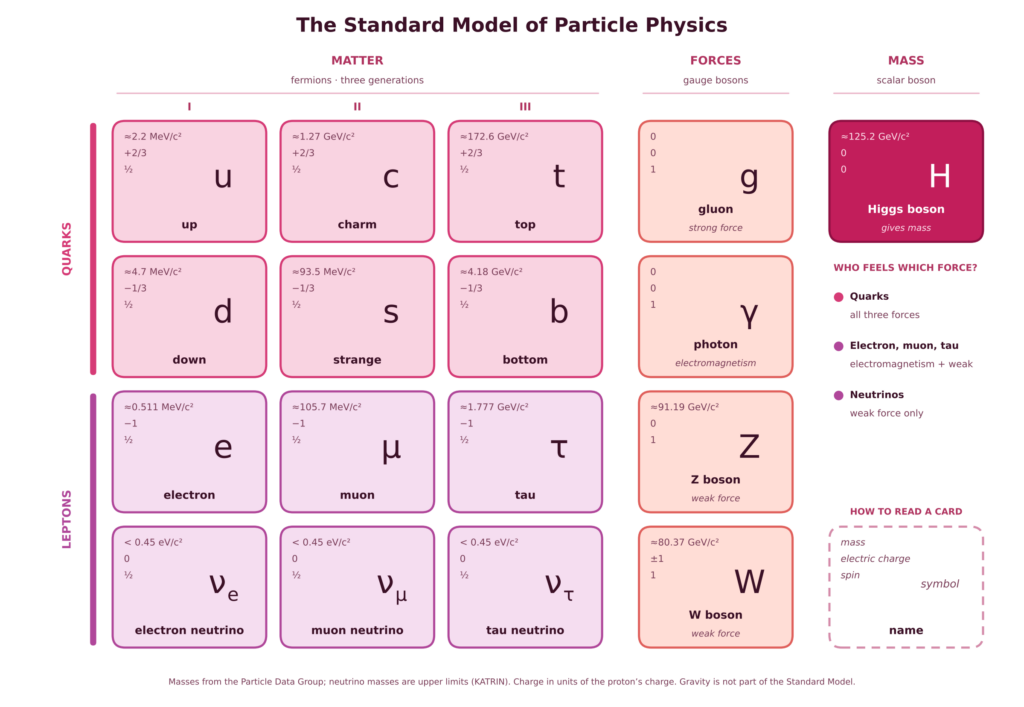
Now look at the neutrino: no electric charge, so photons ignore it. No color, so gluons ignore it. All it feels is the weak force (and gravity, far too feeble to matter here), so it only interacts if it passes within that minuscule range of a quark or an electron. Since atoms are mostly empty space, it almost never does. Hence the light-years of lead needed to stop it.
But weak doesn’t mean never: it means rare, and the way to beat rare is with numbers. In 1956, Clyde Cowan and Frederick Reines set up tanks of water next to a nuclear reactor in South Carolina, which pours out a flood of antineutrinos, and caught a few every hour. They telegrammed Pauli the news, and he replied that everything comes to those who know how to wait. Catching the rarest, most energetic neutrinos from deep space, though, would take something much, much bigger.
The catch is that the most interesting cosmic neutrinos, the ones with enormous energies, are rare, and nearly all of them sail straight through whatever you put in their way. To catch even a handful a year, you need a target about a kilometer across, and nobody can build a cubic-kilometer tank. Halzen’s idea was not to build one at all: the South Pole sits on nearly three kilometers of ice that is clear, dark, stable and, crucially, already there.
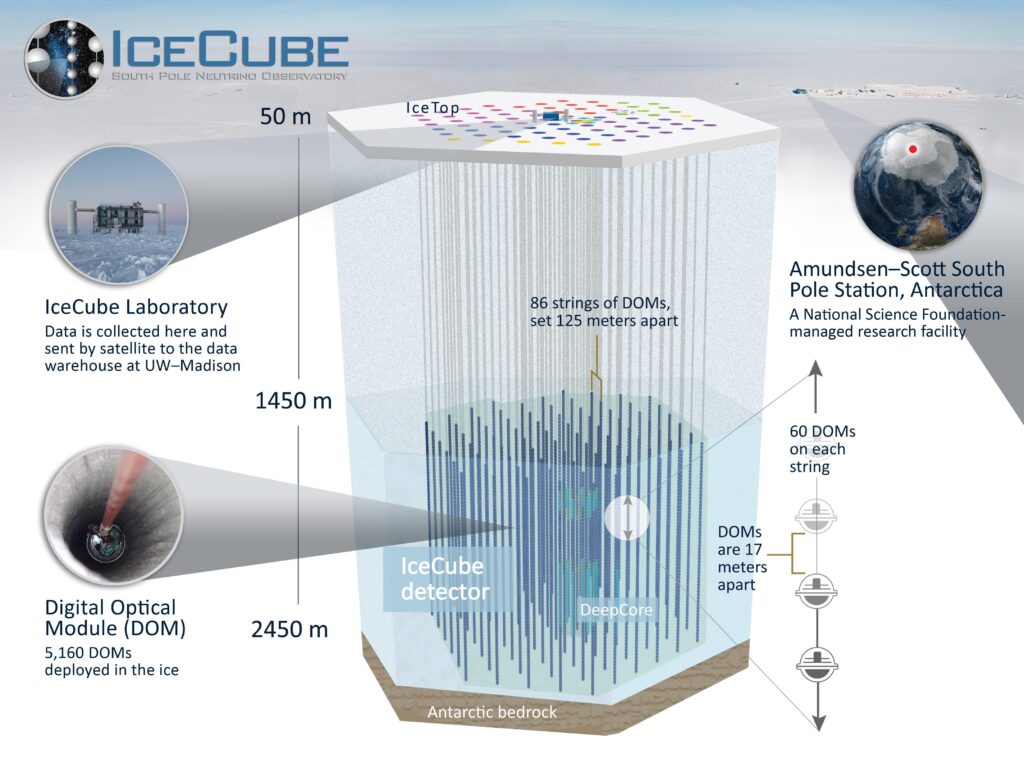
The first prototype, AMANDA, went in during the 1993–1994 Antarctic summer and hit its first obstacle: less than a kilometer down, the ice was still full of tiny air bubbles that scattered the light hopelessly. The fix was to go deeper, where the pressure squeezes the bubbles into crystals that barely scatter at all. Between 2004 and 2010, a hot-water drill melted 86 holes into the ice, and into each went a string of sensors, hung between 1,450 and 2,450 meters down before the water froze around them for good: 5,160 glass spheres, each holding a photomultiplier tube that can register single particles of light.
Now, our ghost. Say a muon neutrino that has crossed the universe for billions of years finally passes close enough to a down quark in the ice. A W boson is exchanged, the down quark becomes an up, and the neutrino becomes a muon.
The muon shoots off at nearly the speed of light, which is faster than light itself travels in ice. This may sound counterintuitive: how is light going to travel at a speed slower than the speed of light? Well, the speed of light is defined based on light traveling through a vacuum, where there are no particles to interact with. However, add a medium (and hence particles), and suddenly light travels slower. Roughly speaking, it’s the same thing as if you run on a track and then try to run in the sea — you’re clearly slower in water. A charged particle outrunning light leaves behind a cone of faint blue glow called Cherenkov radiation, the optical version of a sonic boom. By timing when the light reaches each sensor, to within billionths of a second, IceCube can reconstruct the muon’s direction to about a degree. Last summer I worked on the trigger for cameras built from the same kind of tubes, for telescopes that hunt Cherenkov flashes in the atmosphere, so this is my favorite part.
One last trick: cosmic rays shower IceCube with muons from above, roughly a million for every neutrino it catches, so IceCube often looks down, through the planet, since nothing but a neutrino can cross the entire Earth without being absorbed. Then, in 2013, IceCube reported two events of about a thousand trillion electronvolts each, almost certainly too energetic to have come from our atmosphere, nicknamed Bert and Ernie. Along with a couple dozen others, they were the first evidence of high-energy neutrinos from beyond our solar system.
That streak of light isn’t just a trophy: it’s an arrow. Cosmic rays, the protons and nuclei that constantly rain down on Earth, can arrive with over 10 million times the energy of the protons in CERN’s Large Hadron Collider, and we still don’t know for sure what accelerates the most energetic ones. Being charged, they get bent by magnetic fields in space, which scrambles their arrival directions. Neutrinos, being neutral and antisocial, fly straight from wherever they were born. And since the highest-energy ones are made when accelerated protons smash into gas or light near their source, find a neutrino source, and you’ve found a cosmic particle accelerator!
On September 22, 2017, IceCube caught a neutrino of about 290 trillion electronvolts and sent out an alert within a minute. Telescopes worldwide turned to that patch of sky, and NASA’s Fermi satellite spotted a flaring blazar there, TXS 0506+056: a galaxy about 4 billion light-years away whose supermassive black hole fires a jet almost straight at us. In 2022 came a steadier source, the active galaxy NGC 1068, and in 2023, the first picture of our own Milky Way drawn in neutrinos instead of light. No wonder the Nobel committee’s chair said Halzen paved the way for “a new kind of astronomy.”
And yet, the particle that opened this window is also the one that cracks our best theory.
When the Standard Model was written down in the 1970s, neutrinos had exactly zero mass. Then, around the turn of the millennium, experiments in Japan and Canada caught them changing flavor mid-flight, which is only possible if they have mass (that one earned the 2015 Nobel Prize). They’re at least a million times lighter than the electron, and nobody knows why. Add dark matter, the mystery of why the Big Bang left behind matter but almost no antimatter, and gravity, which still refuses to join the party, and our beautiful model is clearly unfinished.
By the time you finish this article, roughly 50 quadrillion neutrinos will have passed through you. The ones crossing you right now left the core of the Sun about eight minutes ago, maybe around the time when you started reading, while the energy in today’s sunlight spent many thousands of years bouncing its way out of that same core. Ghosts, it turns out, are the only messengers that reach us straight from the heart of a star, or from a black hole’s jet 4 billion light-years away. All it took to start listening was a cubic kilometer of ice, and a physicist stubborn enough to wait.
Enjoying the content on 3QD? Help keep us going by donating now.