
by Anton Cebalo

Like any literary form, history-writing has its own genres. There are heroic stories, gothic, satirical, comedic, romantic, folk, great epics that span civilizations, and, of course, tragedies.
Tragedy is the most difficult one to effectively tell. This is because its arc fully reveals itself to us much too late. The tragic form—most ominous and foreboding when the story is at its climax—is nearly invisible during prosperous times. Historical narratives therefore have to look backward and excavate otherwise invisible fragments that hint at fate. For example, the Roman historian Polybius could not have understood how prophetic his recollection of Carthage burning would be. As general Scipio Aemilianus told him, which now reads as pure tragedy: “A glorious moment, Polybius; but I have a dread foreboding that some day the same doom will be pronounced on my own country.”
Because historical tragedy is backward-looking, the contemporaries who speak of it are often not found in the obvious historical record. Rather, the necessary material exists in the world of fiction, private correspondences, autobiographies, and dramas that play out in passing. To speak of historical tragedy is to also enter the world of conjecture, anecdotes, hunches, and forewarnings alongside vanity, hubris, and other immeasurable human qualities that together, in all their odd combinations, make a fall possible.
Russia, for example, found one of its most influential tragic voices in the early 19th century, the philosopher Pyotr Chaadayev. Recognizing the uneven social climate that pervaded his country, and how their struggle out of backwardness would elevate suffering to “prove themselves” to the world, he viewed Russia’s role as acting out this sad story. He wrote:
We are an exception among people. We belong to those who are not an integral part of humanity but exist only to teach the world some type of great lesson.
For only these words, Chaadaev was deemed insane and put under medical supervision by the Czarist government. He died in relative obscurity. After all, Czarist Russia had only begun to modernize, and the state thought now was not the time to speak ill of the future not yet realized.
Chaadayev would enjoy two waves of posthumous rediscovery, both times precipitating falls: In 1905, as Russia suffered a catastrophic defeat to Japan, foreshadowing the later overthrow of the Czar; and in the late 1970s, when intellectuals reread his words under the stupefying and slow-moving decline of Brezhnev’s Soviet premiership. Chaadayev would have undoubtedly been surprised that his tragic words found life not once, but twice, and possibly now a third time under Putin’s reign.
In another tragic historical narrative, the historian William Appleman Williams turned his attention to the United States. The Tragedy of American Diplomacy (1959) begins with a definition, taken from philosopher Karl Jaspers’s treatise Tragedy Is Not Enough (1947). To explain America, Williams saw in Jaspers, who was addressing the moral failings of postwar Europe, a guide for understanding history.
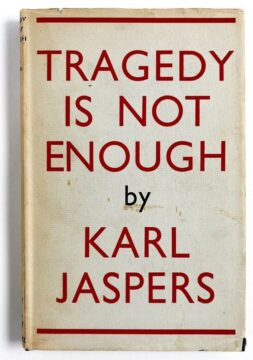 Jaspers believed that genuine tragedy comes only in those moments of destruction that “grow out of success itself.” Life is not irrevocably ruined by these failings; they can instead produce transcendence. Speaking to a ruined continent, Jaspers wrote that to exist only in tragedy is to be left “distracted, drifting, falling into nothingness.” Tragedy must deliver a new understanding, otherwise it is just empty sentimentalism. He wrote:
Breakdown and failure reveal the true nature of things. In failure, life’s reality is not lost; on the contrary, here it makes itself wholly and decisively felt. There is no tragedy without transcendence.
Williams presents modern American history through the prism of transcending tragedy. In his telling, there are flashing moments where otherwise good intentions undo the better end they could meet. American tragedy comes out of the successes of the open door policy that allowed its exports to dominate the world; these exports then formed a moneyed class that demanded more, integrating itself with political objectives; the imperial ends became synonymous with national ends; and the tragedy plays out, not as an aberration of the ideals, but made possible by their very success.
The trap for many critical writers is believing tragedy is enough and reveling in fatalism. Williams instead took the genre as a means of imagining other possibilities. Almost 70 years after the book was published, the tragedy has hardened. U.S. politics has repeatedly rejected lessons that would make its story redeeming, and the state is crippled by domestic dysfunction and behavior abroad that resembles angry paroxysms over its decline. Late in his life, Williams felt the past had not been understood. Rather than tragedy, he turned to themes of terror and horror to better describe America’s military adventurism.