
by Bill Murray
 Donald Trump’s lame duck-hood means two years of danger for the United States. Very little about the second Trump administration has been conventional, and there’s no reason to expect its end will be, either. The final two years could be turbulent, and we have good reason to remain vigilant throughout them. Here’s why.
When their second midterms conclude, presidents enter a period when their political authority begins to diminish, even as the temptation to exercise the power they have left to secure a legacy increases. A conventional lame-duckhood involves the gradual loss of patronage, political leverage, influence and attention. Trump is unlikely to yield those (especially attention) without a fight. MAGA is an unusually personalized movement led by a man who thrives in the limelight. But while he works to keep attention on himself, might a consequential number of other actors reject the legitimacy of the transition—with or without his complicity? What happens if they do?
Meanwhile, members of Congress and others will increasingly be calculating the cost or benefit to their own lives and careers of supporting policies that may live past Inauguration Day, 2029, even as the president retains his ability (and demonstrated inclination) to act unilaterally. This is a potentially unstable combination, especially with a new post-midterm White House chief of staff described as ‘a wartime consigliere,’ ‘the ideological id of the MAGA movement’ and a ‘flamethrower.’
A scant few months from now, in spring 2027, prospective successors will begin to declare their candidacies to replace Trump, bringing his impending departure into immediate focus, and setting a highly personalized political apparatus against an intra-Republican succession struggle. This all points to potential conflict ahead, exacerbated and further strained by a complicated international environment, in which the president, again in his highly personalized way, has effectively switched the country’s alliances in midstream.
•
Domestically, we’ve already seen the president’s powerful drive to establish a physical legacy that will live on beyond his tenure as president. As he approaches the end of his term, he is likely to only get more ambitious (Trees of the District, beware!).
Internationally, Trump is probably interested in securing a more metaphorical landmark, some sort of dramatic diplomatic agreement before leaving office, and perhaps less inclined than most to consider the good of the country in order to get it.
He may seek to hasten deals, finalize regulations, make appointments and otherwise lock things into place—to establish facts on the ground before his successor takes the helm.
In general, claims of institutional independence and presidential authority—always expansive during the Trump administration—are likely to escalate and could become matters of sustained conflict between the incoming administration and Trump/MAGA loyalists.
Some may argue that after his comprehensive defeat in the midterms just past, the fire has gone out of Trump’s desire to stay on. We’ll see. But suppose Trump believes that his power and the movement he created should remain under his personal control even as he leaves office. Suppose he might not want to leave office at all.
We don’t have to suppose; we know damned well that this is a president who will take a Qatari jet for his own (sorry: for his foundation’s own), to have and to hold forever. It’s a president who plans to remain the leader for life of his pay-to-play ‘Board of Peace.’ And who has even arranged immunity in advance from the Supreme Court. THAT was a neat trick.
Might he impede the transition procedure? There is precedent.
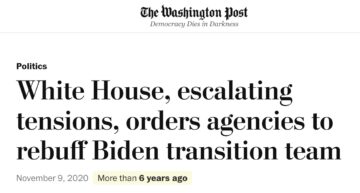
In 2020–21 he didn’t just disrupt the transition, or complain about election results; he attempted to overturn them. So we ought not assume an orderly transfer of power merely because the law mandates it.
In late 2028, Trump could challenge the way the election just past was run. He could explore federal intervention into state functions. He will certainly question outcomes that don’t suit him. (“I just want to find 11,780 votes….”)
Or, if a Republican wins, he’ll surely seek to retain power behind the throne. And if we’ve learned one thing from the staffing of his second administration, it’s that the well of useful stooges willing to help him is just about bottomless.
Even should Trump ultimately decide to fade gently into a spreading orange sunset, the next two years could be anything but orderly. A repeat of the January 6, 2021, insurrection attempt is not the only danger; there’s another that could be just as perilous.
•
Trump, like all modern presidents, operates in a crowded universe of organizations, fund-raisers, interest and advocacy groups, wealthy patrons (especially wealthy patrons), state governments and their politicians, charities, political activists, and, somewhere in the Trump milieu, probably even pardon brokers. In an acute challenge, some of these will remain accountable to Trump, but others will have their own interests.
With each of the 750 days between January 1, 2027 and Inauguration Day 2029, adherents and acolytes alike will become more self-driven, more insistent that Trump attend to their individual concerns and more determined to preserve their sinecure or cause, in order that the decline of Trump’s personal influence need not lead to the decline of the MAGA movement. What Trump created as a means to the presidency has become, for them, a movement in which they they are now invested. The president may lose control of some of those determined to keep him in power (or their careers intact). And he might welcome any disruption they cause.
Potential troublemakers abound. Some will view a new administration as a threat to what, under MAGA’s wing and cover, they have built. Call this the Russell Vought/ideologue wing, comprising the revamped and ready-to-rumble Heritage Foundation, the Claremont Institute and some of the characters in Laura K. Field’s Furious Minds.
Appointees, activists, donors, entrepreneurs and people close to Trump-friendly media and think tanks now have stakes in the political order. Claremonters, post-liberals, national- and paleoconservatives may view a Democratic victory not merely as defeat but as a deadly threat to their unfinished project. They will have both ideological and practical reasons to salvage what they can.
As director of the Office of Management and Budget and a primary architect of Project 2025, Vought has been more influential, and has put more radical ideas into play than most. Will he want to stand down from his revolution-in-progress?
Elon Musk has already spent more on campaigns than any human in history. He has shown his personal control over Ukraine’s fate—and been responsible for deaths—through his commercial enterprises. He wields a world-leading channel for propaganda. Will he want to stop?
These are dramatic examples, but others in and close to administrations always move to protect what they can, their livelihoods, their pet projects. In every outgoing administration, a cadre of elected officials, political appointees, contractors and influence-peddling private individuals fear the new boss might endanger their jobs. Call these the self-preservationists.
The Trump administration’s unusual levels of alleged corruption raise an additional incentive to resist a new administration: the prospect of subpoenas, public exposure, disgrace or expensive litigation. Some may also fear the loss of an identity built around MAGA.
And it’s not just federal officials. Ambitious elected MAGA Republicans at the state level could conclude that accepting the 2028 election results would alienate their most fervent supporters and could, without coordination or instructions from above, challenge election certifications or amplify local claims of voting irregularities, thinking such actions would preserve, or even enhance, their political futures.
More ideological members of the public might object in principle to rule by the Democratic Party. Some might regard themselves as patriots; some could be nothing more than simple anarchists.
The truest MAGA zealots, mostly found on the streets, will surely regard the coming metaphorical end of days as the end of days, a political emergency that calls for breaking glass to take extraordinary action.
Which could develop momentum of its own. Imagine that a substantial 2028 defeat prompts Trump to cry voter fraud. Certain supporters might take that as a mandate to contest the results even without instructions to do so.
When Trump was finally prevailed upon to tell the January 6, 2021, rioters to leave the Capitol, most complied. There is no guarantee the next generation of militants would.
•
We’ve all heard the adage that ‘it wouldn’t have gotten to the president’s desk if it weren’t a hard problem.’ Trump can cancel a live execution, but can he—will he even want to—insert himself into heated ideological fights among his hardest core MAGA supporters? Despite his “you’re fired” show-business persona, it’s said that the president has trouble grappling with personnel issues, firing people by tweet, for example.
The groups most committed to preserving Trump’s legacy could prove the most resistant to any White House compromise. For factions that depend on conflict, accommodation may look like betrayal. Independent actors, without coordinated goals, could reinforce one another’s actions and produce a turbulent or even violent transition.
•
During a September 2020, presidential debate with Joe Biden, Trump addressed the far-right extremist group the Proud Boys with the words:
“Proud Boys, stand back and stand by.”
Alongside pride in their white supremacy and their violence-prone street-fighting mien, the Proud Boys celebrated that recognition and made “Stand Back and Stand By” a part of their online messaging and merchandise:

Completely unsettling.
Note the canny verbiage. Trump did not command his wannabe militia to ‘stand down.’ He only asked them to ‘stand by’ for further action as needed. It’s a good bet that if called upon in the future, some Proud Boys would respond that they’d stayed ready. It remains to be seen if they will all stand by for a summons from the president.
If scattered Proud Boys initiated confrontations in different states, officials could face simultaneous disputes, each governed by a different enforcement procedure. Trump has encouraged federal intervention in areas like elections, traditionally left to states, in the past, and there is congressional testimony that his new chief of staff has advocated invoking the Insurrection Act, which gives the president authority to deploy federal troops on American soil.
Such a scenario, involving post-election violence in the wake of different state-administered elections, each of which has its own rules and procedures, might have a domino effect, involving legislatures and citizen groups, bringing in the courts, political advocacy groups, activists and individuals. Opportunists could be all too willingly drawn in.
In a national crisis like that the White House might be tempted to intervene with the Insurrection Act, to call for everyone to cool off while, say, it seized ballot boxes.
Any such scenario might involve not just the normal political confrontation between outgoing Republicans and incoming Democrats, but could be complicated by competition between the hardest-core MAGA factions that each claim to be the movement’s authentic continuation, with one faction demonstrating its commitment to the cause through escalation, prompting another to go even further.
Cumulative escalation may seem far-fetched; let’s hope it is. But all these scenarios, combined with President Trump’s attempt to overturn the 2020 election, make it imperative to watch closely over America’s commitment to democracy every day of the next two years.
***
I write more like this every week at Common Sense and Whiskey on Substack.
Enjoying the content on 3QD? Help keep us going by donating now.