
by Steve Szilagyi

Yeah, we like our fictional detectives to outsmart the killer. But sometime, smart isn’t enough. Sometime, you have to out-stupid them. That’s where Rebecca West messed up. She was one of the smartest people in the world. But when she came up against accused killer Brian Donald Hume and his defense team – she just wasn’t stupid enough.
The whole thing started out on the Essex marshes, where England runs out into the North Sea. It’s miles of flat swamp out there. One day in 1949, a single-engine plane flew over. A package fell from the plane into the water. Not long after, there was a fisherman out there. He was a decent man with an extended family living in a shack in the swamp. He spotted a suitcase-sized package in the reeds. He poled his flat boat over there, picked up the package and took it to a dry patch. “What could it be?” he wondered as he unbound the waterproof wrapping. We can only imagine the symphony of sensations as he de-puzzled what lay before him.
It was a human torso with the head and legs cut-off. Who would do such a thing? Probably some criminal mastermind who bumped people off and used his private air force to dump the evidence in the ocean. Or not. Because, while whoever put this neat package together did a good job of removing the head and legs, he forgot to take off the arms. And arms have hands. And hands have fingerprints.
So it wasn’t too much trouble for the police to identify the victim as Stan “the Spiv” Setty – a black-market kingpin in London’s then-seedy Fitzrovia district.
Yeah, the British won the war. But three years later, you couldn’t buy a lot of things. The government was still rationing. Crooks sold contraband goods. In “Spiv” Setty’s case, it was imported automobiles.
When the cops finished with Setty’s fingers, they started looking at his associates – zeroing in on one in particular. Brian Donald Hume. This fellow lived in Golder’s Green. He had a wife, a baby daughter, and a dog named Tony (remember Tony. He comes back). A former communist, Hume moved back and forth between legitimate business and black market jiggery-pokery. He was a skilled mechanic. That made him useful for a bloke like Setty who sold cars. But what really made him interesting to the police was this: Hume had a pilot’s license.
Oh but there was more. He’d taken a cab out an airport and rented a plane. Three times. Shortly after Setty disappeared. And he’d paid the cab driver with a five-pound note with a serial number that matched a load of cash the victim had withdrawn from the bank the day he disappeared. Airport personnel reported that Hume loaded packages onto the planes he’d rented. And there was even more to discuss after the cops searched his apartment ….
Hume was arrested and interrogated. At first it was sort of like:
“Sure, I rented a plane that day. So what? I didn’t have any packages on board.”
“We dunno,” the cops said. “Guy who rented you the plane said you took three packages on three separate flights.”
“All right, I had a few packages. But I didn’t drop them anywhere.”
“Airport fellow said the packages were gone when you came back.”
“Okay, maybe I dropped them out of the plane. But they weren’t mine.”
“Where did you get them?”
“Uh, three mysterious guys hauled them up the stairs and dropped them off at my flat. Paid me to get rid of them. Cash – including the five-pounder I paid the cabbie with.”
“What did you think was in in those packages?”
“Counterfeit petrol ration cards and that sort of thing.”
“Couldn’t you tell they contained the parts of a dead body?”
“Well, one of the packages made a kind of gurgling noise as I hauled it downstairs. But I couldn’t be sure.”
“Why didn’t you report it to the police?”
“I was scared. These three guys were scary. In any case, I didn’t kill anybody. Not me.”
“Of course not, Mr. Hume,” the police put on their rumpled raincoats, and started for the door. “Oh, and one more thing …”
“Yes?”
“What about that huge puddle of blood on your living room floor?”
So, in addition to the airplane and the five-pound note, the Crown’s case against Hume came to hinge on these four facts:
- A substantial quantity of blood matching the victim’s blood type, soaked into the floor boards of Hume’s flat.
- Shortly after the presumed time of the murder, Hume took his living room rug to the local cleaners and asked them to wash out the stains.
- Around the time the corpse would have been dismembered, Hume brought a carving knife to a nearby shop to be sharpened.
- Hume’s wife, charwoman and neighbors couldn’t recall any “three strange men” visiting his apartment.
Every so often, a criminal trial grabs the public attention and becomes a sensation. Happens everywhere. The Hume-Setty affair had all of England talking. There hadn’t been a good torso killing since the Buck Ruxton “Jigsaw Murders” of 1935
The talk reached the ear of Harold Ross, founder and editor of The New Yorker. Here, he probably thought, was one of those true-crime stories that throws a light on a whole society. He called his friend Rebecca West, who was good at finding the larger significance of things, and gave her what appears to be carte blanche to report on the murder and the trial, at whatever length she chose.
No stranger to the courtroom, West had already written multi-part pieces for the New Yorker on the Nuremberg tribunal and the prosecution of British traitors like “Lord Haw Haw”. Her reporting landed her on the cover of Time magazine in 1947, where she was hailed as “one of the greatest of living journalists” and “indisputably the world’s No. 1 woman writer”. (Dorothy Thompson, Martha Gelhorn, and Lillian Ross might have wanted a word, but never mind.)
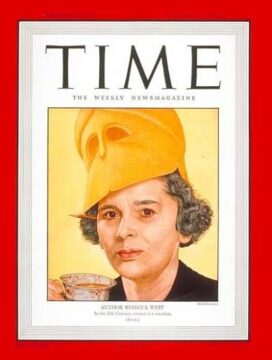
West had gained notoriety years earlier as the 20-year-old mistress of the married, 46-year-old H.G. Wells (they had a child together). The brilliance of her own writing quickly outshone the scandal. Soon, her reputation towered – not only in journalism, but criticism, history and political thought.
If Ross and The New Yorker were looking for something short and snappy, they’d come to the wrong person. Ten years earlier, West sat down to write a travelogue on her trips to Yugoslavia. This blew up into the two-volume, 1,200-page Black Lamb, Grey Falcon – a sui generis masterpiece of history, aphorism, and personal observation on the order of Burton’s Anatomy of Melancholy or Doughty’s Travels in Arabia Deserta.
When West’s article on the Hume-Setty affair was finally delivered, it was approximately 35,000 words and bore the title, London Masque. It went on to fill three issues of The New Yorker (December 2-9-16, 1950).
The trial itself was full of weird drama. As the judge entered the courtroom on the first day, West and nearly every other observer was aghast at his sickly appearance. “He was visibly wrestling with death,” she says. He was removed from the bench and shortly after, death won. A new judge was appointed. The gallery was entertained by a parade of underworld types and London working-class characters, and saw inside the full cabinet of evidence against Hume. None of it made him look good.
Hume stuck to his story of the three scary strangers. The jury heard him out and retired. Many observers, no doubt, rubbed their hands together in gleeful anticipation of Hume’s being taken hence to a place of lawful execution and then hanged by the neck until he was dead.
They were disappointed. It wasn’t Hume that was hung; it was the jury. To the exasperation of all, he first jury failed to agree on the murder charge. A new jury was convened. The judge ordered it declare Hume not guilty of murder. In return, Hume pled guilty to the charge of being an accessory – guilty only of hiring the plane and disposing of the body.
Rebecca West was satisfied with this outcome. She’d heard all the evidence; she’d analyzed the psychology and backgrounds of the principals; and she believed that:
- It was ridiculous to think a gangster of Setty’s stature would even set foot in the upstart Hume’s home.
- Further, it was impossible for Hume hack up Setty’s body without anyone hearing.
- Yeah, there was human blood on the floor, but not all that much blood.
(Who among us doesn’t have at least a few pints of human blood soaked into our living room floors?)
“It was … impossible,” she wrote, “to believe that Hume had, alone or with help, dismembered the body in the apartment.”
Finally, while she granted that Hume was a bad man, he wasn’t so bad that he’d, you know, kill a guy. “It is certain that in essence Hume’s story was true”
And she went further:
“The possibility that Hume murdered Mr. Setty can definitely be excluded.”
The man is innocent, I tell you. Innocent!
But Hume was not off the hook. Having pled guilty to being an accessory after the fact, he was sentenced to 12 years in prison – Dartmoor.
With London Masque out of the way, West moved on with her life. She continued to write and win international acclaim.
Meanwhile, Hume was immured England’s worst lockup. People forgot about him. Eight years passed; he was released early for good behavior, to live out his days in, one could only hope, obscure contrition.
But that was not to be. This imaginary scene encapsulates what happened next: It’s 1958. Rebecca West is walking down a busy street in London. As she comes to a newsstand, she pauses and gapes. A fresh pile of newspapers blares the sensational headline:
I KILLED SETTY… AND GOT AWAY WITH MURDER – signed Donald Hume.
Protected by double-jeopardy, Hume knew he could not be prosecuted again for the Setty murder. So once he was out of jail, he came clean to the Sunday Pictorial, pocketing £2,000-£3,200 (accounts vary) from the newspaper for his confession.
Yes, Hume declared, it was all true; he’d stabbed Setty in the back; dragged his bleeding body into the kitchen, and – using his newly sharpened knife – hacked Setty’s head and legs off on the kitchen table top. Then he cleaned up the mess and air-mailed the parts into the fens. Why’d he do it?
Well, the victim was an arrogant SOB with an attitude. But that wasn’t enough. Remember Tony, the dog? Hume loved that dog. More than he loved his wife and infant daughter (he writes in his confession). It seems that one day, Hume, Tony and Setty were on the street. Tony jumped on one of Setty’s cars and scratched the paint. The furious “Spiv” gave the dog a good, swift kick. That was enough for Hume. Then and there he resolved: Setty must die.
What did West think of Hume’s confession? Didn’t it demolish her certainty that he was innocent? No, no, not at all. That man, she said, was a known liar; now he was lying again to get paid by the Sunday Pictorial. He was broke. Notorious. Just out of prison. What else was he supposed to do?
Flush with fresh dough, Hume high-tailed it to Switzerland, where he proceeded to blow it all in the company of a lovely hairdresser he’d lied to about his identity.
Now, it’s soon after this where any normal person who’d doubted Hume’s guilt in the Setty killing would probably change his or her mind. Broke again, he went back to England and pulled a couple of robberies. With a gun. Shooting and wounding two bank employees. He escaped back to his Swiss miss and tried the same thing at another bank. This time everything went wrong. He wounded a teller, shot a taxi driver dead, and was run down by a mob
A Swiss court convicted Hume on five counts, including murder. He was sentenced to life with hard labor. This time, he didn’t get off for good behavior. Violent and disruptive, he spent 17 years in a Swiss jail before he was transferred to mental institutions in Britain. Freed in old age, he died while wandering outdoors in 1998.
Well after the confession, West wrote, “My impression was that though Hume was a horror—an infantile, grouchy, grumbling, envying horror—he had not got to the point of murder then, though he was to come to it. I think he was inspired by the trial and imprisonment.”
In other words, Hume didn’t have in him to kill in the beginning. But eight years at Dartmoor coarsened his character. And hearing the prosecution case against him in the courtroom gave him all the material he needed for his “confession”.
Rebecca West was no bleeding heart. She’d sat in the courtroom in Nuremberg and looked into the faces of Goering, Hess and Streicher. She knew the depths of human depravity. All her life she was a firm anti-communist. But for some reason, she gave Hume a break.
So how did “the world’s No. 1 woman writer” get it so wrong?
The question was taken up in 2021 by Theodore Dalrymple, the prison doctor turned essayist. Writing in City Journal, he classed West among those intellectuals who think that criminals are bad for “reasons”: poor upbringing, etc. Hume had a lot going for him early in life. But he stupidly chose a life of crime and disorder because it was more exciting. What else do you need to know?
But West was a novelist as well as a journalist. In a mystery novel, it’s a good idea not to jump to the most obvious conclusion. The characters and their motivations must be studied and analyzed.
London Masque gives us insightful character studies of the major and minor players (most memorably, the fisherman who found the torso along with his Dickensian extended family).
But she either didn’t know about or failed to recognize the emotional importance of a key four-legged figure on the periphery: Tony the dog.
No mystery novelist would give us such a complex web of characters and circumstances and leave us with, “He kicked my dog.”
Dame Rebecca West (named Dame Commander of the Order of the British Empire in 1959) didn’t swallow it for a moment. But I suspect that the ordinary reader of the Sunday Pictorial did.
It’s just stupid enough to be true.
***
Enjoying the content on 3QD? Help keep us going by donating now.