
by David Hoyt
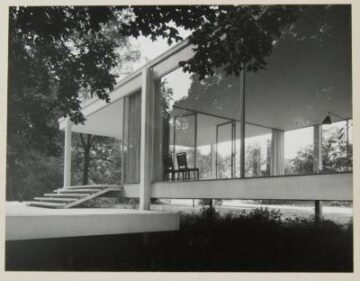
About an hour’s drive southwest of Chicago is a grassy bank on the shore of the Fox River where, according to some, the predominant architecture of the twentieth century first took shape. It was here that a precocious and independent-minded physician, Edith Farnsworth, asked her newly-emigrated German friend and paramour, Mies van der Rohe, to build her a country cottage. He did so, after a fashion.
The structure known as Farnsworth House stands outside of the village of Plano, Illinois. It was begun in 1945 and completed in 1951. By the time it was “move-in ready”, its new owner declared it unlivable, and broke off relations with the architect, at which point Mies filed a lien against her and Farnsworth responded with a countersuit against the patron saint of modernism.
A sculptural masterpiece of steel frame construction, the house seems to float above the meadow as if defying gravity, wrapped in glass without internal partition as if to announce to obsolescence of privacy well before the advent of social media. Yet it was too hot in summer, and frigid in winter. It lacked adequate ventilation, was prone to leaks from the roof and window frames, and was located squarely within the flood plain of the Fox River, which has inundated it several times.
Farnsworth’s disappointment with the structure was given metaphorical expression in an unpublished poem she wrote in 1960. Yet the poem, titled “Artifact,” is more than a metaphor. It announces a fundamental flaw in the paradigm of glass-and-steel modernism that has come to dominate so much of our built environment. The large expanses of sheet glass that seemed to “let the outside in” (as Mies put it) actually did the opposite: they gave an illusion of intimacy with nature while walling it off. The price paid for this illusion, among other costs, was the ongoing destruction of wild and free-flying birds crashing into it.
The poem reads in full:
Artifact.
The dawn was close this morning when I woke
To hear some flying creatures strike the pane
Of glass beside my bed – strike and flutter
For a moment, strike and beat
Bewildered wings upon the glass.There was no light.
It was not day, or night.
I could not see the wounded flying thing
But I could hear the fluttering, breaking wing
Beating its moment out upon my pane
Of glass. Why does it not recoil, or die?The unseen wings are slipping down the pane;
The splintered feathers agonize in vain.
The moments pass
And in the grass
Below, there lies
My hope, and dies(Source: Edith Farnsworth Papers, Newberry Library Archives)
Elements of Farnsworth House – the low-rising staircase, the exposed H-beams – would show up in later works such as the Illinois Institute of Technology campus, the twin residential high-rises at 860/880 Lake Shore Drive, and elsewhere. Scholars have duly traced these genealogies of style. But they have mostly overlooked what Edith Farnsworth experienced in the predawn hours of a morning in 1961, and what most people have at some point likely experienced in their own home. Wherever buildings with large expanses of glass are built, be they multi-story curtain walls or living room picture windows, birds collide with them, most often fatally.
The biggest bird killer in Toronto, on the shore of Lake Ontario and thus a major migratory stopover, is the Toronto Dominion Center (1967), designed by Mies van der Rohe. The largest avian mortality event known in Chicago, and one of the most severe ever recorded in the United States, and perhaps anywhere, occurred over the night of October 4-5, 2023, when nearly 1,000 birds died in collisions with the giant glass walls of a single building: McCormick Place (1971). The building was designed by two students and former employees of Mies van der Rohe.
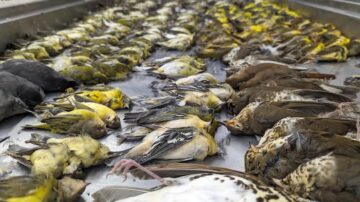
In roughly the same way that modernist art critics such as Clement Greenberg, roughly contemporary with Mies, (1909-1994) theorized the trend towards painterly abstraction as an expansion of the subject beyond the frame containing it, the predominance of glass in modern architecture is envisioned as a way of making a building transparent, of exceeding its structure, of making its own steel frame disappear. It is a way of removing itself from any context, of “letting the outside in” – without, on the other hand, providing any real connection to it.
The American architect and broker of German modernism in the United States, Philip Johnson, recognized that the new architecture was, from a visual and external point of view, all about larger glass surface area. (Johnson’s own Wells Fargo Center (1983) in downtown Denver, Colorado, has been marked as the deadliest building for migratory birds in that city).
This trend began in the downtown Chicago of the 1880s, as engineering advances facilitated the construction of multi-story consumer emporia and allowed for the larger windows which delighted shoppers and filled terra cotta-clad buildings with natural light. Johnson sees this tendency of modernism as, coining a matchless phrase, one of “maximal fenestration.” “Windows constitute a more important element in modern architecture than they have in any architecture since that of the Gothic cathedrals,” wrote Johnson in his paradigmatic 1931 handbook, The International Style.
Mies grew up in the shadow of one such cathedral, commissioned by the Emperor of the Franks, Charlemagne, at Aachen. One of the oldest and greatest cathedrals in Europe, it is known as the Glashaus for its palpable yearning to break free from masonry constraints so that its windows can harvest their light from the heavens. The years of Mies’ early adulthood in the post-war Weimar Republic were the seedbed for countless utopian dreams and projects, including one movement which sought to design future buildings of the German republic from colored crystals, a sort of secularization of the Gothic stained-glass window, but with a shared intention of elevating the soul.
Two of Mies’ earliest drawings from this period, representing a transition from expressionist fantasy to Bauhaus functionality, and considered by scholars as among the greatest buildings never built, are a pair of glass-walled skyscrapers situated in Berlin.
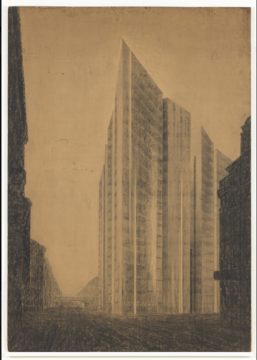
This mystical aspiration for light and invisibility in architecture dates to the emergence of German modernism in the immediate aftermath of World War One, but continues today in the market for ever taller condo towers with ever better views. What emerged as a functional element in the service of social liberation and transparency in the 1920’s is now a commodity allowing for aesthetic consumption from atop supertall condo towers or unobstructed lake house panoramas.
Absent mindful adaptation, both kill birds in great numbers.
As one trade website remarks, in “A Trend in Modern Architecture: More Glass,”
One walk around New York City, Chicago, Los Angeles or Seattle and one can see the … trend of larger curtain walls, including those with glass to make the building envelope seem almost transparent … Floor to ceiling glass spans are growing by the day as architects want sustainable designs with breathtaking views.
While there are voices within the architectural establishment that have begun to question Johnson’s drive for maximal fenestration, in the typical list of problems cited, bird mortality is almost never mentioned. The issues are more often of the LEED-sustainability sort, centered on metrics of consumption, rather than an ecological framework centered on organic relations. One spectacular example of this is the sparkling new BMO Tower at 320 South Canal (2022). Located on the banks of the Chicago River in what has become a canyon of glass-walled skyscrapers, it is a documented bird-killer. It is also a LEED Gold-certified building pitching itself as “Chicago’s Healthiest Office Tower.”

Certain architects are concerned with climate change, resource consumption, or that catch-all category of neoliberal virtue, energy efficiency. Industry correspondingly provides solutions in the form of glass with better thermal regulation (“modulating capacity”), panels that contain or serve as photovoltaic cells, or “cold bending” glass that can be shaped one way and then reused in another. The adoption of architectural glass with simple and cheap accommodations for wildlife seems to be a derogation in a primarily anthropocentric world of designing and raising buildings.
An inspiring but limited exception to this is state of affairs can be seen in the work of architect Jeanne Gang, founder of the Studio Gang firm headquartered in Chicago and a sponsor of the exhibit Flyway City: Architecture for a Flourishing Ecosystem, currently running at the Chicago Architecture Center. Gang is perhaps best known for her decision, like Wright a century before, to ‘break the box’ – the ‘box’ for Gang being the steel-glass cage of modernism, rather than the dim cubbyholes of the Victorian interior in Wright’s time. The style is exemplified in her 2009 Chicago River tower, ‘Aqua’. Popularly appreciated for its apparent vertical curvature, suggestive of the nearby lakeshore on a summer day, it is in fact intentionally bird-friendly. Specifications called for fritted glass throughout, which make windows visible to birds, and undulating balcony platforms, which interrupt reflections confusing to birds.
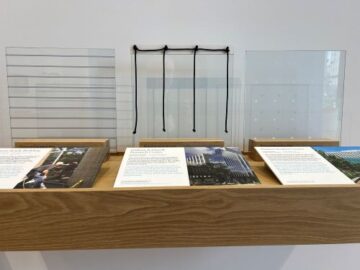
The exhibit serves a much needed educational purpose, for the public remains largely ignorant of avian window strikes and their appalling death toll. Partly this is because building managers and advocacy groups alike both descend on downtown pavements before the first light of dawn to gather carcasses and send any survivors to a suburban forest preserve hospital specializing in wildlife rehabilitation. The public thus rarely encounters the physical results of avian window strikes. Flyway City presents one – very small – display case with half a dozen ‘skins’, or preserved bird carcasses, recovered from various addresses in the Loop, together with a poignant documentary short which features a young volunteer witnessing the mortal collision in real time of a bird (what appears to be a Dark-eyed junco) and an all-glass tower along the Chicago River. The film may be the most compelling feature of the exhibition.
The address in question, in case you are curious, is 155 North Wacker.
Studio Gang is but one firm facing down a very, very large problem, led by a principal who is a strong advocate of bird-friendly design. But even this firm has recently built a very tall, all-glass tower (the St. Regis, 2021) that now commands its section of lakefront flyway. The building deploys several collision-deterring elements, but not the gold standard of fritted or patterned glass, widely understood to be the most effective means of steering birds away from windows. I am unable to find any information – which is typically guarded, both by property owners and by volunteer collision monitors – as to how many birds strike the St. Regis.
But the larger point is that, as Jeanne Gang openly calls for, and as Flyway City openly advocates, municipal regulations are necessary to reduce Chicago’s architectural carnage. Self-policing of architectural firms and the developers who realize their designs is no more reliable than it is with industrial pollution, banking, or artificial intelligence. This is why a movement has arisen for the passage of a municipal, bird-friendly building ordinance to mandate certain safety elements in all new construction.
Predictably, the ordinance runs into opposition in City Council from alderpersons representing major property management firms and architectural designers in downtown Chicago. First introduced in 2019, it has languished for nigh on a decade with no prospect of passage in sight. The chief objection, also predictable, is to allegedly higher construction costs and the follow-on effects that this presumably leads to, like fewer jobs. This hasn’t prevented architecturally and geographically comparable cities such as New York or San Francisco from passing mandatory bird safety ordinances. Though one need not look so far afield for exemplars: already in Chicago’s near-north suburbs of Evanston and Skokie, bird-friendly building ordinances have passed; and since it was signed into law by Governor J.B. Pritzker in 2021, the State of Illinois mandates all state-owned buildings must use patterned glass on 90% of glass exteriors to forty feet in elevation.
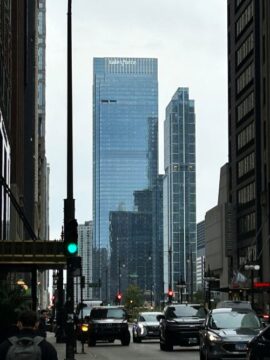
The absence of a mandatory bird-safe building ordinance in Chicago has resulted in a decade of heedless, see-through pleasure boxes rising along the River and elsewhere, such as Norman Foster’s Michigan Avenue Apple Store (celebrated in Architectural Digest), 150 North Riverside Plaza, and the shamelessly obtuse Salesforce Tower on the Chicago River. Typically, buildings such as these are conceived with no bird-friendly accommodations, as if those involved were still living in a 1920’s Bauhaus bubble and were too busy to read the headlines about cratering North American bird populations. Though some developer/owners may take action after the fact to address collisions, as happened after much public shaming at McCormick Place and the Apple Store, or offer bird-friendly assurances before building, as at the riverfront Bally’s Casino, there is no guarantee that whatever measures are taken will sufficient to address the problem in the absence of legal requirement.
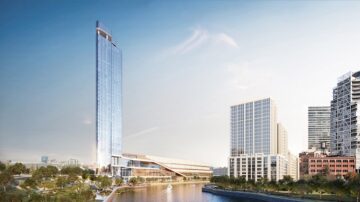
Opponents of a city bird-friendly building ordinance argue that it would be costly, cumbersome to administer, and stifling of housing supply. The leading researcher on avian window strikes in North America, Daniel Klem, argues in a 2025 paper that a municipal law would have the effect of driving up demand for patterned glass, which in turn would eventually drive down costs, as has happened in the market for photovoltaics – at which point, compliance becomes less painful for developers.
Klem also points out that specifying treated glass in construction designs typically accounts for less than one percent of total project costs, and even less when average cost overruns are included. And, as an urban planner told me recently, glass is actually the cheapest cladding for a building. It costs much more to clad a structure in marble or Indiana limestone, both of which are comparable to modern glass in terms of thermal efficiency. The extreme bottom-line mentality evident here will never satisfactorily address the problem of its own accord. This is why the public must be rallied to the cause. But before that can happen, the public must be educated. And, as I discover every day, the majority of people are simply unaware of the problem and its proportions: according to the latest research, between 1.28 billion to over 3.46 billion birds die from window collisions each year in North America alone.
One thing that can quickly awaken public opinion is publicity stemming from a mass mortality event such as occurred at McCormick Place in 2023. For decades, birders and ornithologists lodged complaints with the massive state-run facility on the shore of Lake Michigan, and a total of over 40,000 dead birds had been gathered there since its initial construction. It was only after the shocking overnight mortality event of October 4-5 that public sentiment became too strong and widespread for McCormick Place to resist change any longer. Over the course of three months in the following summer of 2024, the facility applied collision deterrent film to all of its exterior glass, at a cost of $1.2 million. A very similar chain of events unfolded in Toronto around the Dominion Center Building in 2021.
Anyone contemplating the work of Chicago’s Louis Sullivan can’t help but be absorbed by the delicate and encompassing vegetal patterns that seem to grow like vines and branches directly out of stone or metal, echoing French art nouveau but from a distinctly American point of origin. This progenitor of the prairie school sought to assimilate the built to the organic and to the simple forms and materials of the Midwestern landscape. The modernism of Mies van der Rohe, on the other hand, was born from the social strife and class conflict of Central Europe, and was welded to an aesthetic of the Machine. Forms of ornamentation – themselves anathema in the heated politics of central European artistic modernism – evolved to suit the local settings in which Sullivan and Wright worked, meant to echo the particularity of place, much the way Fernand Braudel lovingly catalogued the various forms of rooftops across provincial France. For Mies and Johnson and the practitioners of the International Style who came after them, all of this echoing and mimicking and organicism was replaced by glass. Glass does not relate to or echo a place. It allows you to look at a place, from noplace in particular.
Unless you happen to be a bird, in which case, glass is what you never see before it kills you.