
by Rafaël Newman
I recently came across a certain Grimms’ fairy tale for the first time, one I had overlooked in the past: Die Boten des Todes, or “Death’s Messengers.” Here it is, in a slightly abbreviated English translation:
Once, a long time ago, a giant was traveling down a country road when suddenly a stranger appeared and cried, “Halt! Not one step further!” “What,” said the giant, “I could squash you with one hand! Who are you to address me like this?” “I am Death,” said the stranger, “whom none withstands, and you too shall obey my command.” But the giant refused, and began to wrestle with Death. In the end the giant won: he struck his opponent down and Death sank to the stony ground. “What will happen,” thought Death, “if I simply remain here? No one will die any longer, and the world will soon be so filled with people that there will be no room for them to stand.” Just then a young man came along the road, whistling a tune. When he spied Death in his parlous state he propped him up, gave him a drink from his flask, and tended him until he recovered. “Do you know who I am,” asked the stranger. “No,” replied the young man. “I am Death,” said the other, “I spare no one and can make no exception for you. But in gratitude for your care I promise I will not come to you unannounced when it is your turn, but will send my messengers ahead to warn you.” “Fine,” said the young man, “I will be happy to know when you are approaching, safe from your grasp at least until that day.” And he went on his way, as cheerful and carefree as ever. His youth and good health did not last for long, however, and soon he was beset by aches and illnesses, which plagued him by day and stole his peace at night. “But I’m not about to die,” he told himself, “since Death said he would send his messengers first.” And as soon as he felt fit again, he would go on living, as happy as ever. But then one day there came a tap on his shoulder. “Follow me,” said Death, “the hour of your departure from this world has arrived.” “What,” said the man, “do you mean to break your word? Didn’t you promise to send your messengers before you came yourself?” To which Death replied: “Did I not send you one messenger after another? Were you not shaken and cast low by fever? Were your joints not pinched by gout? And did Sleep, my brother on earth, not remember me to you each night? Did you not lie abed as if already in your grave?” To this the man had no answer; so he resigned himself to his fate and departed with Death.
Now, you may understand why I would never have read this particular story to my children when they were young, even if I had know it in the first place; indeed why, despite my Swiss-German grandmother’s taste for the macabre, I had never heard it myself. It might be a cracking yarn for a Hallowe’en party, or for a gathering at a cemetery on the Day of the Dead, but it’s hardly suitable for bedtime, if only because children would likely be kept awake by the troubling paradox of Death himself being on death’s door.
In fact, I encountered the tale first in a book devoted to just such paradoxes—or rather, to contradictions. This year marks the 50th anniversary of the publication of Freiheit für den Widerspruch (Contradiction Set Free), by the late German-Jewish philosopher Hermann Levin Goldschmidt (1914-1998), and I was invited to present a paper at a commemorative conference held in Zurich, where he spent much of his professional life. The volume, published in 1976 and re-issued in 1993, with a new edition prepared by Willi Goetschel out this year, presents in compact form the gist of Goldschmidt’s critique of dialectics and his elaboration of a philosophical method he called Dialogik, or dialogic. Instead of resolving contradictions dialectically in the form of synthesis, which Goldschmidt saw as prone to dogmatism—and ultimately to totalitarianism—dialogic aims to preserve contradictions and to make use of the productive tension arising from them. It is a profoundly humanist and democratic approach, characteristic of Goldschmidt’s own progressive political commitments during his long life.
Each of the chapters in the 1976 volume deals with a specific field of human endeavor—ecology, politics, technology, religion—and tests Goldschmidt’s technique of non-reconciliation to determine the contradictions at play in each case, and to investigate their potential utility. The chapter that opens with his recapitulation of the Grimms’ tale is headed “Der unausweichliche Widerspruch”—“The inescapable contradiction”—and addresses the history of the medical profession’s attempts to stave off death by sequestering the ill and aggressively treating their various conditions. More crucially, Goldschmidt reviews our willingness (or, increasingly, our unwillingness) as laypeople to tolerate the evidence of “Death’s messengers,” which remind us of our own mortality, of the scandalous “contradiction” of life that is death. We are, in other words, like the young man in the Grimms’ fable, who goes on whistling happily, serene in the mistaken certainty that he is safe from Death’s approach even as Death sends him one harbinger after another.
In Goldschmidt’s view, by removing the ill and dying from our midst until they return to their presumed “normal” state of health, we deprive ourselves of the experience of the “meaning” (Sinn) afforded by the boundedness of our lives as mortals, even as we also deny those who are ill and dying the traditional comfort of charitable visits. Because after all, reasons Goldschmidt, we are never entirely healthy ourselves; nor are the ill ever only ill. And it behooves us, moderns though we may be, to recall the medieval maxim, ascribed to Notker Balbulus, a 10th-century Benedictine monk from St. Gallen, and preserved in a Gregorian chant: Media vita in morte sumus—“In the midst of life we are in death.”
On a recent visit to Berlin, the city of Goldschmidt’s birth, I went on a tour of a local project that aims to reconcile the contradiction of death in life. Or rather, in Goldschmidtian terms, what I witnessed was a dialogical attempt to allow this foundational contradiction of human life to persist, and to persist profitably, without striving to sublate it—that is, to synthesize or transcend it—by means of dialectics. And in the process to turn Notker’s reminder, that even in life we are surrounded by death, on its head.
The Neue St. Jacobi Friedhof in the Neukölln district was established in 1867 and continues to this day as a cemetery under the care of Berlin’s Evangelical Cemetery Association. As the website we were referred to by our guide explains, however, Neue St. Jacobi has seen a steady decrease in burials since the 1980s—not, presumably, because Death has ceased to operate in Berlin, but due instead to “demographic and cultural shifts”. Berliners are increasingly turning to cremation and the communal interment of urns, the website explains; in addition, although the site does not suggest this, the fact that a large proportion of Neukölln residents have a Muslim background may mean that many locals simply follow other religious customs and prefer different burial grounds.
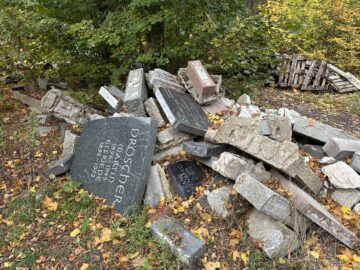
The graveyard has thus been closed for new burials since 2016, although existing gravesites for which upkeep continues to be paid remain, and may be visited. Meanwhile, graves that are no longer tended and financed have been exhumed, their headstones removed and recycled, and their plots freed up for other purposes. These may not be commercial in nature, “for reasons of piety,” as the website explains; and thus in 2018 the Prinzessinnengärten Kollektiv Berlin began to develop community gardens on Neue St. Jacobi’s newly available areas.
There are several of these gardens currently in operation within the cemetery, with a variety of planting methods—in boxes, in pots, and in beds laid directly in the ground—as well as stations for the collection and preparation of organic compost. The gardens include crops such as cabbages and salads and flowers both decorative and edible, as well as didactic displays of plants like tobacco, with panels providing historical and sociological information. There is a small apiary built of recycled wood, a bicycle repair shed, and educational offerings, as well as a café just outside the burial grounds proper. And thus, with members of the horticultural collective and schoolchildren crossing paths with the families of those still interred there, bringing cut flowers for active graves as gardeners come to cultivate their own floral produce, the effect is a happy reversal of the medieval memento mori: for even in the midst of death, the Prinzessinnengärten Kollektiv implicitly proposes, in the spirit of Goldschmidt’s dialogical maintenance of contradiction, we are surrounded by life.
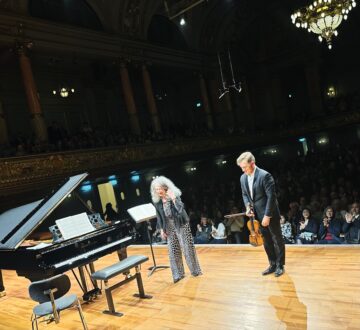
That such a reversal runs the risk of occluding its own salutary message was borne in to me at another recent event, this time in Zurich, where as it happens a similar move is afoot to repurpose parts of the city’s underused cemeteries. My mother was visiting from Toronto, and as a gift for her 86th birthday, which we celebrated during her stay with us, I had invited her to the Tonhalle, to a performance by Martha Argerich and Renaud Capuçon. The program included the Kreutzer, my mother’s favorite among Beethoven’s sonatas, and I had been able to get us places on stage in the overflow ranks built up there to accommodate the extra public keen to attend a recital by the two stars. We were seated stage right, directly behind the piano, so that we could see Argerich’s hands as she played.
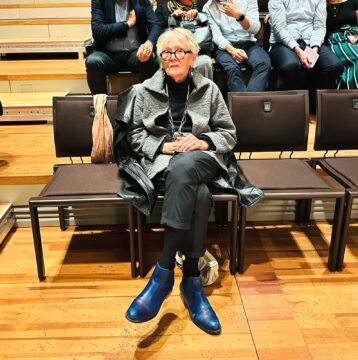
During the sonata’s third movement I became aware of a disturbance behind us: nothing audible, simply an excess of motion in my peripheral vision. I turned my head and saw a woman, two rows back and to our left, gesturing urgently to the ushers positioned downstage from us at the top of the short staircase. She was waving them over as she pointed to a place in the very midst of the stage seating, where an elderly woman had slumped over and was about to slide from the riser and onto the floor.
The rescue and extraction of the ailing attendee that ensued, and went on throughout the rest of the third and final movement of the sonata, through the applause and curtain calls that followed it and into the first of two encores, was carried out in perfect silence and with a minimum of disruption, although in full view of the entire auditorium, some 1400 people seated in the stalls, the gallery, the balcony, and of course on the stage. The ushers used their cell phones to alert an emergency medical team, which arrived in short order, two specialists in bright yellow neon vests and boots bearing bulky equipment cases. They climbed the stairs to the stage, threaded their way through the rows of listeners, and examined the woman where she had collapsed. They evidently found no cause for great alarm, because they simply laid her out on the seats on either side of her, now vacated by her companions, and allowed her to rest for a moment before escorting her, one on either side of her, across the stage and down the stairs to the lobby. By the time the concert had ended and the rest of us, in better health, filed out ourselves, there was no sign of her or the EMT workers.
Throughout the whole thing we had continued to listen to the musicians, to applaud them and to call for an encore, even as those of us on stage kept turning our heads to check the progress of the medical procedure going on behind us. What were we to do otherwise? Understanding we could ourselves contribute very little, we placed our faith in the professionals, who appeared promptly in their conspicuous uniforms and who seemed to have the situation under control. For all we knew initially, the lady behind us could have been dying, or might already have died, killed indirectly by the Kreutzer Sonata like the woman in Tolstoy’s eponymous novella (although her murderer does find the presto finale to be the work’s weakest movement). And yet for all that we were content to remain in our (expensive) seats, and to enjoy the luxury of music performed live, in our immediate vicinity and under a gilded ceiling, by top-caliber artists.
We were in the midst of death—indeed, Death himself, resuscitated after being struck down by the giant, may have been in our midst—; and yet we were in life. How like our response to Death’s current rounds, I thought, on the world’s stage: as our fellow spectators succumb variously to disease, natural catastrophe, and calculated mass murder, we continue to pursue our lives, content to allow a host of experts—medical, scientific, political—to intervene on our behalf. Continue to hope that they will intervene, as we cultivate our collective gardens while graves are tended all around us.