
by Richard Farr
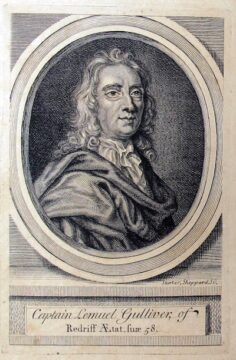
Ladies and Gentlemen, let us raise a toast to one of the greatest and most loved books ever written, for this October 28th is the tercentenary of Mr. Lemuel Gulliver’s magnificent account of his misfortunes and discoveries, never out of print, Travels Into Several Remote Nations of the World. You may know it by its nickname, Gulliver’s Travels.
I find his four narratives of exotic, accidental tourism so rich and vibrant — so full of old passages remembered and details never before noticed — that I think it will live forever. And, unlike the hapless Luggnaggian immortals he encountered, the struldbrugs, who are condemned to an eternity of vile decline, at 300 it remains as vigorous and youthful (and funny, and cutting, and perceptive, and joyously obscene) as the day it fell from the presses. Somehow indeed its snivelling courtiers and pointless wars seem more relevant than ever.
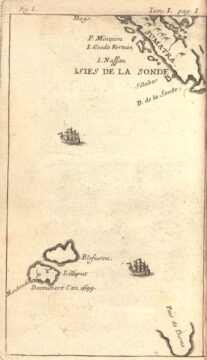
Granted, we are never quite sure how much of Mr. Gulliver’s tales to believe. Consider how he introduces himself in the first adventure — both exhausted and pickled. During a terrifying storm in the heat of the tropics, his ship is torn asunder on a rock. He and a few others escape in a lifeboat, which is itself then wrecked, and he nearly shares the watery fate of his companions. In a detail more than strange he admits that, having washed up on an unknown shore, he falls into a profound slumber partly because of “about half a pint of brandy that I drank as I left the ship.” Really? He also gives the last position of the doomed Antelope as “to the north-west of Van Diemen’s Land [Tasmania]… in the latitude of 30 degrees 2 minutes south.” Perhaps some evidence of the brandy here, for this would put the site of the disaster not in some chartless southern reach of the Indian Ocean ocean but in the deserts of southern Australia. To make matters worse, his own map places him far closer to Tasmania than he could have been but also, impossibly, near Sumatra. Caveat lector.
Still, he’s a fascinating and complicated figure, well worth getting to know. A rock-ribbed swashbuckling patriot, an optimist and idealist, brave and principled, he’s also a bit of a glad-hander, painfully obsequious, a misanthrope, a depressive, and a misogynist. Not often said: he is a kind of philosopher too, though not perhaps in a good way. At the Academy of Lagado he shows himself skeptical of abstraction. But as the years pass, and his experiences make him increasingly aware of human cruelty and folly, he forgets his doubts about excessive reliance on Reason and finds in the society of the Houyhnhnms — or thinks he finds — a safe harbor in perfect rationality. Alas, what he hopes will be his salvation from the corruption of his own species all but destroys him.
No greater fan of Mr. Gulliver’s work than the self-described “Tory anarchist” George Orwell, who has something telling to say, for both his time and our own, about the politics that underlies this Hanoverian philosophical thread. Why, he asks, is the Houyhnhnms’ cure for what ails Gulliver worse than the disease?
“The General Assembly of the Houyhnhnms ‘exhorts’ Gulliver’s master to get rid of him, and his neighbors put pressure on him to make him comply… Gulliver’s master is somewhat unwilling to obey, but the ‘exhortation’… cannot be disregarded. This illustrates very well the totalitarian tendency which is implicit in the anarchist or pacifist vision of society. In a society in which there is no law, and in theory no compulsion, the only arbiter of behavior is public opinion. But public opinion, because of the tremendous urge to conformity in gregarious animals, is less tolerant than any system of law. When human beings are governed by ‘thou shalt not’, the individual can practice a certain amount of eccentricity: when they are supposedly governed by ‘love’ or ‘reason’, he is under continuous pressure to make him behave and think in exactly the same way as everyone else.”
But let me offer a more cheerful note and return to Gulliver’s third book, especially Chapter V, with its classic account of a great university. One professor,
“who had been eight years upon a project for extracting sunbeams out of cucumbers,” pleads for help with his funding because he “did not doubt, that, in eight years more, he should be able to supply the governor’s gardens with sunshine, at a reasonable rate.”
There’s also cutting-edge medical science about gas. After Gulliver suffers “a small fit of the colic,” he is introduced to
“a great physician… famous for curing that disease…. who had a large pair of bellows, with a long slender muzzle of ivory. This he conveyed eight inches up the anus, and drawing in the wind, he affirmed he could make the guts as lank as a dried bladder. But when the disease was more stubborn and violent, he let in the muzzle while the bellows were full of wind, which he discharged into the body of the patient; then withdrew the instrument to replenish it, clapping his thumb strongly against the orifice of the fundament; and this being repeated three or four times, the adventitious wind would rush out, bringing the noxious along with it.”
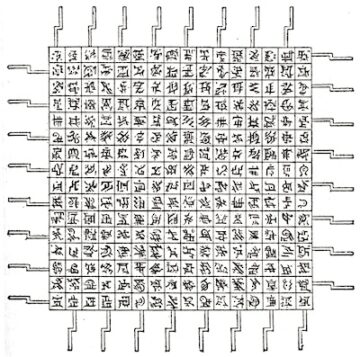
Despite reading all this many times before, I had never noticed (and, as far as I’m aware, no one has yet credited Gulliver with) what is surely the first description of a nascent AI data center, complete with schematics:
“The first professor I saw… observing me to look earnestly upon a frame, which took up the greatest part of both the length and breadth of the room, he said, “Perhaps I might wonder to see him employed in a project for improving speculative knowledge, by practical and mechanical operations. But the world would soon be sensible of its usefulness…. Every one knew how laborious the usual method is of attaining to arts and sciences; whereas, by his contrivance, the most ignorant person, at a reasonable charge, and with a little bodily labour, might write books in philosophy, poetry, politics, laws, mathematics, and theology, without the least assistance from genius or study.” He then led me to the frame, about the sides, whereof all his pupils stood in ranks. It was twenty feet square, placed in the middle of the room. The superficies was composed of several bits of wood, about the bigness of a die, but some larger than others. They were all linked together by slender wires…. [T]he professor showed me several volumes in large folio, already collected, of broken sentences, which he intended to piece together, and out of those rich materials, to give the world a complete body of all arts and sciences; which, however, might be still improved, and much expedited, if the public would raise a fund for making and employing five hundred such frames in Lagado, and oblige the managers to contribute in common their several collections.”
This is not Gulliver’s first encounters with great intellectual advances. In Book II, the King of Brobdingnag has gathered his own scholars to consider what manner of creature the diminutive Mr. Gulliver is, and at first he suffers the indignity of being hypothesized “an embryo, or abortive birth.” (Famously, the King exhibits his prejudices by responding to Gulliver’s praise of England’s great virtues by saying “I cannot but conclude the bulk of your natives to be the most pernicious race of little odious vermin that nature ever suffered to crawl upon the surface of the earth.”) But on the matter of Gulliver himself, at least, more sober philosophick reasoning prevails:
“After much debate, they concluded unanimously, that I was only relplum scalcath, which is interpreted literally lusus naturæ [a freak of nature]; a determination exactly agreeable to the modern philosophy of Europe, whose professors, disdaining the old evasion of occult causes, whereby the followers of Aristotle endeavoured in vain to disguise their ignorance, have invented this wonderful solution of all difficulties, to the unspeakable advancement of human knowledge.”
A lusus naturae Mr. Gulliver may have been, and not as sober or reliable as we might prefer. Still we owe him our gratitude for his ever thought-provoking instruction.
October 28th, 1726: hip hip (hip hip hip hip hip, and so on) hooray.
***
* A note on raising a toast: we should probably be filling our glasses with glimigrim, that “most delicious” wine of the Lilliputians. A very great deal of it, from their point of view — but this does offer a small further puzzle to any scholar with time on their hands. Quoting Gulliver: “The reader may please to observe, that… the emperor stipulates to allow me a quantity of meat and drink sufficient for the support of 1724 Lilliputians. Some time after, asking a friend at court how they came to fix on that determinate number, he told me that his majesty’s mathematicians, having taken the height of my body by the help of a quadrant, and finding it to exceed theirs in the proportion of twelve to one, they concluded from the similarity of their bodies, that mine must contain at least 1724 of theirs, and consequently would require as much food as was necessary to support that number of Lilliputians. By which the reader may conceive an idea of the ingenuity of that people, as well as the prudent and exact economy of so great a prince.” Presumably they reasoned that at twelve times their height, Gulliver had 123 times their volume and capacity. But that would be 1728, not 1724. Is this subtle error theirs, or another of Gulliver’s? Or is it perhaps the fault of his Irish editor, who I am told was a Mr. Swift?
Enjoying the content on 3QD? Help keep us going by donating now.