
by Carlota Figueroa
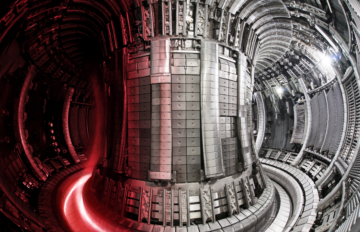
I know that a “boom” sound is usually associated with something negative, like putting tinfoil in the microwave and the inevitable trip to the hardware store for a new one. However, just sometimes, having things explode or implode can actually be very beneficial to us: especially when it comes to harvesting energy. Nuclear power as a whole is a controversial topic, but as a physicist, seeing how much our energy demand is growing year to year, I wouldn’t be able to sleep soundly at night if I didn’t talk about fusion energy and convince you (or at least try to) that it is nowhere near as scary as it sounds.
A 2022 study showed that its participants overestimated the risks of nuclear accidents compared to natural disasters. It also argued that there may be a trigger in our behavioral immune system that makes us much more naturally averse to nuclear energy, as if it were a contagious disease. In my opinion, the main problem is that in many cases fusion is not distinguished from fission: they are both grouped under the general “nuclear energy” umbrella, which evokes that feeling of uncertainty that makes so many uncomfortable. Is there really any difference between the two?
The way fission reactors work is that they take a very large (and radioactive) nucleus and split it, releasing energy in the process. Have you ever tried to buy your geeky, Big Bang Theory-loving friend an original gift with a physics motif? I am sure one of the first things that comes up is a mug with one of the most important equations in physics printed on it: E = mc^2. Well, this little equation is the main reason why we can harvest energy from dividing a heavy nucleus: the two daughter nuclei you get from the split weigh less, together, than the parent nucleus you started with, and that missing mass is released as energy. I won’t go into more detail, but hopefully you get the idea.
Now, let’s turn our attention to fusion, as the story is slightly different. You might remember that protons are positively charged, so they repel each other through the Coulomb force. Think about pushing two magnets together north pole to north pole: the closer they get, the harder you have to push. So why doesn’t a nucleus just fly apart? Because at very short distances, about the size of a proton, another force takes over: the strong nuclear force. It acts on protons and neutrons alike, it’s attractive, and up close it’s far stronger than the electric repulsion. Imagine those magnets had powerful Velcro on their faces. Push hard enough to get past the initial repulsion and they snap together and stay stuck.
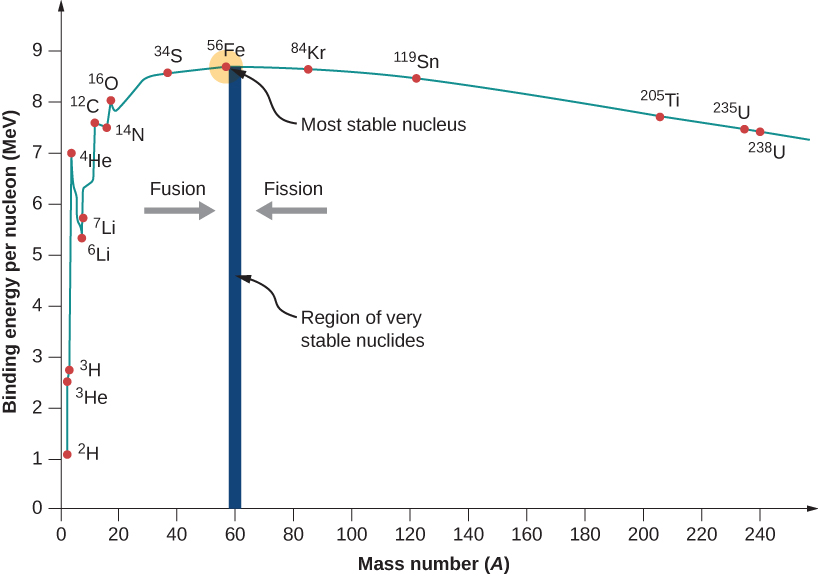
When protons and neutrons snap together like this, the finished nucleus ends up in a lower-energy state than the separate pieces, and the difference is given off as energy. This is where E = mc^2 comes in: the nucleus actually weighs a little less than the parts it’s made of. That energy is the binding energy. Run the process backwards and it’s also exactly what you’d need to pull the nucleus apart again. Divide it by the number of protons and neutrons and you get the average binding energy per nucleon, a measure of how tightly each one is held. The higher it is, the more energy was released in building the nucleus. That’s why fusing light nuclei into heavier, more tightly bound ones gives off energy.
The key point is that fusion energy is inherently safe because it is so hard to keep going: if anything goes wrong, or we simply stop feeding fuel into the reactor, the process stops on its own almost immediately. This isn’t necessarily the case with fission reactors: if you get a runaway chain reaction, it can be very hard to stop (although modern reactors are designed to make this extremely unlikely). And even once a fission reactor is switched off, its fuel keeps producing heat for days, which (without cooling) is what caused the meltdowns at Three Mile Island and Fukushima. Either way, fusion reactors don’t have these problems. On top of that, fusion energy is very clean, since it emits no greenhouse gases and its radioactive waste is far shorter-lived than that of fission (and, in some cases, there’s barely any at all!) But one of fusion’s most attractive points is its flexibility: energy can be produced on demand, and reactors can be built in different sizes.
Now, you might know that the Sun also produces its energy by fusing light elements into heavier ones, but the fusion we strive for on Earth is quite different. In the Sun, the first step involves fusing two hydrogen nuclei together, which are just two individual protons that have to get together to form a deuterium nucleus (alongside a positron and a neutrino). We’re getting into the muddy regime of particle physics, so here’s just a quick overview. A deuterium nucleus is formed by just one proton and one neutron. Wait, if we started off with two protons, where did that neutron come from? A very special fundamental force, the weak force, can change a proton into a neutron and vice versa. I know, it sounds like magic: protons and neutrons are made up of smaller constituents called quarks, and they each have 3 of them. What a fun coincidence, we’re talking about 3 quarks in 3 Quarks Daily! I’ll write a whole article on particle physics another day, but for now we need to know that each quark has a flavour (yes, just like ice cream), and that by changing the flavour of one of its quarks we can get a proton to become a neutron. As usual with things that sound like magic in physics, this takes a very long time: a proton in the Sun’s core waits, on average, about 9 billion years before it manages to fuse with another one. Yeah, us mortals on Earth don’t have time for that. So, we jumpstart the process and start with D-D and D-T fuels.
D-D and D-T fuels have some of the highest reaction cross-sections (especially D-T), which in layman’s terms means that these reactions are among the most likely to occur. In D-D, two deuterium nuclei fuse to form either a tritium nucleus (which consists of two neutrons and one proton) and a proton, or a helium-3 nucleus and a neutron. In D-T, deuterium and tritium fuse to produce a helium-4 nucleus and an extra neutron. These reactions are extremely energy dense: kilogram for kilogram, D-T fusion releases about four times more energy than even nuclear fission. Deuterium is a naturally occurring hydrogen isotope found in seawater, with around 1 of every 6500 hydrogen atoms being deuterium. Tritium, on the other hand, can be produced from lithium. Well, put together the lithium in your laptop’s battery and the deuterium in half a bathtub of seawater and you can cover one person’s electricity needs not for a month or a year, but for the next 30 years. When we talk about energy density, fusion (and in particular, D-T fusion) takes the undisputed crown.
So far, I’ve told you what we need to put together to get energy, but how do we actually put them together? The catch is that the fuel has to reach over 100 million °C, several times hotter than the Sun’s core, and that’s very hard to achieve. There are two main approaches to fusion: magnetic confinement fusion (MCF) and inertial confinement fusion (ICF), and they both focus on very different things. For the first approach, we need a very dilute plasma that we keep hot for a long time, whereas for the second we need a very dense capsule of fuel compressed for a very short time. Let’s look at them one by one.
You may have noticed I said MCF needs a plasma without telling you what that is. A plasma is a quasi-neutral ionised gas that exhibits collective behaviour, which roughly means that we have a gas formed by atoms which have been stripped of their electrons (so we have forced the nuclei to divorce their electrons) and that is, on a macroscopic scale, electrically neutral. The fact that it exhibits collective behaviour is why a plasma is so special: its nuclei and electrons will respond if we apply a magnetic or an electric field to them. I think you can see where the “magnetic” in “magnetic confinement fusion” is coming from. ICF uses a plasma too, just a far more concentrated one, squeezed inside a tiny fuel capsule.
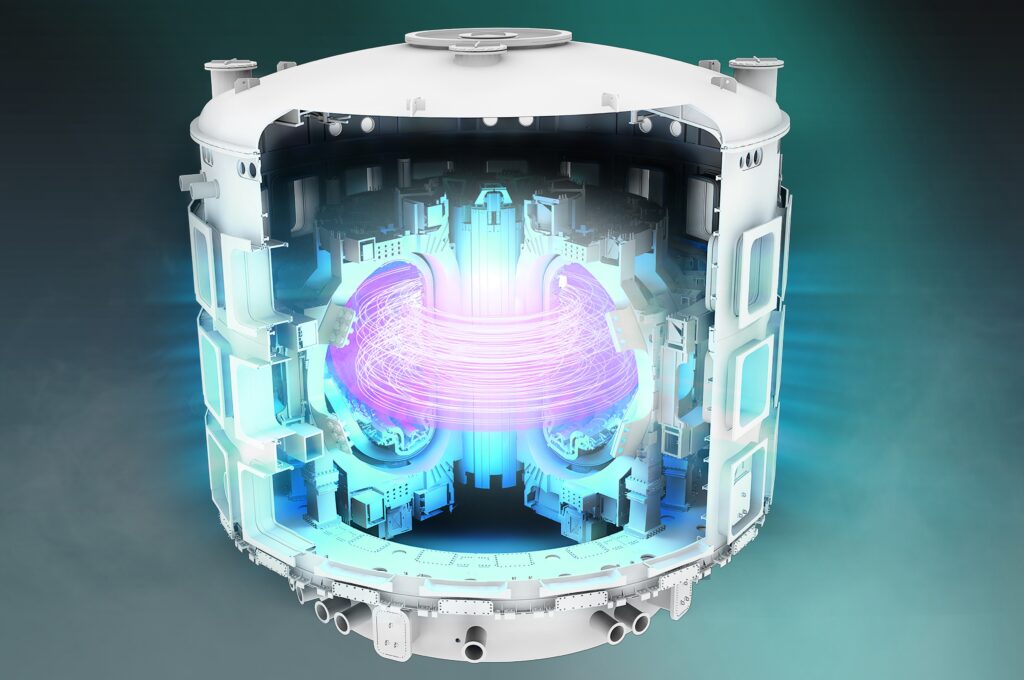
Here, you can see a picture of ITER, one of the most famous examples of a type of MCF reactor called a tokamak. Roughly, it works by inserting your plasma in that central donut shape and then running a changing magnetic field through the central solenoid (that long tube in the middle of the donut hole). From Faraday’s Law of Induction, we know that a time-varying magnetic field (in our case, going vertically upwards through the tube) will induce an electric field perpendicular to it (in our case, wrapping around the tube). To picture it, point your right thumb upwards and see how your fingers curl around it: that’s how the induced electric field wraps around the tube. What do we do with an electric field? Well, the electrons moving freely in the plasma react very quickly to it, moving in the opposite direction. You might remember that moving electrons generate a current. Hey! All of a sudden we have a current running through our plasma, heating it up. This alone can’t get the plasma hot enough, so we also blast it with radio waves and beams of fast particles. Very cold plasmas don’t fuse (they just don’t have enough energy to), but the hotter the plasma gets, the harder it is to keep stable, so controlling the temperature is key in achieving MCF. To confine the plasma, huge coils wrapped around the donut create a strong magnetic field running the long way around it. Combined with the magnetic field produced by the plasma’s own current, this gives twisted, helical field lines that keep the plasma trapped.
The Lawson criterion tells us that if the product of the plasma density and the confinement time is higher than a certain value (at the right temperature), we get a certain number of reactions. This determines whether we get enough energy out to make up for what we put in. So, MCF doesn’t focus on compressing the fuel, but on keeping it dense enough for long enough to get the reactions we need. There are many more details (and plenty of instabilities to deal with), but for me the important thing is that you get an overview of how this approach to fusion works.
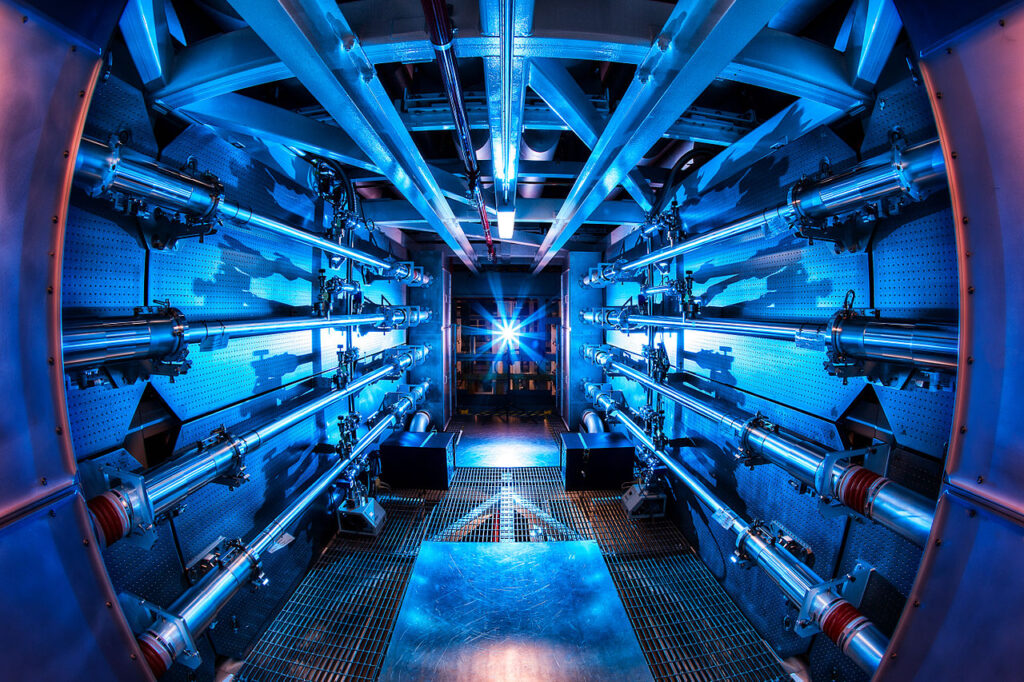
Parents are always told that they’re not supposed to have a favourite child, but fusion researchers skipped this lesson: every single one will be either Team MCF or Team ICF. Once again, there are different approaches to ICF in itself, including indirect and direct drive. Indirect drive involves putting a small capsule of fuel coated by an outer shell of usually high-density carbon (and by small, I mean less than a milligram of fuel) in an empty chamber with gold-coated walls, and then using lasers to heat up the walls. X-rays will be produced by the gold-coated walls all around this empty chamber, called a hohlraum. These X-rays in turn heat up the capsule from all angles. Direct drive works the exact same way, except that lasers heat up the fuel directly. In one key way, this approach is actually much harder: it is crucial to hit the capsule with the same energy from all angles to avoid deforming the fuel, which would introduce instabilities. In indirect drive, the X-rays are generated almost isotropically, meaning they heat the capsule nearly equally from all directions. After this, the outer shell ablates, meaning that it heats up and blasts outwards very rapidly and, just like the exhaust of a rocket, this pushes the rest of the capsule inwards, compressing it. Once the fuel is squeezed tight and hot enough: BOOM! It ignites and fuses, releasing our sought-after energy in the process. Exactly, this is the good boom I have been talking about since the beginning of the article.
You may ask me, “Carlota, if this is all so great, then why isn’t a fusion reactor providing me with the energy to make my coffee each morning?” Sadly, we are not at that level yet. Don’t get me wrong, we have produced record amounts of fusion energy in tokamaks and we have achieved ignition at laser fusion facilities, but the problem is that a lot of energy needs to go into getting the plasma hot enough or the fuel compressed enough (and by a lot, I mean that a single laser shot can use around 300 megajoules of electricity, enough to power a home for several days). Are we getting energy out of these processes? Yes. Is the power output enough to compensate for the power input? Well, not yet. There is a very important metric called the Q-factor, or gain, which effectively tells us whether a reactor is ready to go commercial. The physics gain is calculated as the ratio between the fusion power that comes out and the power we put in to heat the fuel: if we don’t get a value of at least Q = 1, driving fusion is just not worth it (and a real power plant will need a Q of 10 or more). It wasn’t until December 2022 that the National Ignition Facility at the Lawrence Livermore National Laboratory achieved a Q-factor greater than 1, achieving fusion ignition and making a historic scientific breakthrough (although this only counts the laser energy that reached the fuel, not the far larger amount of electricity needed to power the lasers). NIF has accomplished this several times since, reaching a gain of more than 4 in April 2025. Meanwhile, public institutions and private companies alike have been searching for new approaches to push Q as high as possible, in the hopes of making fusion commercially viable. However, for that, they need patience, support and, more than anything — funding.
All in all, I hope you now agree with me that not everything that goes “BOOM” is bad: inertial confinement fusion is believed by many experts in the field to be a serious contender for the future of fusion energy. And it’s nothing like the nuclear disasters people fear: the boom happens inside a capsule smaller than a peppercorn, and if anything goes wrong, the reaction simply stops. However, if you still don’t like implosions, you can just support our friends over in the magnetic confinement fusion department. It doesn’t matter what fandom you’re in as long as we keep investing in and researching different approaches to what I (and many like me) consider the future of energy production. It’s almost as if the most important thing is that we fuse our efforts.
***
Enjoying the content on 3QD? Help keep us going by donating now.