
David Chanoff at The American Scholar:
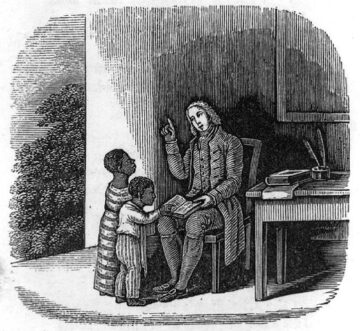 In his 2007 book, Head and Heart, Garry Wills called Anthony Benezet “the one unquestionably authentic American saint.” More than 200 years earlier, French revolutionary Jacques Pierre Brissot wrote, “Who is equal to Benezet? Who was more virtuous than Benezet? Who was more useful to society, to mankind?” Benezet, an 18th-century Philadelphia Quaker, was instrumental in ending the transatlantic slave trade. It was Benezet, too, who precipitated America’s long national discussion of Black and white equality, an unthinkable concept in his day. He was a person of not only national but global importance. Yet astonishingly, he has almost entirely slipped out of the American historical memory. Today, this man, who did so much to trigger America’s abolitionist movement and England’s as well, is known mainly to a small circle of scholars.
Philadelphia’s Quakers had started brooding about slavery in 1688, seven years after William Penn founded the colony of Pennsylvania. A group of Friends in nearby Germantown had issued a remonstrance that made its way to the Quakers’ highest colonial authority. “We are,” the Germantown Friends declared, “against the traffic of men-body … To bring men hither, or rob and sell them against their will, we stand against.”
more here.
Enjoying the content on 3QD? Help keep us going by donating now.