by David Hoyt
From where I stand, the rotor of the wind turbine rises above the moraine like the body of a breaching whale. A horizontal uplift of ponderous mass, the defiant, graceful camber as the tail reaches to the vertical, sloughing off wind as a whale might saltwater. It is followed by another, and then another. The turbine is anchored on some farm on the plains below, out of view, sending its westward-facing rotors up to the sky, over and over.
The wind that turns them is the wind I will use to burn the ground I’m standing on. It blows light today, scuttling around in the vales and lobes of prairie between the lines of timber, turning east then west. The fire will need to be herded, nudged here and there with sprays of water and kept within the bounds of the firebreaks mowed for just this purpose.
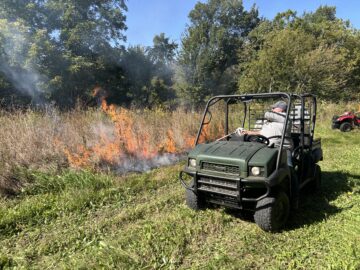
We round the old field on Kawasaki four-wheelers, a canister of diesel fuel rattling between my legs, and water in a fifty gallon tank sloshing on the back of the buggy. In each canister are the fluids bringing life and death to the fire that will make its own decisions for much of the afternoon about just where it wants to go and just what it wants to do.
Our equipment is modern – diesel fuel, four-wheelers, walkie-talkie radios to communicate through fields of drifting smoke and the crackle of burning prairie grass. But the essence of what we are doing is ancient. We are herding something wild across a tiny portion of what was largest grassland on Earth. Things meant to live here spill like water on a gently tilted surface, roaming from horizon to horizon. The wind, above all, roams unstoppable from the Great Plains to this eroded glacial hill, as it once roamed with the enormous beasts of the Pleistocene, with the caribou, the bison, and with fire. None of them knew boundaries.
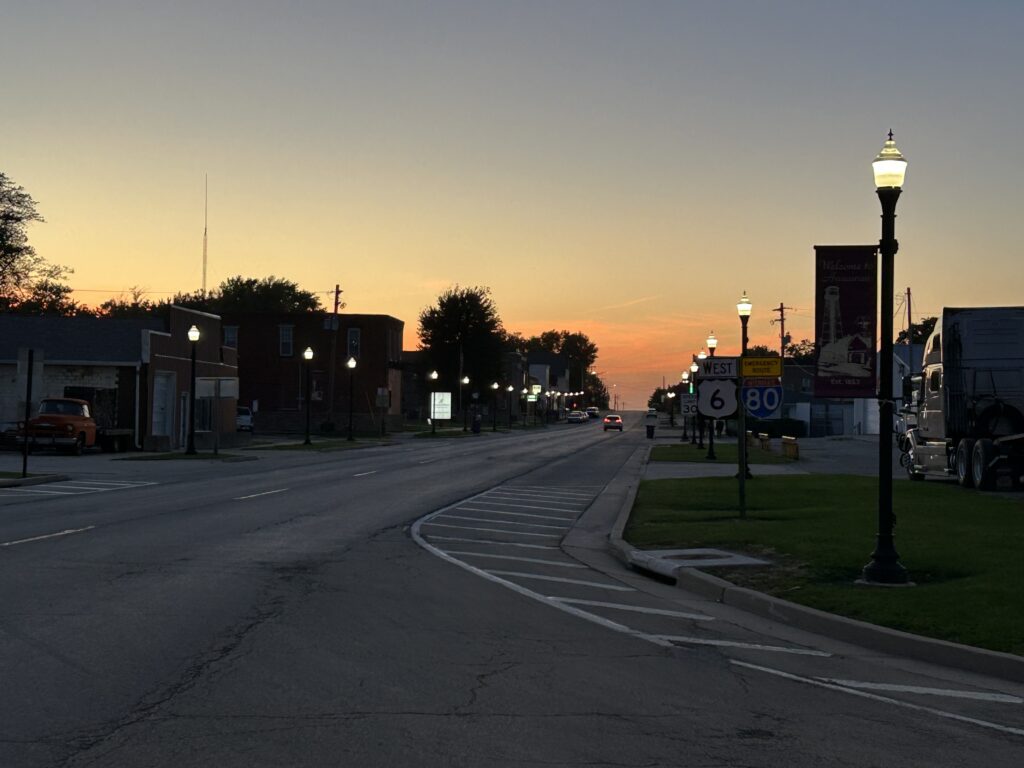
The only thing besides the wind that still roams across these plains now is the traffic on I-80, but even that is contained in a narrow, roaring ribbon, a procession of semi-tractor trailers laboring along trails where woolly mammoths once tread. As Stephen J. Pyne, America’s philosopher-historian of fire puts it, the combustion that has inhabited this and other landscapes for millennia, the fires that coevolved with oxygen-dependent life on Earth, have been boxed and corralled, stowed away in internal combustion engines and power plants, snuffed out on the land nearly everywhere.
Where fire does reassert itself, it does so angrily, often out of control, bursting from its confinement with a fury fanned by aggravating factors new since the days of free-range fires of Native America. We will welcome it back here, cognizant of its rights, thankful of its benefits to the land and the life of which it is an intrinsic part. For a brief time, on this prairie, in a controlled way, we will set it free again.
The burn boss, who I will call Frank, is a Kawasaki cowboy. Side-by-side on the four-wheeler we circle the section to be burnt, about five acres – small, but tricky – stopping at each angle and bend. If I happen to be saying something to him, he stops listening. He’s looking at the seed heads of the big bluestem, the three-pronged “turkey feet” of racemes characteristic of this ubiquitous and towering prairie grass. Theses specimens are not long for this world, bobbing at the tops of six, seven, or eight foot stems now brown in the dry air of early October.
Yet they betray themselves with each subtle nod of their turkey feet seedheads and sway of the stem, indicating wind direction. “I’ve seen wind go out into a finger of grass and come back in a completely different direction than you would ever expect,” Frank tells me as we gallop to the next contour of the fire break. “This is a tricky one.”
He hands me the drip torch, a can full of diesel mixed with gasoline at a 7:3 ratio. He turns to Sid, who looks like a much thinner version of John Fetterman in black, wrap-around sunglasses and a cigarette hanging vertically from his lips as if pasted there. Sid throws me the lighter. I dip the torch over the green, wetted grass of the firebreak and light the wick. This is the flame that will grow to consume a part of this prairie. We are at the highest point of the property, and one of the highest points on the surrounding moraine. We are about as far east on the parcel as we can get. We are lighting the backfire, a line of fire set into the wind as a backstop against any fire, much more powerful, driven towards it by the prevailing wind.
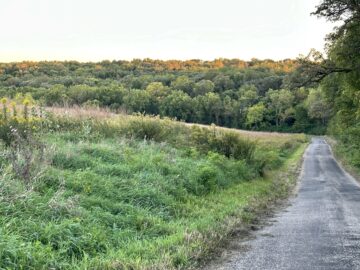
I call this upland a moraine, but that’s not really what it is. A moraine is a lip of gravel till left at the edge of a receding glacier. It is usually full of gravel and stones. But the soil profile of the prairie provided by the USDA indicates that this field, which has probably been planted in corn for over a century, is “Fayette silt loam.” Silt is not, properly speaking, the stuff of which moraines are built. In fact, Fayette silt loam is a type of loess, and what characterizes loess is, in a lexical convergence of geology and poetry, its eolian origin. It was deposited over the course of ages by the wind.
So these hills, which do outline more or less the tongue of the last, departed Illinoian glacial extension, were not shoveled here like snow left by a plow. Picture a plain of frigid, towering sand dunes on an arctic surface, and a horizon hidden by howling clouds of stone meal cast off by the work of glaciers busy grinding the bedrock of a continent. For a hundred miles or so west of the retreated ice sheet, this sand drifted and accumulated into dunes, which became the uplands and rolling hills of Henry County, Illinois. It is visible from the surface a few miles north, where it washed out from under the heavy belly of the glacier and into the broad flood plain of what is now the Green River.
The loess that makes the upland, the hill which hides half the wind turbine to the west, was built by the wind before any green plant grew here. Now the turbines harvest the wind that moved the earth. Dunes and, later, giant camels to climb them don’t make up the typical Midwestern sense of place, but they have residency claims to the local imaginary as solid as any corn silo or hog barn. And the loess of which they are composed is some of the best farmland on Earth.
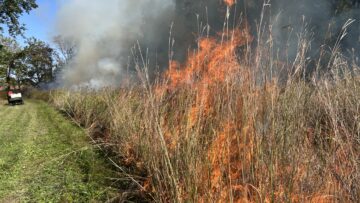
I swing the drip torch into the vegetation, targeting the browned, bunched leaves of the Big bluestem that form a layer of thatch just above the ground. I am rewarded with an instant crackling, the kind of sound I imagine a Hollywood production engineer would pull up whenever a campfire scene was called for. But that lasts less than a minute. I begin walking the wet line, where Frank has already passed with his water nozzle several times. I drip flaming fuel into the grass. Behind me, orange wraiths are summoned from the field. Dancing effigies of flame stand to look me in the eye, then drive me further down the line with their heat. The burn is on.
What we are doing is a fall, or late-season burn. They are less commonly practiced than a spring, or early-season burn. By March, most of what is on the ground is dead and dry and ready to go up like kindling. A spring burn clears thatch, lets the sun reach seeds and young shoots that might otherwise have been shaded by the thatch or more aggressive plants.
A late-season burn, in contrast, goes after living vegetation in order to damage it, set it back, and make room for competing plants. Without a fire, a prairie will evolve over time towards a state of less diversity, in which a few dominant plants crowd out others and approach a state of monoculture. With less floristic diversity, there is less diversity of invertebrates (bees, beetles, butterflies) and with a monoculture, the vegetation structure supports fewer species of birds and small mammals.
A Bluestem monoculture is what I was looking at as we circled the prairie. Tall, indigenous grass, yes, but virtually devoid of pollinators or Lepidoptera. The lack of stiff stemmed plants such as Prairie dock or Indian plantain meant fewer perches for Dickcissels or Common Yellowthroats. The absence of variation in height meant fewer of the sparrows that prefer lower vegetation or cover. A uniform field of Bluestem or Goldenrod, which is what I had, is not ecologically much different from a field of planted corn.
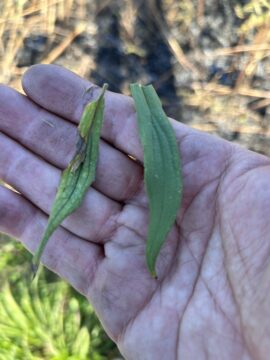
So we are here to knock back these tall, dominant plants while they still have some life in them, not just to burn them away, but to cook the stems and leaves until they are no longer able to photosynthesize and store nutrients in their roots ahead of the coming winter. In this diminished (though by no means terminally damaged) state, they will emerge next spring less vigorous, ceding a bit more ground and resources to other shorter, less aggressive plants that I will seed over the winter. Or, at least, so I hope.
We outline the eastern edge of the field with fire. Where it first rose up to look me in the eye, it now crackles low to the ground, moving slowly across the earth like a foraging animal. A few dragon flies and rabbits make their escape, but nothing like the stampede of wildlife triggered by the true prairie fires described by early settlers to this region.
Frank says it is a good fire, that it is slow but steady. It’s chewing into a lot of green goldenrod, feeling around for fuel, slowing down where there is not enough. But all of this was as expected. Across the firebreak, another section of Bluestem will go several more years before burning, so as to further diversify the habitat, building thatch all that time. Frank knows how it would go. “With a big field of Bluestem and a good wind it sounds like a frickin’ freight train.” With optimal conditions and an experienced crew, such a fire can create its own updraft, a sort of tornado of combustion that draws the air towards it and, most importantly for the neighbors, the smoke.
“You have neighbors,” Frank tells me as his Kawasaki halts in front of me a little ahead of the fire line. “Did you send them a letter?”
“I did,” I tell him, as required by the burn plan. Everything we are doing today has been planned months in advance, permitted and approved by several layers of bureaucracy.
That neighbor is a kindly man with a handsome and brindled red Irish pointer which carouses in my fields all winter and has never yet approved of my presence. His evening barking occasionally rouses every coyote within a mile’s radius to join in a somewhat intimidating canid chorus.
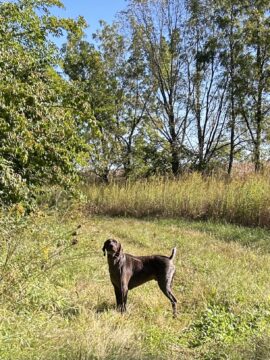
The neighbor didn’t really understand why we were burning, and certainly not why someone would pay good money to have it done. But it is a part of country life, and I am neither the first nor the only one to do so. “You’re the first this fall,” Frank tells me. “I’ve got about 50 lined up after you.”
I emerge from the peninsula of prairie, surrounded by timber, and into the wide open field. We’ve ignited the leeward perimeter and I’m approaching the windward firebreak. The field has now been ringed with fire on three sides. Once this has had a chance to burn and form a backstop of charred ground, we will close the box by lighting on the windward side. In principle, all these fires should approach the center of the field and collapse in one final, disciplined conflagration.
“If it gets hot,” Frank tells me several times, “don’t be afraid to run.”
There was reason for me now to step back. Two flanks of fire were meeting in a corner of the field and sending flames reaching into the sky. I set down my torch to behold as the two fronts merged into something of greater heat, height, and wildness. The smoke reaches up thick and the noise becomes hard to shout across. A neighbor who had owned this land and burnt this prairie before me told me, “You’ll get 25-30 foot flames, and you’d better be on the right side of ‘em ’cause you can’t outrun ‘em.”
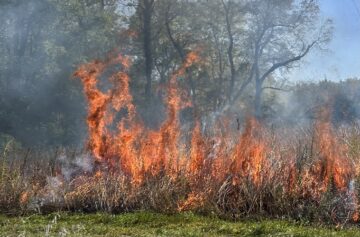
I suspect that this neighbor, a sensitive but independent-minded individual, had the habit of lighting head fires, beginning on the windward side and letting it go until it ran into the timber three quarters of a mile away. With that much grass and a good west wind, I can well imagine a racehorse of a fire speeding to the far property line and possibly beyond. I’ve found charred wood in the surrounding ravines beyond the firebreaks, and I observed that the fleece collar of his winter Carhartt coat had been completely singed off.
That’s not the kind of fire we had nor wanted. But the one we had was powerful enough to demand respect, and powerful enough to do the job. The thick white smoke drifts sideways, and then straightens up into a column. I hop on the Kawasaki with Frank and we circle to observe, checking in via radio with Sid on the other side. Now the head fire was going, leaping and dancing forward and back, throwing the strange gaseous shapes that we call fire into the air as ashes fall all around.
This land had been burnt many times, but did not present itself as a healthy, diverse grassland ecosystem. It looked like a recovering corn field that could hide a lot of deer, which is the way some people like it. We knew it had been repeatedly burnt in the spring, which advantages warm season grasses and taller plants like Big bluestem. So we were trying to correct this imbalance, to introduce a different kind of disturbance to benefit a different set of organisms, with greater diversity being the ultimate objective.
But it’s hard to know what the land wants. I admit to having my own preconceptions. I’m sure each of the previous owners of this small piece of Earth for the nearly two centuries of recorded cadastral land transactions has had their own preconceptions, to say nothing of the many generations of Indigenous peoples who preceded any of us.
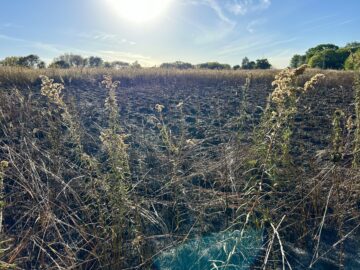
When the State of Illinois first surveyed the lands within its newly established boundaries in the 1830’s, this area was forested, as one would expect for well-drained, upland country. A century later, by the 1930’s, when the USDA undertook to aerially photograph all of the nation’s agricultural land, the tree cover was gone and most all of the area was in cultivation. Even the surrounding slopes, with grades approaching 30%, were under the plow. Trees were scattered. Erosion was a likely outcome. Now, it is somewhere in the middle. The surrounding erosion-prone slopes have been put into prairie, and timber has returned to the ravines, property lines, and lower areas. In the middle and above much of it sits Grouse Prairie.
What does Grouse Prairie want to be? Now parts of it are blackened. Next year, different parts may be blackened. New seeds will be sown on this black ground after the frost, and the land will supply a provisional reply next spring, or perhaps the spring after that. Does it want to be a prairie? Or does it want to be a wood? Or does it want to be a savanna, something in between? Does it want to summon birds I most desire to help, or does it have its own ideas that I may not yet have imagined? It is hard to know with something that communicates in such cryptic ways, and over such long time spans. But I am here, and I have started to listen.