
by Lei Wang
The money of the mind is attention, I read recently in the first line of a poem, which may as well be a poetry x LinkedIn post title collaboration. Meanwhile, I’ve also heard that the definition of poetry is attention, period, so is poetry the money of the mind? (Sorry, I’m not a logician.) And if so, what do we spend our poems on?
Growing up in a tiny town in urban New Jersey, just across the river from New York, I was obsessed with Annie Dillard (RIP). But in recent years, I’ve heard she wasn’t cool anymore: too earnest, interested in the sublime unironically and without drugs. I miss the days when I did not pay attention to what was cool, when I mostly wore free oversized T-shirts from Envirothon, a team natural science competition in sniffing soils and identifying bird calls (my only sport in high school). Except my high school in a converted factory was so removed from nature that the first time I ever saw the shape of deer poop was in the form of rubberized scat our environmental studies teacher ordered as a teaching tool.
In comparison, Annie Dillard felt so wise and cultured, so knowledgeable about nature (though she also grew up in the city—Pittsburgh!). I was jealous of what she recounted in An American Childhood, when her whole family would sit around at the dining table dissecting a joke. Sometimes the punchline of a joke would come a full week later: hers was that kind of family, that knew how to spend well the money of their minds. Humor, after all, is a free gift from the universe: less about the object than about a way of seeing the object, a way of seeing anything, object +1.
There are so many free gifts from the universe, and Annie Dillard noticed them, delighted in them, wrote about them specifically and yet with that edge of humor and mortality (people are always linking her with mortality), like a snarkier, more Goth Mary Oliver. But while she wrote about what she saw, she also wrote about what was missing, which is maybe where the real mortality is, everything that is lost that is right in front of us:
“Now I can see birds. Probably some people can look at the grass at their feet and discover all the crawling creatures. I would like to know grasses and sedges—and care. Then my least journey into the world would be a field trip, a series of happy recognitions. Thoreau, in an expansive mood, exulted, ‘What a rich book might be made about buds, including, perhaps sprouts!’ It would be nice to think so. I cherish mental images I have of three perfectly happy people. One collects stones. Another—an Englishman, say—watches clouds. The third lives on a coast and collects drops of seawater which he examines microscopically and mounts. But I don’t see what the specialist sees, and so I cut myself off, not only from the total picture, but from the various forms of happiness.”
That line: “I would like to know grasses and sedges—and care.” An aspirational mad lib for anything. I would like to know _______ and ________—and care. To turn the world into a field of care. “The lover can see,” Annie Dillard continues, “and the knowledgeable.”
But we can’t all be a herpetologist who sees a rare endangered pit viper—and cares not just to get the hell away from it. We simply don’t have this capacity to care about all the things there are to care about, even though the self-help world likes to expound on how time (at least in days, if not years) is egalitarian. Everyone gets 86,400 seconds in a day, every day. The psychologist Daniel Kahneman says that the psychological “present” lasts about three seconds, so doing some poetic math, we have 28,800 potential moments of presence in a day. We all have the same money of the mind to spend, theoretically, though some people have much more harrowing or leisurely seconds. (As the poet Naomi Shihab Nye writes in “No Explosions,” “To enjoy fireworks you would have to have lived a different kind of life.”)
There is so much we miss, that we can’t help but miss: this is what extroverts understand about strangers, that they are potential friends. Sometimes when a country or other distasteful-to-me song is playing (imagine what you will), I imagine other people cuddling to the song, a very long song. When I am bored at a classical music concert, I consider friends who go into raptures over Dvorak. Clearly, I’m the one missing the receptor.
And yet the receptor may not so much be essence as education, what we choose to spend the money of our minds on. When life is good, the things we love align with the things that we pay attention to, and really deep attention is a kind of love. We can’t learn to love everything, or love the world as abstraction, but we can get TO love through anything, if deep and specific enough. But we all seem to have our specific doorways, things that work better for us than others.
When I have a love interest, anything they’re interested in takes on a new sheen for me, and now I am willing to learn about Latin American politics, about UK soccer. (My mother says, if only I had fallen in love with a physicist in high school instead of an environmentalist, I’d be good at math now.) A lot of meditation is actually about the question of fit. Which objects work better for you to pay attention to than others? It very well may not be the breath, yet if you do pay attention long enough, it could be. If humor is a point of view, so is meditation, more than any technique that gets us to that point of view.
This past summer, I was one of a handful of artists hanging out with a bunch of scientists at the Diverse Intelligences Summer Institute, three weeks of lectures on animal cognition, collective intelligence, and AI that often went over my head. But one of the lectures was from a humanities scholar, Phil Ford, who challenged us to think about the intelligence and aliveness of objects. He told us about the Rilke poem in which Rilke is basically describing a statue and then, out of nowhere, says, “You must change your life.”
He told us to go to an art museum, find a piece of art that felt alive to us, whatever that meant, and look at it for at least half an hour to an hour, to really pay attention and see what happens. And at the end, we were to “perform a reverence” to the piece of art, a hand over heart or some other gesture, as if it were really a being we honored. If we had trouble determining what was alive in the first place, he said, we should simply pretend to be witches with the ability to spot life. It was about intuition versus the intellect. Two months later, I finally tried it. (Apparently, the New York Times has a similar 10-minute art challenge, but I have always liked to do the more extreme version of things.)
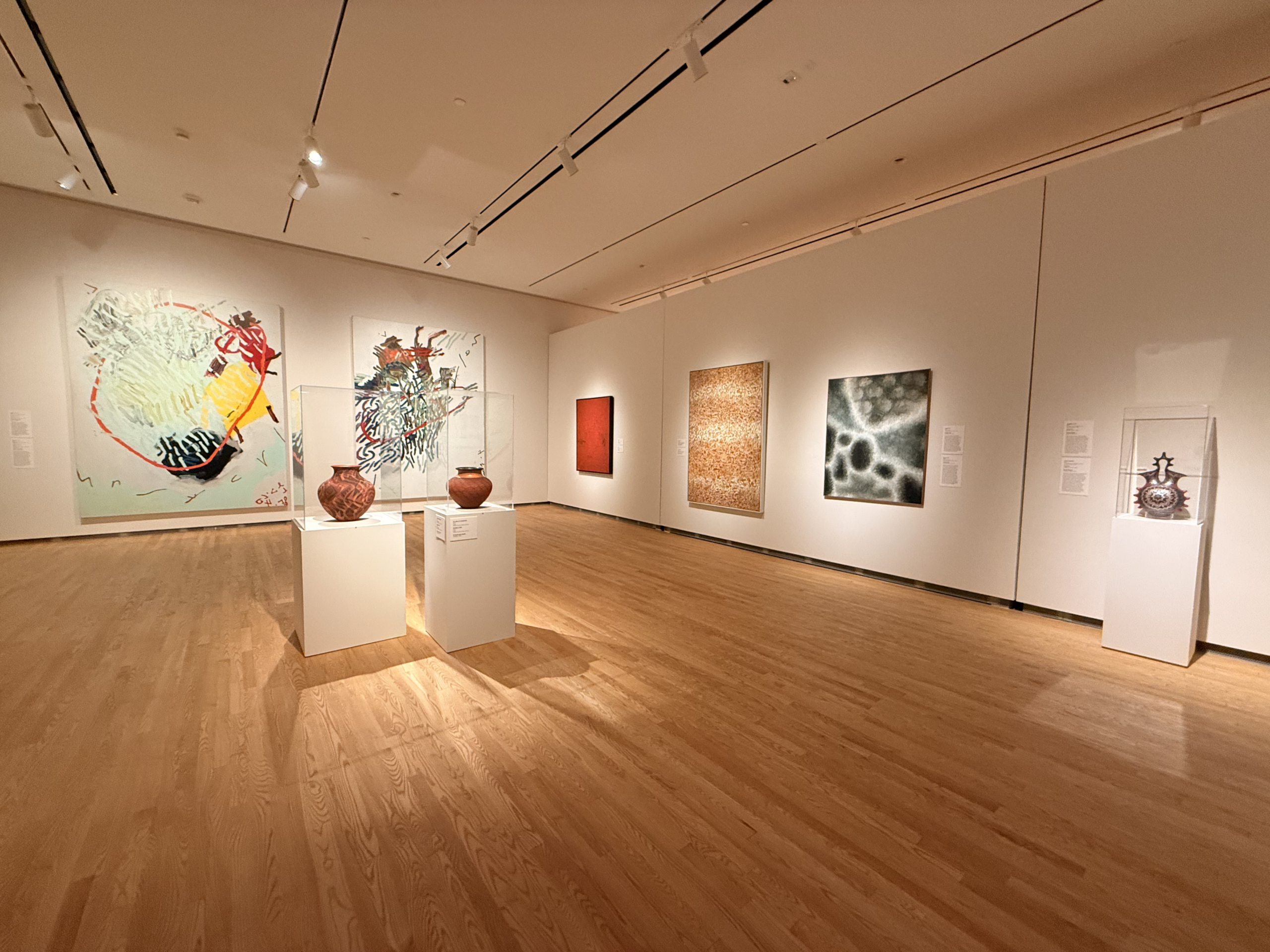
This was truly a challenge for me, because I have never understood visual art (though I’m often told it is not about “understanding”—again not about intellect). But aside from a very few artists I personally know and like, paintings have never really done it for me, especially paintings in museums. I always end up feeling inadequate, like I’m not getting something important that other people, and they don’t even know—so I’m a big pretender!
The last time I went to a museum with a friend (the Gardner in Boston), simply because that is a thing one does when visiting a city, she showed me a trick: instead of looking at the objects in the museum through the point of view of an art appreciator or aficionado, or even from the point of view of a learner who is still supposed to “get” something, what if I looked at it from the point of view of a shopper? Suddenly everything became much more fun. Would I want this statue of disgruntled baby Jesus in my living room or not? I was not using the money of the mind to evaluate or worry about whether or not I was supposed to like something, I was using the money of money. I could much better access whether or not I actually LIKED something, i.e. wanted to spend an extended period of time with it, by using a part of my brain I already knew how to use, instead of thinking I was missing a different part that could look at art specifically. It was a great trick.
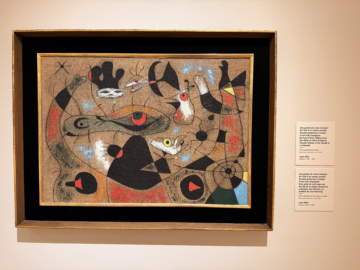
But now I had to drop this trick, do something more earnest. I went to the local art museum on Thursday, looking not even for what I liked but for what felt “alive.” I tried not to fret about making the wrong decision. The painting I settled on, by a Japanese painter I had never heard of, was not the most flamboyantly alive. In fact, though it was supposed to represents rocks in water(?), it looked kind of like cells, so I may have been interpreting the prompt too literally.
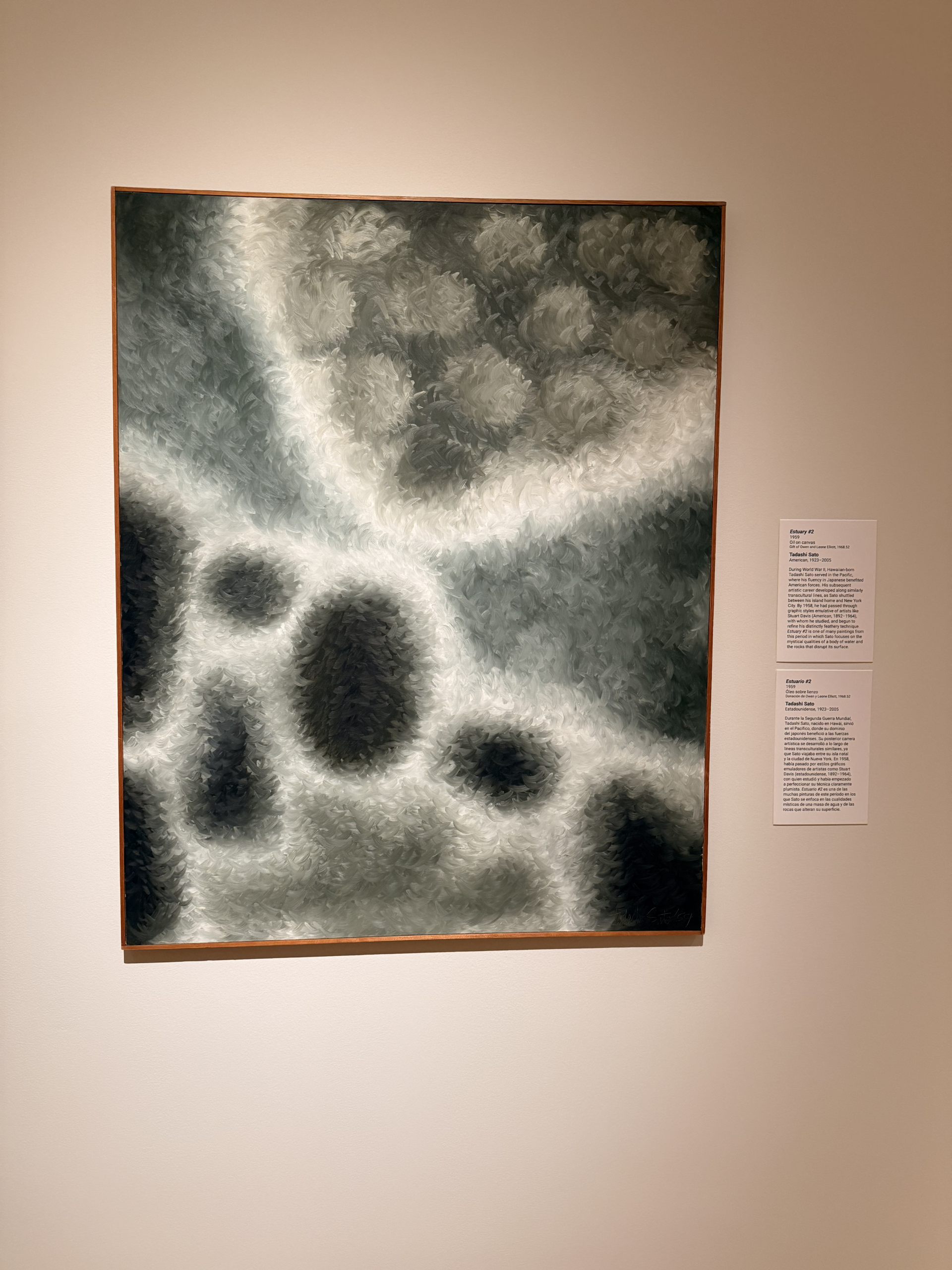
But I did it. I stayed, and I looked, without knowing what I was supposed to be looking for. I did not do a full hour, not even half an hour, just 18 minutes, the length of the longest single song I knew. At first, the painting just looked like a close-up of a scruffy modern refrigerator. Every so often the motion sensor gallery lights would turn off and the painting would change. Because there was no seating, I was standing in front of the painting in a miniature tai chi horse stance, and it felt a bit ridiculous, looking like this, but I could feel something happening. I was still paying attention to the painting, but then I was really paying attention to attention itself, to the soupy potential space that held the painting but also the wall, the floor, my body, my mind.
I had slipped into meditation by accident and once again, I was afraid of doing it wrong: I was supposed to be paying attention to the painting! It felt really good though. The opposite of happiness, I’ve heard, is not sadness but boredom. And boredom is not simply having nothing to do but nothing worth paying attention to.
I could have been looking at anything, even a piece of garbage, this way, and felt good, if I were really looking. Advanced meditators look at blank walls and see textures and patterns, because a blank wall is never blank.
And then I started crying for a totally different reason, which was thinking of how my parents never learned to pay attention this way. All art was frivolous, but even in a now frivolous country, they only know what other people consider to be good instead of what they truly consider to be good, looking always outside and not inside. They are still too busy spending the money of their minds on survival and Chinese television.
This looking did not change my life, except in the sense that everything we do changes our lives. It did not really even change my attitude towards paintings. I was not Annie Dillard in my favorite chapter of Pilgrim when she described the blind girl seeing for the first time:
“When her doctor took her bandages off and led her into the garden, the girl who was no longer blind saw ‘the tree with the lights in it.’ It was for this tree I searched through the peach orchards of summer, in the forests of fall and down winter and spring for years. Then one day I was walking along Tinker creek and thinking of nothing at all and I saw the tree with the lights in it. I saw the backyard cedar where the mourning doves roost charged and transfigured, each cell buzzing with flame. I stood on the grass with the lights in it, grass that was wholly fire, utterly focused and utterly dreamed… I had been my whole life a bell and never knew it until at that moment I was lifted and struck.”
I have seen the tree with the lights in it, and this was not it. But I am always somehow looking for the tree with the lights in it, and missing just the trees, just the ordinary light. I did not need the painting to change my life, because no one thing can. If the painting were alive, if the painting were a person, that would be way too much pressure on any relationship. I no longer want to change my life in one fell swoop. I want to pay attention in small ways, not as if everything were art—again, too much pressure—but as if everything were worthy of attention—and what mattered was the quality of my attention, not the quality of the object. Even red dresses on sale in little boxes and other things on my computer screen count. Even solitaire.
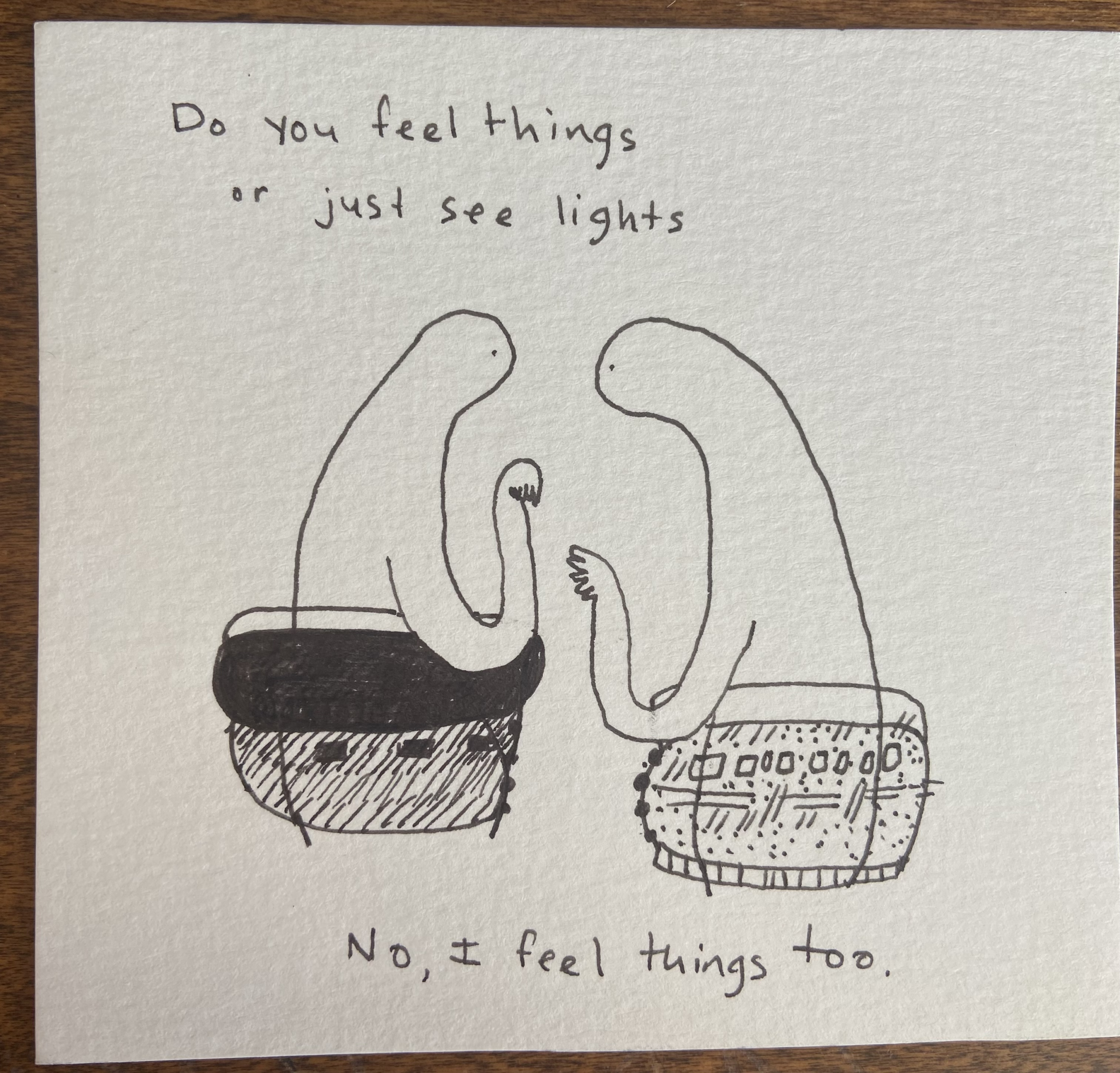
Just now, I went back to the Joshua Bennett poem that began with, “The money of the mind is attention,” only to find that the whole line is, “The money of the mind is attention, maybe.” The money of the mind may very well be something else! Anyway, the longest single song I know is called Pockets of Light, which felt very apt, and when it was over, I bowed to the painting and left to spend the money of my mind—or whatever it is—elsewhere, knowing I could look at anything at all.
***
Enjoying the content on 3QD? Help keep us going by donating now.