
Alex Lanz in LARB:
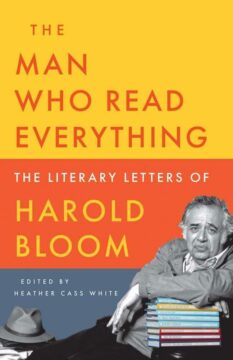
“MR. BLOOM READ with relish the lustrous verses of Blake and Shelley,” I am tempted to write, since Harold Bloom, the author of The Anxiety of Influence: A Theory of Poetry (1973), delighted in sharing his surname with the everyman hero of Jewish descent in James Joyce’s Ulysses. The American critic, born in New York City to Yiddish-speaking, Orthodox Jewish parents in 1930, taught at Yale from 1955 until his death in 2019, his reputation proving as expansive as those of the poets he extolled, and at a time when those figures were critically out of fashion. Tall tales grew around Bloom: that he was a prodigious reader who had finished Moby-Dick before age 10, gifted with a photographic memory that let him recite Milton backward, and so on. Students in my younger-millennial age group, if we thought of him at all, considered Bloom a curmudgeonly taste baron from the 1990s. He seemed like a dangerous man, hidden in obscurity like Kurtz in Heart of Darkness, in the unlit corner of some Yale building’s cellar floor.
No doubt these representations say more about me than about Bloom. But with The Man Who Read Everything: The Literary Letters of Harold Bloom, a new book of correspondence between Bloom and his literary colleagues (edited by the scholar Heather Cass White), we are afforded a chance to hear what Bloom had to say for himself. “Lord knows what I am,” he wrote to the poet John Hollander, the “savant” of prosody, in 1975, “not a poet, critic, scholar, historian, psychoanalyst, philosopher, or theosophist—but a worthless mélange of the gang of it.” To the great Southern lyricist A. R. Ammons, he once wrote, “Don’t tell me I ought to write verse—I don’t want to, can’t and shouldn’t. Something will develop if I can just keep working, but it will be in prose. I’m not an artist or a critic, or a hybrid of the two, but something odder and less, a reader.”
More here.
Enjoying the content on 3QD? Help keep us going by donating now.