
by Laurence Peterson
Let’s just plan for catastrophic success. —Jared Kushner
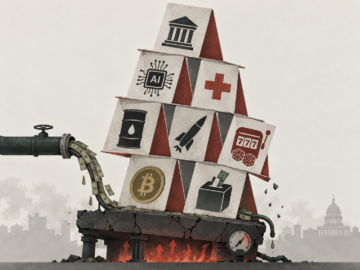 The present must certainly constitute one of the weirdest and most perverse economic conjunctures in my lifetime, maybe in the whole grotesquely contradictory history of a modern capitalism we can recognize. What productive power remains in it seems these days exaggeratedly limited to an AI sector that vanishes into opaque and circular financing schemes of extraordinary complexity–and whose own chief boosters advertise its propensity to replace all our jobs or even destroy humanity altogether–a health care system renowned for its waste, poor outcomes and expenses that consistently outpace inflation, dirty energy, merchants of death in arms manufacture and scams like gambling and crypto (all sectors contributing outsized amounts in the upcoming already donation-bloated midterm elections, by the way), which has been endowed by the recent siphoning of profits from tariff refunds that will never get passed on to consumers; and this feeds, in turn, into a dangerously delicate financial structure that provides liquidity on condition that its main players can skim off the top and hide risks, all whilst assuming that the government will bail out the perpetrators if the liquidity spigot explodes in what Adam Tooze calls an “intensifying spiral of perverse interactions“–more on this later; and all this gets pressurized in a political environment featuring an unprovoked war almost no one supports, which is contributing to historic deficits that even traditional buyers of US debt are balking at opportunities to buy into, with vital energy sources beginning to show long-overdue signs of drawing-down, bottlenecks and stress, all of which will compound the inflation that threatens to explode the liquidity spigot; and all of this supervised–if that’s what you want to call it–by a government spectacularly unresponsive to much of anything beyond expanding the otherworldly extent of its corruption, vilifying and repressing its opponents, and doing the bidding of a genocidal regime, Israel, that seems completely indifferent to its very fate. Whew. I am sure I am neglecting organic elements of potential catastrophe, but I think this is a satisfactory start where assessing the lunacy is concerned.
The biggest problem with all this consists in the fact that unprecedented amounts of money, collateralized by tremendous debt, are being thrown into a growing, but still narrow part of the economy that has yet to produce profits anywhere near the amounts that would justify the vast sums invested. In addition, the visible productivity gains captured by employing AI, which might begin to appear in wider macroeconomic statistics, are doing so only slowly and bear significant caveats. Boosters of AI rightly point to the outstanding and rapid success of AI model performance in just the last year-and-one-half alone, but the question remains whether so, so, so much investment–predicated on assumptions of significant, or even exorbitant, profits–can be realized by anything at all, remains. And another issue arises: because so much is flowing into AI, does that not imply that there is very little else worthwhile to invest in in our economy?
As a percentage of GDP growth contributed by AI, the picture is again unclear. There is no question that the figures are quite high in the industry narrowly considered and also in closely related industries like data center and utility construction, but the growth may obscure dependence on increasingly fragile supply chains (which are now endangered by tariff threats and disruption due to the Iran and Ukraine wars), and which include a large import component; so the lopsided contributions may again, especially when the quarterly GDP figure has been low (which it has been for three out of the last six quarters, or the whole of the second Trump Administration), testify to weakness in the rest of the economy as it does to vigor in AI-related sectors that may have to adjust to the realities of a deteriorating trade situation in the near future, anyway.
To get a better idea of what is going on in the economy beyond AI, a few developments must be highlighted. As mentioned above, corporate profits scored nearly a record high in the quarter ending June 30th, with much of the gain accounted for by the refunding of Trump’s tariffs deemed illegal by the Supreme Court to corporations–not consumers. Meanwhile, the labor share fell to a record low. On top of this, it appears that the performance of the US economy depends more and more on the spending of the wealthy, who usually tend to save more of their incomes than ordinary or poorer people, as their extra purchases are non-essential, suggesting that the rich are splurging whilst those less fortunate are cutting back on essentials. This also means that any pullback in asset prices, especially stocks and bonds, could push the entire economy into contraction, with the wealthy cutting back unnecessary purchases in tandem with the losses, unless the labor share somehow reverses rather miraculously, and completely contrary to the historical pattern. And this information is amplified by a very recent finding that American spending is driven more by assets connected to Wall Street than to what has been traditional in the US for generations: real estate (the prices of which are lagging equity prices by quite a bit). Thus: rather than using homes as collateral or a reference to gauge an appropriate level of consumer spending, asset price performance provides those parameters for the distinct few who hold those investments in this country. Meanwhile, household (and housing) debt is close to an all-time high.
On the employment front, 162,000 jobs were created in August, but that encouraging figure followed three poor months, all of which were subject to important revisions. Average hourly earnings clocked in at a 3.1% annualized increase over the August, 2025 figure, which would be alright, but for the fact that it lagged the 3.4% increase in inflation significantly. And this is where the elephant in the room–inflation–makes its dramatic entrance into the discussion.
Since the time of COVID, US inflation has been on a rollercoaster ride, with the somewhat shockingly high readings resulting clearly from bottlenecks deriving from the pandemic settling down, but at mysteriously high levels, which the economist Isabella Weber has called “sellers’ inflation” (and others have referred to as greedflation, still others as “shrinkflation“, and on and on), which refers to corporations maintaining higher prices when supply considerations no longer demand them, until the late Biden Administration and into Trump’s second term. But with the onset of Trump’s peculiarly aggressive and erratic tariff policy and a launching of war on Iran that pushed the oil–and other: fertilizer, helium, vital in silicon chip production–and other essential component and secondary markets into utter turmoil, price pressure has been consistently high and it is debated amongst many why inflation is not much, much higher.
Recent developments regarding the situation in the theater of war only magnify this sentiment. The amount of oil getting through the chokepoints of Strait of Hormuz, and the Bab-al-Mandab is extremely difficult to gauge, but the figures I have seen have suggest only something like half to two-thirds of what transited pre-war, in the case of Hormuz, and a few months of that from the time of the onset of hostilities and the signing of the Memorandum of Understanding which brought them to a kind of halt. That is an enormous deficit. Now Ansar Allah, or the Houthi group fighting another Yemeni faction allied and aided by Saudi Arabia have attacked and disabled an important oil pipeline which circumvented the Iranian chokehold, and have taken much of the lower Arabian peninsula, though it appears that now the Saudis have resumed shipments on Hormuz to compensate. In any case, with peace negotiations nonexistent and Chinese and other important international stocks (including those of the US) of oil at sometimes historically low level (and signs the Chinese are beginning to top their reserves up, taking more of the international market for themselves, whilst Russian supplies, particularly of diesel, are being destroyed, delayed or circumvented due to Ukrainian attacks on Russian infrastructure), the oil price (Brent) seems firmly above the $100.00/barrel mark, the so-called diesel crack spread is at the highest level on record, and the US average price per gallon settled in at $4.44 a gallon yesterday (I am writing on the afternoon of September the 18th).
The war itself seems to be coming down to a game of chicken set for late October and early November, all because of the US midterm elections, of course. Trump said this week that his next big decision may be to “annihilate” Iran, but I believe (following commentators like Trita Parsi) Trump will not risk military losses (including weaponry and property: America has lost at least 13 bases in the Middle East so far during this war) until the elections are over, whilst the Iranians see themselves doing the most possible damage to Trump and his regime right before the elections. In either case, neither outcome bodes well for the idea of oil coming down–or even stabilizing–in the near-term, or mid-term, for that matter. Even if no military action takes place, it is hard to see how pent-up and accumulating pressures in the oil market will not push prices steadily up, with the possible–if remote–exception of a complete US pullout from the region, perhaps brokered, of all countries, by China (and that only after significant hostilities do take place).
Finally, borrowing costs in the just last fortnight or so have been rising at alarming rates. Since September the 3d (I write after the markets closed on Friday the 18th), the 6-month Treasury has risen from 4% to 4.275%; the 2-year from 4.351% to 4.754%; the 10 year (especially important for mortgages) from 4.76% to the much-feared 5% exactly; and the 30 year from 5.243% to 5.328%. These increases alone will cost American families dearly. Then add on oil. Then healthcare. Then food. Then education. And so on.
All of these delicate and potentially dire situations, stacked up on one another and intertwined as they are, are compounded, once again, by the inflation factor in the global bond markets, especially in the rapidly evolving market for US Treasury bills and bonds. There is an extraordinary article from the Jain Foundation’s Phenomenal World magazine entitled “Private Leverage, Public Costs“, by Stephano Sgambati, which explains what I will trace here only in faded outline, in some detail, and which I strongly encourage everyone to read. In the article, Sgambati makes the case that US Treasury market–the largest securities market in the world at $30 trillion according to Liberty Street Economics (world annual GDP is $126.3 trillion according to Wikipedia)–has become essential to the profit-making strategies of vital nonbank players in the global economy. These institutions, especially hedge funds, rely not only on the assets they own for market power, but borrow tremendous sums, with much of this consisting of Treasury bonds. Sgambati writes: “Top hedge funds do not buy Treasuries simply because they are safe, but because their safety makes it possible to borrow heavily against them, finance positions cheaply, and scale tiny price discrepancies into “absolute returns”–profit regardless of the success of the market. Hedge funds have mastered the art of making money out of usually stable assets.”
Meanwhile, on the other side of the trades:
Large dealer banks such as JP Morgan and Goldman Sachs make this whole system work by arranging and syndicating leveraged loans…that connect leverage-hungry speculators to cash rich money market funds. In short, dealer banks are the balance sheet infrastructure through which corporate credit, sovereign debt, equity markets, and money markets become entangled with the operations of hedge funds, private equity and leveraged entities alike: alternative financial firms whose business model rests on borrowing at scale while making sure others pay for it.
There is a lot of jargon here, but I think I can say accurately is that the large dealer banks–the masters of the universe, if you will–for a fee, provide a means whereby those nonbank–and essentially unregulated–entities who can scale their investments by borrowing more and more (and increasing the perceived safety from risk by borrowing so heavily), can achieve the “absolute returns” spoken of above. The problems arise when investments, often in other areas of finance, start to make losses. Given the extraordinary levels of interconnection involved in the stacking and bundling the leveraged loans spoken of in the paragraph quoted above, such losses can quickly force firms that have borrowed huge sums to invest in the hope of achieving “absolute returns” to sell other assets–even the ones generally considered the safest, like Treasury bonds–to raise cash fast in order to repay losses on assets rapidly losing value. And if enough players find themselves in this unhappy position, even Treasury securities can be subject to a breakdown in the market, as occurred, as Sgambati documents, in the “Repocalypse” of 2019.
Sgambati sums up:
This is not a conspiracy, but what the Financial Times has described as a “toxic co-dependency” between leveraged private actors and the Treasury. Treasury markets are too big to fail. If Treasury liquidity disappears, or if yields rise suddenly because leveraged funds are deleveraging, the problem does not remain inside the hedge fund industry. It spreads through banks, money markets, pension funds, insurers, asset managers, public borrowing, corporate finance and household balance sheets. Even more ominously, there leveraged fund complex–which includes a variety of markets now addicted to cheap leverage, including equities, corporate credit, commodities and energy–is too important to fail, because its disorderly unwinding the refinancing machinery on which much of corporate America now depends.
Maybe Trump’s insistence on low interest rates is not all part of deluded fantasy after all.
And what does this have to do with the already-battered conjuncture today?
“If yields keep rising, it will raise refinancing costs. According to a recent leveraged-finance industry report, a looming $15 trillion refinancing wall [is] maturing in 2026-28….If these deadlines hit without a reduction in yields, highly indebted firms may face downgrades, defaults, restructuring or cost-cutting.”
The ultimate result?
And so, society as a whole is made to live with leverage that cannot be allowed to unwind–leverage organized overwhelmingly for the benefit of economic elites…..We all end up paying one way or another, both for their leveraging–when they make absolute returns we can only dream of, thanks to privileged access to cheap, scalable, limited-liability debt, while we experience rising rents, costs, suppressed wages and degraded services that sustain those returns–and for their deleveraging when we are made to bear their losses and underwrite their soft landing.
Please, please, please vote on Election Day, November the 3d, to remove this criminal, real-life confederacy of dunces in whatever way possible. And be mindful, now and in the future, of the dalliances many Democrats who colluded to construct the kind of insane financial system detailed above, especially, were involved in. We require a wholly different politics. We must get rid of the criminals, parasites, psychopaths and, yes, fascists now. But we cannot forget about those who colluded for so many years, during so many administrations, during the construction of abominations we remain subject to. There is no normal to go back to.
***
Enjoying the content on 3QD? Help keep us going by donating now.