
by Richard Farr
The past few days, I’ve been unable to get away from the sense that perhaps there’s something wrong with me. When so many people love Christopher Nolan’s The Odyssey, why have I found myself only deflated and disappointed by it? Many hours examining this question leave me unsure, so what follows is meant to describe a reaction more than persuade you to agree with it.
Matt Damon is an actor it’s impossible not to like. His Charming Boyish Grin beats anyone this side of Harrison Ford, and unlike Ford he can also do both determination and vulnerability without hamming it up. That’s what made him such a perfect choice for Jason Bourne, and I have to think that Christopher Nolan or his casting gurus had that quality in mind. A clue here? They must have thought Odysseus was that same kind of hyper-competent modern man, with advanced MMA skills but enough inner turmoil to make him, as they say, relatable. But it seems to me that Homer’s Odysseus is in certain ways deeply unrelatable — bigger, more wily, more psychically powerful and more strange than any kick-butt action hero. And that problem of characterization leaks across the whole canvas.
Some bits of the film are genuinely visually original. The horse on the beach is an old cliché rescued and re-imagined. The cyclops is enjoyably frightening, in a large rubber monster kind of way. But the filmmakers were unwilling or unable to enter imaginatively into a world where the supernatural is real and yet still supernatural. Charlize Theron plays Calypso as a blandly winsome babe in a vacation commercial (“Come to Ogygia Island Resorts and forget all your troubles!”). Zendaya’s Athena is an ordinary woman with a frown who you might bump into at the grocery store. Samantha Morton gets more to chew on as Circe, but she isn’t even all that frightening while turning soldiers into swine, and later, sitting defeated at her table, she’s nothing but a bitter single with a cooking pot. In an especially pointless scene, the Laestrygonians in their silver armor look like the local Medieval Battle Reenactment Society. The Shades in Hades are the same people they were when alive, except that now they’re smeared all over with bitumenous gravel and resentment. There’s neither primal wonder nor primal horror in any of this.
Back on Ithaca the suitors are an undifferentiated mob, except for their leader Antinous. Fair enough. But Antinous is played by Robert Pattinson as a sneering barfly, and it doesn’t work. You can get away with the others being louts, but Antinous has to plausibly undermine Penelope’s resistance. To do that, he needs to have at least a hint of Odysseus in him. But this Antinous is one-dimensional, unsubtle, a smarmy lightweight. The real Penelope would have shown, without bothering to overtly signal, an Olympian contempt for him.
Ay, Penelope — there’s the rub. I don’t know whether to blame Anne Hathaway or the script and direction (probably the latter) but what we have here is merely a woman of thinning patience and rising anguish with some bitter anger thrown in, a stereotype of emotional womanly helplessness or of Woman as Emotion; she would be right at home in any sexist TV drama. And with that, it seems to me, you lose the whole point of the Odyssey, which is why must Odysseus endure all he endures and come home?
Homer calls Penelope sophros gunaikos. For a certain kind of man with tenure and a bald spot it’s always been easy to assume that the correct translation of this is modest woman. Or dutiful spouse. Or tradwife. As Tennyson almost wrote:
Most blameless is she, centred in the sphere
Of common duties, decent not to fail
In offices of tenderness, and pay
Meet adoration to my household gods,
When I am gone.
That should be he, since these are the words in which Tennyson has “Ulysses” condescend not to Penelope, but to Telemachus, who at least by his father’s exalted standards is a bit of a milk-sop. But it fits perfectly the image that generations of male scholars have carved of Penelope herself. And we’re not persuaded, Mr Casaubon. We don’t buy it at all Sir.
Clue number one: this is the woman Odysseus chose to marry, and Odysseus is a man entirely too big for you scholars to grasp. (Try! Try for starters to imagine his name carved in blocks of granite a thousand miles high. See? You can’t do it!)
Clue number two: this is the woman who, left alone by her Wanderer, played the vile hand that fate had dealt her with a steely, calm, thrilling brilliance. Nolan misses this completely. He nods to the trick with the shroud, but he doesn’t see her as Odysseus sees her: as a woman above all others, a woman who is, in both the obvious sense and the other one, a match for him.
Judging from the lit, sophrosyne is way too easily translated. Plato, like Greek culture generally, seems to have meant by it half a dictionary of things: innocence, purity, prudence, self-restraint, self-mastery, modesty, discretion, harmony, balance. But I’ve always had the sense that something is missing from all this, even before we get to Victorian bachelor translators who like to define her with sobriety and chastity.
Let’s revisit Charlize / Calypso for a minute. The great man spends seven years captured by her in what is, she points out, literally paradise: no worries, no monsters, no storms to weather or bills to pay, not even old age – just all eternity in which to laze on the beach, eat exotic fruit, and give each other backrubs. But when Odysseus shakes off enough of his lotus-sleep to think, he says: no thank you. No thank you, because paradise is not an appropriate place for a human being. The right thing for a human is to struggle, achieve, fail, grow old and die. In Book Six, in a scene omitted from the movie, he explains his motivation in another way, to another of Homer’s dazzling women, the princess Nausikaa (Nors-ik-ai-a). In telling her what he most wants, and what in gratitude he wishes for her too, he says “There is nothing better in this world, than that a man and a woman be of one spirit in a house.”
The key Greek word here is homophroneonte. A closer translation might be “of one wisdom.” It suggests not mere agreement but a deeper, more absolute joining and a deeper, more absolute equality in understanding. Like two strands of a double helix – as if the right relationship is itself a new conception. Homer’s Penelope is “of one wisdom” with her husband, and theirs is not the transcendental wisdom of the priests, or the abstract wisdom of the philosophers who were to come. Their phronesis is an understanding of how to live a life well, despite the endless adversity for which Odysseus’s journey is a metaphor – an understanding of how to live a life well in the shadow of what distinguishes us from both gods and animals, which is knowledge of our own mortality. But Damon/Hathaway aren’t homophroneonte. They’re just the nice couple next door who’ve been through the wringer, and patched it up, and in their retirement still have magnificent teeth.
Gosh look at the time: must move along. In drafting this piece I complained at length about some visual elements that struck me as cheesy and fake despite all the money: both Scylla and Charybdis, the burning buildings at Troy, Circe’s absurd-looking menagerie. I fulminated about the scene in which Odysseus is recognized by his hunting dog, Argos — one of the most emotionally resonant moments in all of Homer, reduced to a plot point. I fulminated some more about the next scene, in which the hero speaks with his beloved in tones suited to a cut-rate therapist’s couch. I praised John Leguizamo (the blind shepherd Eumaeus) for being one of the few famous actors to disappear convincingly into his role. But I’ve cut out most of this, and many other perceptive gems, so that we can get to the Big Fight.
If there’s a prize for Single Most Exhausted Cliché in all modern entertainment, I offer for consideration any scene in which Bond (or Bourne, or Reacher, or a legion of other damaged men on a mission), is surrounded by five huge Bad Guys and beats the crap out of all of them anyway. Just stop to consider how important this cheap fantasy of power must be to the male ego, given that popular culture serves it to us over and over without end. Odysseus’s slaughtering of Penelope’s suitors is perhaps its original, but Nolan has found a way to inflate the original into parody.
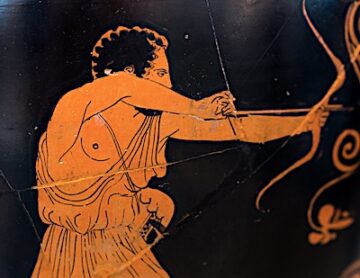
His identity revealed, Odysseus is in an enclosed space armed only with his bow. There are not five suitors facing his wrath but dozens. After picking off two or three with arrows, he is attacked by more or less all the rest at once — except that, according to modern custom, it never is all the rest at once. However hard any TV or movie director tries, I can never watch these scenes without asking why oh why Bad Guys #3, #4, and #5 hang there on the periphery like jackets on hooks, waiting politely for their turn to come alive, step forward, and be punched, stabbed, or kicked in the essentials. Nolan’s Odysseus has to deal with Bad Guys #19, #20, #21, and the melee gets more stagy and unreal with every lunge. (At one point, in a take that should surely have been omitted, you see a suitor hovering only a couple of feet from our sweaty, whirling hero. This man is not fighting, but frozen in place. He holds his sword out in a tentative gesture as if waiting to explain what a needle is at a knitting demonstration.) Why are we prepared to believe that Odysseus can defeat all the suitors? Because he has the help of Athena. But Nolan has no feel at all for this idea of supernatural influence. What we get instead is a “realistic” fight, within the unrealistic assumptions of the genre. It’s Bourne with a Bow. And we don’t believe it for a second.
Pattinson’s Antinous has an especially ticklish problem in this scene. As soon as he knows the jig’s up, he switches from treacly to terrified. He absolutely must stay out of the fight, because Hollywood’s dramatic arc rulebook says (contra Homer) that he has to be killed last. So he hides behind a pillar, then keeps popping out to gape and cringe and remind us he’s there and egg the others on. It’s a parody of cowardice so crude and so unintentionally funny that Rowan Atkinson might have used it in Blackadder. Minutes later, when Odysseus looks him in the eye and then fillets him like a fish, he makes such heavy weather of the dying that I almost expected him to roll his eyes one more time and say “Alack I am undone.” It was that reminiscent of amateur Shakespeare.
Nolan has given us a Hollywood action movie in the old Cecil B. DeMille mode — war, gods, mutiny, monsters, mayhem — but with every modern excess, including scenes at sea so bloated that you find yourself wishing they’d get on with it and drown. The soundtrack could induce hearing loss. The body count isn’t countable. As with DeMille, or his epigones in the Marvel Universe, the point is breathless spectacle but it’s considered polite to tack on a bit of emotion.
Towards the end, as Odysseus and Penelope set out to sail beyond the sunset, I found myself imagining a very different film. What if you could have fired all the stars, with their intrusive, over-sized faces, and replaced them with unknown Greek actors? What if you could have fired the director too, and replaced him with someone capable of reaching beyond our most stereotypical, most unimaginative cultural expectations? What if the story could be remade without stripping it of its powerful strangeness?
Far fewer people would have seen that film, and it would not have made $1.6 billion. (Zeus!) Besides, even if it were in some sense better, so what? The wise course of action for you, the one displaying phronesis, is probably to ignore everything I’ve written if you’ve seen the film, and ignore it and go if you haven’t.
Like most people, you’ll probably have a blast.
***
Enjoying the content on 3QD? Help keep us going by donating now.