
by Martin Butler
Rootedness, says Simone Weil,
…is perhaps the most important and least known human spiritual need. It is one of the hardest to define. A human being is rooted through their real, active and natural participation in the life of a collectivity that keeps alive treasures of the past and has aspirations for the future. This participation is natural in that it stems automatically from place, birth, occupation and those around them. Every human being needs to have multiple roots and to derive almost all their moral, intellectual and spiritual life from the environment to which they naturally belong.[1]
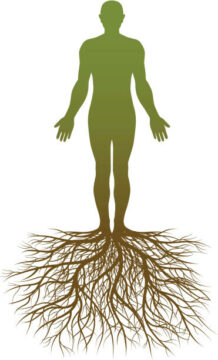
There is something paradoxical about Weil’s account. The idea that rootedness is a need, rather than simply a fact about human beings, implies that the need might not be met; and indeed, The Need for Roots, from which this quotation is taken, is a kind of manifesto for a society which recognises the importance of this need along with other moral and spiritual needs. Her discussion of the different kinds of uprootedness makes it clear that rootedness cannot be taken for granted, yet the quotation above suggests that rootedness is normal and natural. Being rooted comes through our ‘real, active and natural participation in the life of a collectivity’. It is ‘natural in that it stems automatically from place, birth, occupation and those around them.’ In other words it would be difficult not to have roots. If rootedness is natural and arises automatically why is this an issue at all? How could we be rootless?
So Weil claims on the one hand that many civilisations and many ways of living lead to rootlessness, or uprootedness. (It’s important to note here that she does not just have modern societies in her sights – she very much has it in for the Romans, as being instrumental in producing uprootedness) On the other hand, her definition of rootedness appears to make it a natural part of the human condition – just a fact about us, like having lungs.
To make sense of this I think we have to assume that Weil believes rootedness naturally occurs in most human beings when raised in normal circumstances, just as children naturally learn to talk. This is not, however, inevitable. Conditions can exist, or external forces can intervene, which lead to stunted development or the destruction of rootedness. Disruption of the natural participation in the collectivity will lead to an inferior way of life because this key spiritual need of rootedness will not be met. Military occupation and colonial regimes are obvious examples of such disruptions. She also identifies some of the consequences of capitalism as responsible for creating uprootedness.
We think of our roots as unchosen, the background facts against which we live our lives: nationality, family background, cultural and religious upbringing and so on. In many societies (and more so in the past), these are so taken for granted they are hardly noticed, like a fish’s relation to water. Whether we are consciously aware of them or not, for Weil they enable us to flourish, they give us a sense of belonging, of being at home in the world, and provide a source of meaning. The fish and water analogy doesn’t quite work here. The fish dies without water. The uprooted individual does not die but merely lives a spiritually impoverished life. The sociologist Emile Durkheim perhaps captures this state with his notion of anomie; a state of normlessness, isolation, a loss of any shared purpose.
We can perhaps get more of a grip on the distinction between being rooted and uprooted through Weil’s point that “Every human being needs to have multiple roots …” By this I take it she means that we need different kinds of connectivity with the collective. A rooted individual has a complex web of interconnections. A society that tends to reduce all connections to one kind is heading towards uprootedness. This would explain why she says, “Money destroys roots wherever it goes because the drive to make money supplants all other incentives. This drive easily overshadows all incentives because it requires so little attention. Nothing is as clear and simple as a number.”[2] Money becomes a kind of mono-incentive, pushing out all others. Even in situations where money is not actually involved, the idea of monetary exchange can dominate a society when most interactions become modelled on purchase or sale. Relationships become transactional, the exchange of goods or services of equal worth. Everything is about individual loss and gain; self-interest is regarded as the only ‘real’ motive. This can become a normative ideal: relationships which seem superficially quite different are reduced to the transactional mode as this, it is believed, is the only solid basis for connectivity. (Examples of theories that make this assumption are the social exchange theory of inter-personal relationships, and contractual theories of morality and politics.) It is noteworthy that Weil’s comment about money echos Marx’s point that capitalist society “has left no other nexus between man and man than naked self-interest, than callous ‘cash payment”.[3]
I doubt whether any actual society could operate solely on this basis, but a widespread belief in this model can become self-fulfilling and corrupting, producing rootlessness through a widespread suspicion that others are always looking to ‘get one over you’, a sense that life is a low-level war of all-against-all. In such an atomised society, one where trust is in short supply, genuine rootedness is difficult to establish.
We should be clear here that the notion of a transactional relationship should not be confused with interactions which might look superficially similar. Gift-exchange, for example, might look like a kind of polite version of what is essentially a transactional relation. I think this is wrong. In its uncorrupted form at least, gift-exchange, which is common in many cultures, is about building trust and cementing bonds rather than getting a good deal or furthering self-interest.
A more obvious example of a mono-incentive occurs when a society becomes so brutalised that all relationships become reduced to power through, for example, a military occupation or a totalitarian state. Relationships then become dominated by either a direct or implicit threat of physical violence and the mono-incentive is fear, which ‘supplants all other incentives’.
It’s worth noting here that the kinds of connectivity we find through family relationships, patriotism, cultural, political and religious practices/beliefs, or even supporting a football team involve obligations and emotional connections that cannot (or at least should not) be reducible to self-interested transactions or fear. This is perhaps why this wide range of relationships are identified with being rooted. I am not, of course, suggesting that Weil believed that transactional relationships and even an element fear are always corrosive to rootedness; rather, they must sit within a complex web of obligations, emotional connections and responsibilities that are not reducible to any simplistic mono-incentive.
An important question rises here. Are roots always good? Can there be benign forms of uprootedness? Weil does not consider this. But the contemporary idea of the liberated, autonomous self goes against the very idea of rootedness. Emotional bonds and responsibilities can be claustrophobic. Roots can constrain us or limit our possible life options. Families can oppress – remember Larkin’s line about ‘your mum and dad’. Religious belief can be an opium, patriotism can be an excuse for division and hatred. Shouldn’t we aspire to a world where we are emancipated individuals in thrall to nothing that we don’t consciously choose? Surely, the existential hero has no time for roots!?
The moral currency of modern liberal individualism is rights based, belying the obligations and emotional bonds that form the substance of rootedness. The moral armour of the autonomous liberated individual is to be understood in terms of rights rather than roots. Rights are what individuals possess, and the demand that these rights be respected is supposed to guarantee the autonomy of the individual in the face of the of the overbearing demands of the collective. The tension between the freedom of the individual and the power of the group is resolved through the recognition of individual rights – rootedness at best being an optional extra. Weil, however, was not a fan of rights. At least she did not give them the primacy they have today. Interestingly, she thought that the enlightenment took a wrong turn as soon as the French revolutionaries put the rights of man centre stage rather than obligations. She claims that:
The concept of obligations takes precedence over that of rights, which are subordinate and relative to it. A right is not effective on its own, but solely in relation to the obligations to which it corresponds. The successful fulfilment of a right comes not from the person who possesses it but from others who recognise they have an obligation towards that person.[4]
This is a compelling point. The demand that my rights be recognised is empty without the network of moral obligations which could give this recognition substance. A group of atomised individuals all demanding their rights is not going to get very far unless there is a prior recognition within the group that obligations are owed to others. And obligations spring from a range of both intellectual and emotional connections, some strong and obvious others more limited and contentious. In other words, rights only make sense when they sit within the complex web of obligations, emotional connections and responsibilities. It could be argued that rights, to be effective, presuppose rootedness.
Rights are also reductive. A right is simply an entitlement, but entitlements come in all shapes and sizes and can be specific to particular relationships or particular individuals. Some entitlements only hold weight under certain conditions. Others are unconditional. Rights talk tends to obliterate these complexities. It also frames the relation between the individual and the collective as one of opposition rather than participation. So, the ‘all you need are rights’ approach, taken together with a focus on self-interest and the primacy of transactional relationships discussed earlier, leads to perfect conditions for a rootless modernity.
Nevertheless, we can’t deny that the ideals of individualism, emancipation and freedom of choice have their attractions, and clearly there is some tension between these ideals and rootedness as I have described it. After all, unchosen obligations and emotional bonds can feel like unwanted ties for those hankering after emancipation. One way to lessen this tension is to expand our notion of rootedness. It’s easy to conceive of the ideal form of rootedness as that realised in what might be described as traditional societies, where structures and beliefs are quite rigid, where social roles are clearly defined, and where everyone has a place and there’s a place for everyone. I’ve suggested that we tend to think of roots as those unchosen features of our life – nationality, family, place of upbringing and so on. But we should not exclude the possibility of ‘putting down roots’, through voluntary connections with groups, friends and institutions in new locations. And we can of course choose religious, political or cultural associations that are quite unconnected with our upbringing. This chosen or secondary rootedness has become more important in modern western cosmopolitan societies, where the primary unchosen forms of rootedness have become degraded, partly at least because emotional bonds have become more fluid, relationships more transactional. Can these secondary roots ever be as strong or meet the spiritual need Weil speaks of? Is blood always thicker than water? The cynic might argue that, when push comes to shove, these kinds of relationship end up being weaker and more transactional in contrast to the genuine emotional bonds that transcend the narrow orbit of self-interest. That, I think, is overly pessimistic and falls into the trap mentioned earlier of seeing self-interest as the only real motive. So perhaps modern individualistic culture can have its cake and eat it. It can hang on to the primacy of individual choice and at the same time manufacture its own rootedness. This isn’t an easy trick to pull off, partly because there is an inclusivity about the unchosen rootedness that doesn’t depend on merit, personality or wealth. Having a family, nationality, or cultural heritage does not depend on your social skills or level of education, but is more of a given birthright. This is its appeal. Some are clearly better at successfully putting down roots than others, so the individualism of western societies suits those who have the wherewithal to carve out a rooted place for themselves. (We could make a further argument here that this very capacity itself requires a certain kind of primary, unchosen rootedness. We cannot create ourselves ex nihilo.) Others however may feel that their birth right has been betrayed and yearn for the assumptions of previous generations, where just being born into a society was enough – where participation in the collective ‘is natural in that it stems automatically from place, birth, occupation and those around them’. Perhaps the division between those who are quite happy to create their rootedness and those who long for the automatic rootedness of previous generations is the source of some of the division we find in modern western societies?
***
[1] Weil, S., 2023 (originally pub. in France 1949) The Need for Roots, Penguin Classics, London, p33
[2] Ibid p34
[3] Marx, K., Engels, F., 1992, The Communist Manifesto, Oxford World Classics, p5
[4] Op cit. p3