
by Mark R. DeLong
 A few years ago I shared a draft of a sonnet sequence with a poet from the Northwest I had followed for a while. I asked him if he’d give the piece a once-over and provide some critique, and his reading was perceptive and useful for me. One comment drew my attention in particular: “I fall flat on ‘beauty,’ ” he wrote. “This is the one place in the poems the image turns outward into metaphor that cannot be touched — ‘beauty’s hidden folds’ is a no-thing” he wrote, pointing out at the last line of the second sonnet.
I thought about it, wondering about beauty and no-thingness, and thinking that beauty must be something more than an empty word or a placeholder for some substantial thing that is a “better” thing. Then, I admitted and still do admit that I don’t really know what beauty is, aside from maybe being something in the “eye of the beholder,” perhaps an evaporated no-thing, really.
Nell Painter discusses her “lying twentieth-century eyes” and how “[t]hinking like a historian misled me as an artist” not too far into her memoir Old in Art School (2018), a book I picked up when I was thrashing through the first year or so of my retirement. For I had toyed with making a turn like Painter, who wrapped up an eventful career teaching and researching history at Princeton and leaped into undergraduate study of art at Mason Gross School of the Arts at Rutgers and then an MFA at Rhode Island School of Design. She was finishing her sixties when she graduated with her MFA.
“It took me years in art school to recognize my twentieth-century eyes as my major handicap as an artist, the real way I was old in art school,” Painter observes. And then she begins to unwrap some of the intricacies of art that she earned at Mason Gross and RISD: “art is fundamentally about taste, and tastes vary; tastes change.” Newly formed tastes can mistakenly be “dismissed as ephermeral fads,” both in art and in scholarship; and she says that “this comforting belief remains widespread.” More than in the twentieth century, in twenty-first century art, the division of art and life has blurred, “almost like the erasure of the divide between public and private and the slender difference separating art and life in reality TV and webcams streaming people’s everyday moments of what used to be private life.”
And with that blurring and flattening of “tastes” and mistrust of one’s eyes, I had to wonder as I read this section of Painter’s memoir where the “beauty” in art might reside. My own lying eyes had settled for rather two-dimensional notions of beauty and its power (or powerlessness), its truth (or lack of it), its transformative potency (or not). It would be easy to relegate beauty to quaintnesses — as in sighing nostalgia and pious reverence for antiquities — or to shuffle beauty over to the domain of kitsch and “mere illustration,” Bob Ross’ happy little trees, and unicorns and rainbows.
Now that techbros are trying to wedge taste into their AI models, I think it is necessary to look at beauty more carefully (and I embrace the ambiguity of that phrasing). Today’s humans need to seek the beautiful and defend the richness of its ambiguity and mystery — as something not reducible to digital data that can be tortured into submission on an Nvidia chip or data-fied at a gallery or auction into to another numerical format: The Almighty Dollar.
How many of us today yearn to make beauty real and present again in our lives? Especially in this 2026 MAGA land of algal blooms, oil wars, a monstrous arch, a mud hole East Wing, UFC fights on the White House lawn, cruelties on American streets, betrayals of allies and friends, and a humiliating “state fair” whose most promising achievement was that it was sparsely attended.
A guard in search of beauty and solace
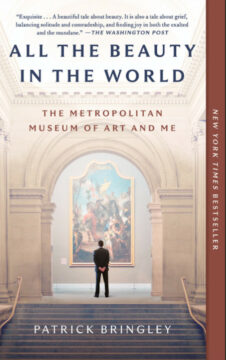
That desire to rediscover meanings in beauty and art underlies Patrick Bringley’s All the Beauty in the World: The Metropolitan Museum of Art and Me (Simon & Schuster, 2023). I read it the year it came out, and now three years later I find myself drawn back to the book. From a distance, you can see the book as a story about a guy whose job is to be watchfully present, but that quick take ignores the richness of Bringley’s experience over the ten years he stood guard at the Metropolitan Museum of Art. It also ignores the manifold layers of the narrative. His decision to quit his job at The New Yorker and put on the uniform of the Met guard was, after all, a response to a personal and family crisis. His older brother Tom’s death by cancer forced the change, and a museum guard salary was hardly the attraction. The book itself tells of people working together, of the bumblings and elegance of people going through the Met for art and for paychecks.
For Bringley, the attraction was the art and the paradoxical hold and liberation it offers. Shortly after Tom’s death, Bringley and his mother retreated into the Philadelphia Museum of Art, “each to find our own sad, bright picture to be near.” Bringley landed on a centuries-old Italian Adoration painted with tempera by an unknown artist. He later found his mother with the painting that captured her:
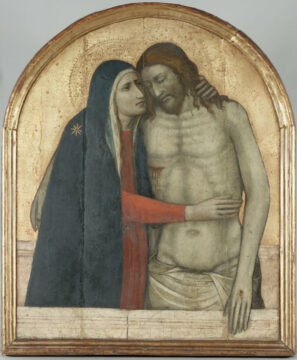
When I spotted her, she was framed by a work more beautiful and even more truthful than the one I had found…. Against a featureless gold background, it depicted a young man who was very beautiful but bluntly dead, supported bodily by his mother, who hugged her son as she would if he were living — a scene called a Lamentation or Pietà. My mother has always been a good one to cry — at weddings, at the movies, but this was different. She cupped her face, and her shoulders shook, and when I met her eyes, I saw she wept because her heart was full as well as breaking, because the picture inspired love in her, bringing both solace and pain. When we adore, we apprehend beauty.
And we grasp more than beauty; we can fall into a way forward after the devastation of loss. His mother and father and sister headed back to their home in Chicago after the museum visit. As Bringley headed to his new home in New York, he decided he would not return to his desk job at The New Yorker. “In the Philadelphia Museum of Art,” he recalled on the train back to New York, “I had been allowed to dwell in silence, circling, pacing, returning, communing, lifting my eyes up to beautiful things and feeling sadness and sweetness only.” The realization set him on his way to guard the beauty of the Met. Back home in Brooklyn, “it all felt remarkably simple. In the fall of 2008, I took up my post in the Metropolitan Museum of Art.”
You could, I suppose, consider All the Beauty in the World as a memoir of Patrick Bringley’s growth and recovery from the loss of his brother. But that would be far too simple a take on this book. Bringley recounts his fateful visit to the Philadelphia Museum of Art and his decision to become a museum guard only at the end of the third chapter, well after he brings his reader into the life of the Met from his new perspective as an employee. Indeed, the first chapter opens with his first workday at the Met, and that sets the foundational story: the living history and operation of the Met as an institution and how it draws from and multiplies the vitality of the city and its people. Bringley shows how he first stepped into his role — and the Met’s vibrant and sometimes unruly life — both literally and figuratively; and the final chapter chronicles his final day as a guard. First day and last day bookend this memoir, seeded as the career was by the tragedy and pain of a lost brother. This is a book of work, told by a worker.
A book of work, by a worker
In the first pages, Bringley marches us readers along as Aada, his first-day guide “whisks” him to his first post in “the old master paintings,” which Aada says is lucky. “When you are here,” she tells him in her slightly accented (Finnish?) speech as she stamps her foot, “wood floors, easy on the feet… A twelve-hour day on wood is like an eight-hour day on marble. An eight-hour day on wood is like nothing.” Even feet are part of the story, and Bringley is amused to find that after surviving his four-month probationary period, he is welcomed into the union and is granted an $80-a-year “hose allowance.” That is, money for socks, one of the many details about life inside the Met that seasons the narrative.
Bringley’s first hours present a bewilderment of contraptions and workers who museums keep behind the scenes, which he says “is all very interesting, but I can’t help but notice we are chatting just feet away from the Madonna and Child by Duccio, from about 1300. All morning, I haven’t faced up to a painting, and I wonder if I might swing Aada’s attention its way by making a reference to its reported $45 million price tag.”
Big mistake. “Aada is only saddened I would say such a vulgar thing,” Bringley recalls.
She pulls me in close to the diminutive panel and all but whispers, “You see the blackened singed bits at the bottom of the frame. Burn marks from votive candles. It’s a beautiful picture, isn’t it? These are beautiful pictures, aren’t they? … You and I, we work with masters. Duccio. Vermeer. Velázquez. Caravaggio. Compared to what?” She looks over at our American Wing neighbors. “Some picture of George Washington? I mean oh come on now. Be serious.”
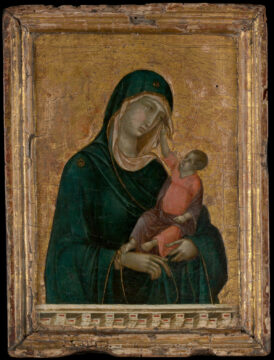
Aada redirects attention. Even to a museum guard paid for attending to things, the weight of beauty and history comes to bear, making some monetary quantity of value mere fog and noise, mere miserly stuff. The votives that burnt the frame hundreds of years ago reflect a stronger witness to the art’s value than a carefully engineered sale through a London art dealer. Aada leaves him at his “C post” in the old masters. All he has to do, Bringley says, is “let my hands remain empty and my eyes stay wide while my inner life grows all mixed up with beautiful works of art and the life that swirls around them.”
Through the contrast of his own monetary “vulgarity” and Aada’s gentle correction Bringley introduces his first ways of seeing and balancing the value and purpose of art. (If, indeed, it makes sense to consider art as purposeful; I have my doubts). It is one of many ways of seeing the art of the Met that Bringley presents, and he was able to gather evidence of these ways over a decade.
The chapter of flesh and blood
The guard’s life in a museum is not merely watching out for the art, not just looking at art. It is also watching other people look at art and interact with it in their own, sometimes inappropriate, ways. Chapter six “Flesh and Blood” begins with entertaining accounts of mishaps (after a careless bump, “the painting swings once, twice, three times on the copper wires anchored just below the ceiling…. It’s hard to feel that all is well when you’ve just seen a swinging Picasso.”), heists at the Met and elsewhere (“Know how he [Hermes, a statue’s head] ended up in a storage locker at Grand Central Station?”), and sundry and amusing thefts. In their criminal or oddly bumbling ways, the stories implicitly nod to the value of art in raw cash or perhaps, in the case of Hermes’ head, wooing a girl.
After such exotic escapades, Bringley turns to the law-abiding, though sometimes clumsy, typical Met visitor, some seven million of them a year. The crowd is “a pageant for whom I’m the steadfast audience,” Bringley says. Over the decade he served as a guard, he classified the visitors: Sightseer; Dinosaur Hunter (“panicked by each new piece of evidence that this museum only has art”); “three distinct kinds of Lovers” (Art Lover, Lover of the Met itself, and “Lovebirds,” who flutter around, “alighting in spaces where silences aren’t awkward and strong emotions feel natural”); the people who just can’t resist touching highly polished ancient marble. And, of course, the single stand-outs: elderly gentlemen bent over their walkers, white-haired ladies who happen to be twins, mothers with children in tow, “listeners,” “talkers,” and (my favorite, I’ll admit), the “baffled.” For the baffled, Bringley sought to “learn not only to choke back any snobbish impulses I might have, but to dismiss them as stupid and absurd. None of us know much of anything about this subject — the world and all of its beauty. I might know the dates of Michelangelo’s birth and death, but imagine how overwhelmed by ignorance I would be in his workshop….”
Bringley’s “pageant” of visitors reveals the elusive power of beauty, showing how the presence of beauty doesn’t reside within works themselves or even in “the eyes of the beholder” but in their relation: in the relation of lookers themselves, looker-to-looker, and the relation of beheld works, the lively pageant of artworks. Beauty emerges from the culture of things by the interaction of things — their echoes, their indebtednesses, their conflicts and arguments — and the trends and fashions that emerge from people sharing space and time. It is no wonder that a museum like the Met has emerged as a monument to artistic achievements; it hosts daily pageants that express and refine all the beauty in the world.
“Flesh and Blood” stood out to me because Bringley first pulls together the rascal, the lover, the clueless, the connoisseur, the tourist and shows them as they behold and, yes, judge the works in the Met. But the chapter closes with his trip home after a work day, and there we see a change arising from the pageant of Met visitors and the Met’s works of art.
Bringley feels the extension of the experience of things in the museum into the experience of the world. Beauty sticks with human experience, transforming it.
Bringley recalls working at the Stieglitz, Steichen, Strand exhibition among Stieglitz’s many portraits of his lover and later his wife Georgia O’Keefe. He sees a gentleman taking a photo of a Stieglitz portrait. “We want possession, something to put in our pocket, so to speak, and carry away,” Bringley writes. “Except what if nothing very beautiful fits in our pockets, and only the tiniest sliver of what we see or experience can be possessed?” And with that thought, that doubt, his experience of beauty shifts as the Met’s human pageant itself transforms into a work of art:
With this thought, suddenly the strangers in the room appear to be wildly beautiful. They have good faces. They have eloquent walks. They’re emotive; their eyebrows jump about. They are daughters who look like their mothers’ pasts, fathers who look like their sons’ futures. They are young, old, blooming, decaying, and in every sense they are real. I strain to use my eye as an investigatory tool, as a pencil, with my mind the sketch pad…. I look for meaning in the way people wear their clothes and carry their weight, hold hands with their boyfriends and girlfriends or don’t, style their hair, cut their beards, meet or avoid my eye…. And when I find I can discover no definite meaning in most of what I see—nothing I could put into words—I take pleasure in the flash and sparkle of the scene.
Thus, the chapter ends with Bringley’s world transformed from art on the walls to a work of art swarming within them.
Beauty and no-thingness
Beauty is a “no-thing” because no thing can completely contain it, not even language, however poetic or expressive, nor paint, wood, or marble.
Beauty is not a matter of possession, not something to be “fit into our pockets,” or even something to be revered. It is—if a no-thing can be anything at all—a matter of experience, of preference, of haphazard luck, and of acquired perspectives or taste. For the artist sees differently from others, and her job (if it can be called a job) is to reveal that difference—a difference that draws not only from the beautiful things that exist in the world but from the beauty that they exist at all. Doing art is to embrace beauty’s power without possessing it; the artist swims in an environment, sometimes is transformed in the process, sometimes able to retain and reveal a glimmer for us all. Bringley looks back at his decade working as a guard and concludes that the place is “where, with your own eyes, you can see what fellow fallible humans have made of the world that you live in.” Which is true, and that I would expand to say that the Met as an institution, with its bustle and bumbling, is another attempt by a host of fallible humans to gather a collection of things that help a pageant of visitors make sense of their worlds and experience a no-thingness of beauty, in all its sometimes difficult comfort and inexplicable depth.
“In art, I can delve into what I can’t know as an historian,” Nell Painter said in an interview in the Boston Review. “That’s a freedom that artist Nell Painter can exploit, but historian Nell Irvin Painter must back away from.” As participants in looking for beauty, we, too, discover a form of artist’s freedom.
Its no-thingness certainly makes beauty a challenge, but it also makes beauty an exceptionally human no-thing. A no-thing that leaps beyond the reach of datasets, computer chips, and AI models. Beauty resides in human experience and in human community.
For the bibliographically curious: The images: Niccolò di Pietro Gerini, Christ in the Tomb and the Virgin. c 1377. Tempera and tooled gold on panel with vertical grain, 40 5/16 x 33 9/16 inches (102.4 x 85.2 cm). Philadelphia Museum of Art, Cat. 8. https://www.philamuseum.org/objects/102619; Duccio di Buoninsegna, Madonna and Child, ca. –1300 1290, Tempera and gold on wood, Overall, with engaged frame, 11 x 8 1/4 in. (27.9 x 21 cm); painted surface 9 3/8 x 6 1/2 in. (23.8 x 16.5 cm), https://www.metmuseum.org/art/collection/search/438754. Patrick Bringley acted, too, but again is writing: Jane Levere, “‘All The Beauty In The World’ Author To Write Again After Acting Stint.” Forbes, May 22, 2025. https://www.forbes.com/sites/janelevere/2025/05/22/all-the-beauty-in-the-world-author-to-write-again-after-acting-stint/. Two pieces of mine tht touch on Bringley’s book and its connection with “hanging out” and with the powers of doing and making: “Book Review: Sheila Liming’s Hanging Out: The Radical Power of Killing Time,” READER, July 28, 2023, https://read.markdelong.me/2023/07/28/book-review-hanging-out-the-radical-power-of-killing-time/ and “Hanging out with Artists in The Ark,” READER, May 4, 2023, https://read.markdelong.me/2023/05/04/hanging-out-with-artists-in-the-ark/. Roku has a 100% AI channel. But can it be beautiful? From the article: “Fairground AI stands out as a pioneering offering dedicated entirely to AI-generated content. The channel features a continuous stream of films, short series, and creative works produced through artificial intelligence tools, highlighting emerging talent in the growing field of AI cinema. It provides a 24-hour rotation designed to introduce mainstream audiences to this new form of storytelling that blends traditional production values with generative technology.” Luke Bouma, “Roku Adds 4 New Free Channels to Roku TVs & Roku Players in August 2026,” Cord Cutters News, August 3, 2026, https://cordcuttersnews.com/roku-adds-4-new-free-channels-to-roku-tvs-roku-players-in-august-2026/. “Art alone puts us in touch with certain kinds of truth and beauty. And in that way, art restores us to reality. For it to succeed, however, it must be left to its own devices (or lack thereof). It must be free to eschew the logic of utility and to embody the freedom we stifle under the pressures of means-and-ends thinking“: J. F. Martel, “Humans Did Not Invent Art. It Was the Other Way Around.” Aeon, July 30, 2026. https://aeon.co/essays/humans-did-not-invent-art-it-was-the-other-way-around.
Enjoying the content on 3QD? Help keep us going by donating now.