
Bartolomeo Sala at The Brooklyn Rail:
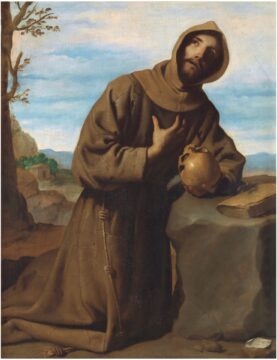 What makes Zurbarán’s art compelling is the co-presence of these two distinct, almost mutually exclusive impulses. Here, sacred and profane don’t exactly exist side by side; rather, the latter is used as the manifestation of the former, a means to intensify its spiritual truth. That’s why, even when Zurbarán’s subject matter seems symptomatic of a retrograde theology very much at odds with more contemporary secular sensibilities, we can’t help but be enthralled by the way the painter renders it.
For a case in point, look no further than the exhibition’s first gallery, and the first of Zurbarán’s many crucifixions. The Crucifixion (1627) is flanked on opposite sides of the room by The Apparition of Saint Peter to Saint Peter Nolasco (1629) and Saint Serapion (1628), both of which similarly communicate holiness by contaminating it with elements of all-too-human pathos. Similarly, the crucifixion between them depicts Jesus not as an abstract entity, but as a man of flesh and blood exquisitely staged against a pitch-black background, his muscles tensed by the suffering he is experiencing.
more here.
Enjoying the content on 3QD? Help keep us going by donating now.