
by Mary Hrovat
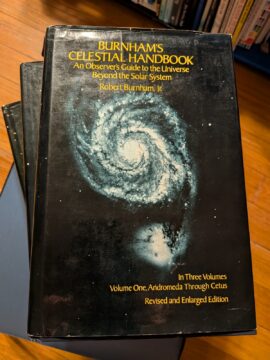 Burnham’s Celestial Handbook, by Robert Burnham, Jr., is a classic text. Its third and final volume was published in 1978. Written as a set of guidebooks for amateur astronomers, it’s a product of its time and circumstances. The abundant illustrations are in black-and-white, and the pages may look very plain to anyone accustomed to glossy large-format books about the universe, replete with color photographs. But to me it’s still immensely valuable, for the sheer amount of information it presents, for its attention to the history of astronomy, and for its astonishing breadth.
The full title of the set is Burnham’s Celestial Handbook: An Observer’s Guide to the Universe Beyond the Solar System. The books were written over a period of approximately 25 years. Burnham was an amateur astronomer when he decided he’d like to write a guidebook that describes the interesting astronomical objects accessible to amateur telescopes. His aim was to update existing guides to these objects, which were old enough to be out of date astronomically. In addition, the older guides covered the objects visible in the small amateur telescopes of their day, not the larger telescopes available to amateurs in the 1950s and 1960s. In his handbook, Burnham discusses around 7000 of these objects.
The first volume contains an introduction to amateur astronomical observing, including an overview of the types of objects outside of the solar system that you can see with binoculars or a telescope, their various naming conventions, and information about the coordinates used to describe their positions in the sky. He explains the abbreviations he uses to describe variable stars, double and multiple stars, and star clusters, nebulae, and galaxies. Throughout the book, he uses these abbreviations to present compact tables of information about these objects.
Then, for each of the 88 constellation, he presents a set of these tables, followed by textual information on the constellation as a whole and on individual stars and other astronomical objects to be found in it. The length of the chapters varies. Those for some of the smaller constellations are quite short, and in several cases, only the tables are presented, without any text. The constellations with more lore or history associated with them are much longer.
∞
As he provides data on the various objects of interest in a constellation, Burnham often uses a particular object as a springboard from which to launch into a discussion on some topic in astronomy. In addition, he presents poems and quotations from observers and historians ancient and modern. He includes many drawings, such as finder charts for various objects, illustrations of the orbits of double stars, and comparisons of the sizes of stars.
Some of the topical essays Burnham presents involve particular stars. In the chapter on Cepheus, he discusses Cepheid variables, which are interesting to astronomers because their periods are related to their absolute luminosities, making them useful for measuring celestial distances. They’re named for their prototype star, delta Cephei. Burnham explains what was known at the time about why these stars vary in brightness. He then presents the history of their discovery by Henrietta Leavitt and their later use by Edwin Hubble to settle a debate about the nature of what were then called spiral nebulae, which Hubble demonstrated are remote galaxies and not a part of the Milky Way.
Other essays involve particular star clusters or galaxies. In the chapter on the constellation Hercules, which has not one but two magnificent globular clusters, Burnham not only describes these clusters but goes into the evolution of clusters of this type, which lie outside the disk of the Milky Way. He also gives a vivid description of how the sky would look from a planet orbiting a star in a globular cluster.
Some of the scientific information is mildly surprising to find in a book for amateurs. Burnham not only explains what a Hertzsprung-Russell diagram is but also presents H-R diagrams in various places throughout the text to illustrate how astronomers use them—for example, to determine the ages of star clusters. In an H-R diagram, stars are plotted according to their mass and luminosity; during most of their lives, stars fall on the Main Sequence, where they may have type O, B, A, F, G, K, or M. As they age and use up their fuel(s), they leave the Main Sequence and become various types of giants. I learned about the use of H-R diagrams in the study of star clusters in an undergrad astronomy class; none of the guidebooks I had at the time went into that much detail about how they’re used. I’m happy that Burnham thought the information was suitable for sharing with amateur astronomers.
He also presents at least one story about an astronomical study that disproved a hypothesis. Harlow Shapley (who had essentially mapped the shape of the Milky Way by measuring the distances to 69 globular clusters) studied the globular cluster M5 to see whether the speed of light might vary according to its wavelength. He found no sign of variation, and these days it seems surprising that anyone asked the question. But again, I like that this information was included in a handbook for amateurs, because null results are part of how science proceeds.
∞
I find this type of historical context to be one of the most valuable things about these books. I was introduced to the handbook when I was an undergrad studying astrophysics. I always enjoyed it when a class in physics or mathematics or astronomy presented bits of this kind of history, and it was a great pleasure to find a celestial guidebook that’s steeped in this context.
Burnham also provides a broad human context for our knowledge of the night sky. He discusses a fairly wide range of cultures and their myths, including some Native American cultures. For example, a discussion of Polaris, the North Star, shifts from the presentation of physical information about the star to a consideration of beliefs about the axis around which the world turns. In the space of 15 pages, Burnham mentions South Asia, the ancient Near East, Siberia, Glastonbury, and ancient China. He quotes Christopher Marlow (The History of Dr. Faustus), William Cullen Bryant (“Hymn to the North Star”), Christina Rosetti, Dante, Wordsworth, Confucius, Keats, Shakespeare, Aeschylus, the 48th Psalm and the Book of Isaiah, and the Dhammapada. These historical and literary explorations are accompanied by photographs, including images of temples and shrines that symbolize the celestial axis.
The discussions of myths, poetry, and stories about the Milky Way are similarly wide-ranging. And, oh, the discussion of the Pleiades in the chapter on Taurus! And the discussion of the Praesepe (the Beehive Cluster) in Cancer! Because so many of us live under skies brightened by artificial lights that obscure the stars, it’s easy to forget that the dark night sky was once a shared space of wonder and inspiration.
This interweaving of scientific data and human history and culture makes the Celestial Handbook superb for browsing. You may begin reading about a quasar in the constellation Virgo and be whisked into a brief meditation on the incompleteness of human understanding of nature. On a single page, Burnham places a quote by scientist Arthur Eddington next to a couple of lines of Lewis Carroll’s poetry, follows up with a few bars of the opening passage of Wagner’s Das Rheingold, and then considers pertinent thoughts from Loren Eiseley, H. L. Mencken, William Dean Howells, J. B. S. Haldane, and Mark Twain. Then he returns to the topic of quasars. The words he quotes are cultural references held in common; the thread that binds them into something like an imagined conversation is his wide-ranging and focused mind.
Burnham describes the books as a compilation, and he does draw on many sources (listed in a section at the end of the third volume, along with other reference material). Part of the work of writing the book was to compare the original sources and try to resolve any inconsistencies among them. But he did more than compile information; he performed a creative synthesis that’s rich and deep, encompassing data, a growing body of scientific knowledge, the history of science and general history, and the works of the human imagination when faced with the night sky. The books strike me as a work of love and devotion.
∞
The original purpose of the handbook, to provide descriptions of deep-sky objects for amateur observers, is now served by other guides that are perhaps more suitable for use in the field. Full-color photographs of deep-sky objects taken by more advanced instruments than those available 50 years ago are now easily available. And of course, some of the astronomical information in the handbook is no longer up-to-date, and some of the terminology is no longer in common use. For example, Burnham uses the term galactic cluster to refer to what we’d call an open cluster.
I don’t know if Burnham planned to update the books. He asked readers to notify him if they found errors so that incorrect information could be fixed in future editions, but he also wrote of the impossibility of completion or perfection. At any rate, in some important ways, these books are no longer the optimal guide.
However, they remain irreplaceable as a unique and heady blend of science, history, and culture. When I began to study astrophysics, in my early 20s, people who knew me were surprised that a former history major who loved poetry would want to study so technical a subject. (“But that’s so scientific,” someone said to me in puzzlement.) When I first encountered these books, I was dazzled by the abundant references to poetry, history, and even philosophy, alongside the tables and text so rich with scientific information. I was also comforted to see that at least one other person viewed these seemingly disparate interests as being inextricably interwoven. Burnham’s work still dazzles and comforts me, forty years on.
∞
Until very recently, I knew little of Burnham’s life. What I’ve learned of it while writing this piece haunts me. He was born in Chicago and moved with his family to Prescott, Arizona as a child. He served in the Air Force during the Korean War and then worked as a shipping clerk. He pursued various intense interests, including astronomy, rocks and gemstones, and ancient history (all of which are reflected in the handbook).
When he was one of three people to independently discover a new comet in 1957, he attracted the attention of the director of Lowell Observatory in Flagstaff, who offered him a job working on a survey of the proper motion of stars. Proper motion is the motion of a celestial object across the sky, which is generally not the same as its actual motion in space. The proper motion of the nearest stars can be measured by comparing images taken at different times. Burnham and a co-worker compared contemporary images with images taken during Clyde Tombaugh’s search for a ninth planet 30 years earlier. They identified not only 9000 stars with high proper motion, but also asteroids, possible white dwarfs, variable stars, and a few comets,
Burnham had already begun thinking about his Celestial Handbook before he got that job, and his time at Lowell made it easier for him to pursue this project (although it was always his own private project). He initially published his work in loose-leaf folders; later a revised version was published in book form by Dover. All three volumes are still listed on the Dover web site as being available in paperback and ebook versions.
In 1979, however, the proper motion survey was completed, and the observatory was no longer able to employ Burnham in astronomical work. He apparently found it impossible to establish himself in a new livelihood, despite his deep knowledge and the skills he had used in researching and writing the handbook. After various travails, he moved to San Diego, where he lived in poverty, painting pictures of cats to sell in Balboa Park. In 1993, at the age of 61, he died of congestive heart failure. His brief final illness was compounded by several other health problems.
A blog post on the Lowell Observatory web site suggests that the loss of the stability and regularity of his job contributed to Burnham’s inability to build a new life. In an article about Burnham, Tony Ortega noted the contradictions of Burnham’s life: “He devoted years of labor to extraordinary, disciplined work, and yet he was incapable of staving off poverty. He was a brilliant writer who had an uncommon memory, yet words failed him in social situations.” Other people thought that Burnham had potential that he himself couldn’t see.
It crossed my mind to wonder whether Burnham might have been neurodivergent. A strong need for stability, difficulty communicating with others, a capacity for prolonged deep focus on chosen tasks accompanied by a tendency to struggle in other contexts: I’m autistic, and these things are familiar to me. In addition, when a neurodivergent person shows great capacity in one area, their family and friends may see their skill and their potential, but not recognize the sometimes overwhelming difficulties that may make it impossible to fully realize that potential.
I don’t know whether neurodivergence had anything to do with how Burnham’s life ended, and obviously I can’t diagnose anyone else, especially someone I’ve never met. But I do feel a deep sympathy for his plight. I’m glad he had those 21 years at Lowell, and I wish I could thank him for sharing all that he could learn about the deep-sky objects he wrote about. I also wish he’d had much more time and opportunity.
∞
The hardbound edition of the books contains 2138 pages. The last object that Burnham describes is the Dumbbell Nebula in the constellation Vulpecula. Burnham writes that strong ultraviolet radiation from the white dwarf at the center of this nebula excites the extremely low-density gases making up the nebulosity, causing doubly ionized oxygen atoms to emit blue light. This process is possible on Earth only under highly controlled conditions. Burnham’s final words in these books are an invitation to reverie: “The observer who spends a few moments in quiet contemplation of this nebula will be made aware of direct contact with cosmic things; even the radiation reaching us from the celestial depths is of a type unknown on Earth…” He adds a small poem that he credits to a female poet of the first century BC who was known as Avvaiyar:
“What we have learnt
Is like a handful of earth;
What we have yet to learn
Is like the whole world…”
∞
You can see more of my work at MaryHrovat.com.
Enjoying the content on 3QD? Help keep us going by donating now.