
Natalie Wolchover at Quanta:
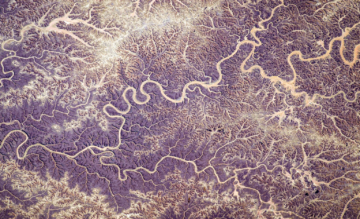 In 1957, a U.S. Geological Survey scientist named John Hack discovered the most important law of river networks. In rivers and streams in Virginia and Maryland, Hack measured the length of each stream and the area of the land that slopes toward that stream and therefore drains into it, called its basin or drainage area. What he discovered is now known as Hack’s law: Any stream, from the littlest brook to the mightiest river, has a length that’s proportional to its drainage area raised to the power of 0.6. (In symbolic form: L ~ A0.6.) There’s a bit of variance around that 0.6 value — Earth is, after all, a complicated place — but “the general regularity of the relation is nevertheless remarkable,” Hack wrote(opens a new tab). “Stream lengths tend to increase proportionally to the 0.6 power of the drainage area, regardless of the geological or structural characteristics of the area.”
More here.
Enjoying the content on 3QD? Help keep us going by donating now.