
by Robert Jensen
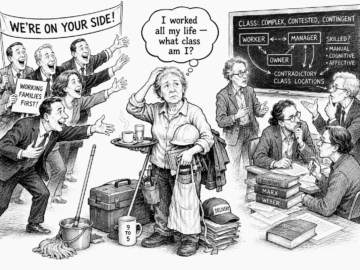 Most politicians pledge to work for the working class, or sometimes for working families, a less Marxist-sounding label. Meanwhile, scholars struggle to define the category. I won’t assess the political posturing or adjudicate definitional disputes, but my work experience—spanning six decades and a wide variety of jobs—illustrates why the claims of working-class authenticity that are prized in today’s politics are so fraught.
Once upon a time, the working class was understood as people in capitalist economies who don’t own the means of production and must sell their labor to owners. But as economies grew more complex, anomalies piled up. What about managers who aren’t owners but make lots of money doing the bidding of owners? What about technical employees whose specialized skills give them bargaining power? What about small-business owners of modest means who hire employees? Turns out there are lots of “contradictory class locations.”
I’ve never been a manager, had any specialized technical skills, owned a business, or made big money, but my class status is rife with contradictions and conundrums.
Work history
My paternal grandfather, an immigrant from Denmark, was a blacksmith in a small town in North Dakota, but my father had no interest in the family trade. After a lackluster college career on the GI Bill, he got a job as an insurance adjuster—a white-collar working-class job for which he wore a shirt and tie to the office but got paid like a laborer. My mother, whose family had a similar trajectory, stayed at home with four kids until we were all in school and then took a series of low-paid office jobs.
Although I didn’t’ realize it at the time, money was tight in our family. I didn’t get shiny new things, and family vacations were low-budget affairs that involved staying with relatives or in a borrowed camper. We always had a house and ate regularly, and I didn’t feel poor, but I knew the difference between myself and the affluent kids at school.
By the time I was in high school, my father had moved into a sales job and was making more money—enough that he could join the cheaper of the two country clubs in town. He quit bowling in a league (a working-class activity) and focused on golf (the appropriate middle-class game). In modest ways, he transcended his working-class roots, financially and socially.
Our family’s class status changed but not our working-class respect for hard work. As soon as we were old enough, my siblings and I earned money. In North Dakota before snow blowers were common, I had ample opportunities to shovel snow profitably. In the summer, I carried golf bags at the fancier country club in Fargo. Once I turned 16, I bagged groceries and worked in a building supply warehouse unloading trucks. To pay college tuition, I bused dishes and set up tables for hotel banquets.
After college, I worked as a journalist, starting at a small weekly newspaper that paid poorly. While covering a county government meeting at which the income levels for subsidized housing were set, I realized that on my “professional” journalist’s salary, I qualified. Eventually, I worked my way up to bigger newspapers and better pay, and after graduate school I settled into a comfortable middle-class life as a professor.
No matter what my job or level of pay, I knew I was a worker who didn’t own or control capital. I also knew I had a pretty cushy life compared with most working people. I was working-class guy, sort of, but one with a Ph.D. and more autonomy than most.
Whatever my class status, I retained a sense of obligation to work as hard as I could at whatever job I had. During my 26 years as a professor at the University of Texas at Austin, I never took a sabbatical. UT didn’t offer the regular research leaves common at other universities, and I never chased the outside grants that allow professors to take time off. I taught a full load, sometimes with a voluntary overload class, without feeling oppressed. When other professors were shocked that I never had even one sabbatical semester, I pointed out that no one I knew outside of academia thought they had a right to be paid for time off. I liked teaching and had time to write books in the summers—a pretty sweet deal.
Class culture
I retired at 60, even though I still loved teaching, because I wanted to get out before I burned out. Because I’ve always been frugal, at least in comparison to my middle-class peers, early retirement was financially feasible. That’s also part of my internal sense of class—I don’t have expensive habits and hobbies. Because I grew up not-poor but not-affluent, my expectations were modest. Reactions to childhood economic circumstances vary—some kids yearn for expensive things, and others make it a badge of honor to not need them. Backpacking through Europe on summer vacation was never on the agenda when I was young, and tourist travel doesn’t appeal to the elderly me. I covet not coveting much.
Today I live outside a small town in New Mexico, the kind of place realtors call “rural residential.” There are a few other retirees and professionals on our road, but most of my neighbors are without a doubt working class—tradespeople, laborers, small farmers and ranchers. I met many of them through the acequia association, a communal irrigation system that is maintained through shared labor. I take pride in working as hard as anyone on ditch-cleaning days and joining every work detail, not just the one I’m obligated to show up for. Most people here don’t ask about what job I retired from, and if they do, I say that I had been a teacher. They probably assume I taught public school, which is viewed as an honorable job. I don’t admit that I had been a university professor unless pressed for details, because it feels uppity.
I came out of the working class. I never aspired to be in the owning class but lived comfortably as an educated professional. Today, I can pass as working class when I show up in my 30-year-old pickup with a shovel and saw. I live on my Social Security check, but I have a retirement account to draw on for emergencies.
Have I ever been “authentically” working class? I don’t know what criteria to use to make that call. I continue to oppose an economic system that creates wealth inequality and undermines community life, a radical working-class politics. But I also advocate for the strong personal work ethic that I think is needed to enhance community life, a value often considered conservative. Both things are important to me.
A final story about that balance, from a friend who ran a nonprofit that employed teenagers from economically depressed neighborhoods to work on a small farm and also took on college-student interns. One year he was telling the interns that one of the goals of the organization was to foster a strong work ethic in those teenagers, and an intern cautioned him: “Telling people in poor communities they have to work hard is a tool of capitalism.” My friend was exasperated. Yes, rich people often accuse poor people of being lazy, lecturing them about working harder to get out of poverty. But the desire to work hard at productive tasks is healthy, no matter what the economic system. The unfairness of capitalism doesn’t negate the importance of a strong work ethic.
In my new book, This I Don’t Believe, I write that we all need opportunities to prove to ourselves that we are competent to run our own lives. One way I’ve done that is by taking work seriously, learning to do work well, and being proud of my work—all part of the core of a working-class identity, even if I’m not part of the working class. It’s my way of trying to live honestly in my contradictory class location.