
by Jim Hanas
 Looking back I see that my undergraduate education—as seen through my three (one merely attempted) majors—was a tour through the grammatical persons. I started out majoring in political science (and studying Latin, to my lasting regret), because I thought I wanted to be a lawyer. Third-person plural.
I quickly switched to psychology, which was divided between third-person singular (experimental psychology) and second-person singular (clinical psychology). This alone should have been the clue that psychology might not be a science, but there were others. Outside of the statistics classes—reassuring as they were to the field’s aspirations—all the textbooks had the same plot. Unlike math or chemistry textbooks, which I assume are at least technically progressive, psychology textbooks were a tour of incommensurate, historically explored possibilities, with chapters on psychodynamic theory, Gestalt, behaviorism, and—finally—the then-nascent field of neuroscience. The apotheosis of the field’s haplessness appeared in each textbook with the appearance of the “diathesis–stress model” of schizophrenia, which proposed that psychopathology arose from a combination of genetic predisposition and environmental factors. No kidding.
This sent me across campus to the philosophy department, where I discovered phenomenology, which—at its most rigorous—is the systematic investigation and description of first-person singular experience. “Lived experience” has become a cri de cœur in recent years, in which I hear the echoes of Husserlian Erlebnis or Sartre’s l’expérience vécue, though—as with many things—current usage is a memed-down version meant to evince uninterrogable private experience. But, or so phenomenology claims, there is a lot that can be said and communicated about the structure of these private experiences. For example, the idea of an object and the object itself, while sharing the same content, have different phenomenological properties. One appears in time and space, is experienced as having permanence, etc., while the other does not. Almost any first-person experience—from the experience of mathematical proofs to elusive states like ennui—can be the subject of such investigations.
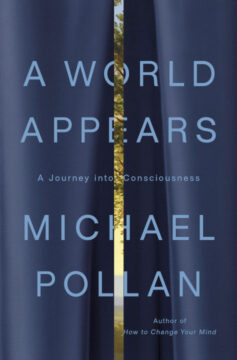
I graduated with a double major in psychology and philosophy and—in the four decades since—it does not appear that much progress has been made in reconciling the third-person view with the first-person view. Psychology with philosophy. At least that is the impression left by Michael Pollan’s eminently readable book A World Appears: A Journey into Consciousness. I have been peripherally aware of Pollan’s lifelong tour through science, from botany and biology to psychology, which looks like nothing so much as his own personal Phenomenology of Spirit, as he moves from the observational sciences to the realization that, as Hegel put it, all consciousness is self-consciousness.
Pollan, as a humanist believer in science, seems surprised by this turn, which reminded me just how out of step the phenomenological point of view is with the popular, scientistic view of the mind.
The book begins pretty much when I left the field—I went on to get a master’s in philosophy—just before David Chalmers’ famous articulation of “the hard problem” of consciousness in 1995. Against a background of materialist eliminativism—championed by Daniel Dennett and the Churchlands—Chalmers called everyone’s bluff, pointing out that no matter how many neural nets you construct or how many brain scans you correlate with mental states, no one had any earthly idea how one gave rise to the other. This also gave comfort to the Continental philosophical charge against analytic philosophy that the latter begins from a realism for which it cannot account. This comes up often in Pollan’s book. A problem only seems to be solved because the scope has been constrained. Ceteris paribus, as scientists (and scientistic philosophers) like to say, although nothing is ever equal.
So what is the phenomenological view? Pollan mentions Husserl a few times, but otherwise he relies on William James, or appeals to stream of consciousness novelists from James Joyce to Virginia Woolf. He considers the Descriptive Experience Sampling (DES) research of Russell T. Hurlburt, who has trained people to describe their inner experiences after being cued by electronic beepers. I’m an ironist where human conceits are concerned and, like a lot of attempts by empirical third-person science to make the first-person appear in its courts, Hurlburt’s project is more appealing to me as a performance art piece, wryly dramatizing its own preposterousness. In other words, Pollan assumes the phenomenological turn must be validated by empirical science, which is allergic to it.
Pollan does eventually get to first-person truths, but—I would argue—in ways sanctioned by third-person science as outside of it: meditation and ecstatic spiritual experience. This does not advance the argument very much, since—as Pollan notes—this is the way the cosmos has been divided up in the West since Galileo, “who determined that the scientific enterprise would achieve the most, and antagonize the Church the least, if it confined itself to the study of primary qualities—the measurable material world,” and left subjectivity to the clergy, a fix made (more or less) permanent by Kant when he “found it necessary to deny knowledge, in order to make room for faith.”
The section on phenomenology is titled “The View from Within” but ultmiately splits into rendering this view from within from without—as with Hurlburt—or into the usual candlelit chambers ceded, provisionally, to art and spirtuality. But, as an early convert, I would argue that the phenomenological view has a much stronger and more rigorous case to make, and it is this:
First-person experience is the irreducible, primary, and more populace mode of experience, in which third-person descriptions become possible. It is irreducible because there has never been a single experience of any kind that has ever happened outside of it. Primary because it occurs first in the order of knowing, and perhaps even evolutionarily and linguistically. Finally, it is the more populated because, while positive science attempts to catalog everything that is the case, first-person experience models everything that is both possible and impossible, only a tiny percentage of which does it take to be the case. Pollan quotes a passage from Lucy Ellmann’s stream of consciousness novel Ducks, Newburyport, which gets at this intuition:
… the fact that there are seven and a half billion people in the world, so there must be seven and a half billion of these internal monologues going on, apart from all the unconscious people, the fact that that’s seven and a half billion people worrying about their kids, or their moms, or both, as well as taxes and window sills and medical bills, shut-in, shutout, dugout, bullpen, the fact that that’s not counting the multiple-personality people who must have several internal monologues going on at once, several each, momologs, Mommalabomala, Bubbela, blogs, vlogs, log cabins, Phoebe’s Christmas logs, the fact that animals must have some kind of monologue going on in their heads, even if it’s more visual than verbal maybe, the fact that bald eagles certainly always seem to be thinking about something when you watch them on the eaglecam….
This doesn’t even include all the people who have ever lived and their internal monologues. I’m not sure how you would count up all the intentional objects from these streams as the denominator by which to divide “the furniture of the world” to which science assigns physical reality, but it is certainly very large. I’m not sure how you would prove that it is not infinite. And if furniture is something you actually live with, isn’t this the furniture, and what materialists call reality a set of specialized tools in a box in the garage? Wouldn’t it make more sense to start with the entire range of experience and specify its types, rather than privileging one type throwing the rest out as noise? Wouldn’t such an approach make us feel more at home, perhaps less lost, amid “the furniture of the world”?
And what of second-person experience? In Pollan’s telling, which matches the structure of my undergraduate psychology department, it was ceded to psychiatry (later “therapy”) and left to fight its own “evidence-based” battles with third-person science. This space, let’s call it interpersonal intimacy, can only appear wild and vulnerable to delusion and abuse to the empirical scientist—and it can be all of that—but it is also a space where, long before science, we agreed on truths that were objective though not verifiable by a third-person sense. Yes, I hear you. It is like that for me. And there, too, does a world—a real world—appear.
***
Enjoying the content on 3QD? Help keep us going by donating now.