
by Steve Szilagyi
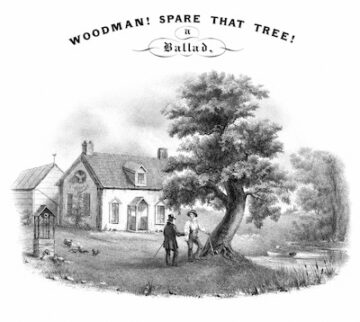
Woodman, Spare That Tree is a poem by George Pope Morris, published in 1837, and quickly set to music by the prolific songwriter Henry Russell (Cheer, Boys, Cheer). It begins:
Woodman, spare that tree! / Touch not a single bough! / In youth it sheltered me / And I’ll protect it now.
By the late 1830s, much of the primeval forest along the settled East Coast had already disappeared. One of the striking discoveries in 19th-century photographs of American towns and countryside is the sheer emptiness of the landscape beyond the main streets and Carpenter Gothic houses. If you can tear your eyes away from the corpses in the foreground of a Civil War battle photograph, you’ll see, behind them, treeless vistas that seem to go on forever.
In muscular young North America, trees were the enemy. Once you got your land, the first task was to clear it of trees and stumps — no easy thing to do with an axe. All across the continent, strapping young men went to war against the forests. They were so successful that, by 1837, those once-heroic fellows could appear as villains in poems of performative sentiment.
I’ve been listening to Woodman, Spare That Tree since 1977, when it was released on the Nonesuch LP An Evening with Henry Russell, sung by Clifford Jackson, accompanied by William Bolcom on piano. I’m still moved by the poem and its plangent musical setting.
So you can imagine my discomfort in July of 2026, when I found myself in the same situation diagrammed by the figures in “Woodman, Spare That Tree” — with one big difference: I was both the woodman and the poet.
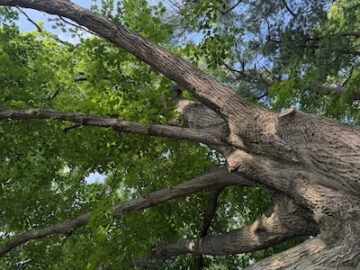
Good fortune has allowed me to live in a beautifully wooded suburb, where 60-foot trees are not uncommon. One such tree overhung the bedroom where my wife and I sleep. It shielded us from the sun, tempered the rain, and every so often dropped a dead branch that would land the roof like a set of barbells, or – one winter night – come crashing through the skylight.
This was the alpha tree on our lot — a great white oak, with a vast mossy trunk, muscular roots, and a mighty crown that spread its thick limbs skyward in ecstatic worship. For more than fifty years it had stood on that spot, showering acorns every five years or so, and carpeting the yard with brown leaves each autumn. We loved this tree. Its ivy-covered bark was the first thing we saw when we opened the front door, and it stood by the porch in stately welcome whenever we returned from our travels.
It was in the shade of this tree, thirty years ago, that we shook hands with the previous owner to seal the deal on the house. It was near its trunk that my wife placed the mosaic-wrapped bench she’d made with her father’s help — a kind of memorial to him after he died. Each spring, I’d kneel at its base, planting beds of peonies. Our grandchildren played beneath it, and generations of indoor-outdoor cats sharpened their claws on its bark.
Yet from the day we moved in, I would lie in bed feeling the weight of those branches high overhead, with only forty feet of air, and a few beams and shingles, between us. Never more so than on April nights when — in our part of the world — huge tempests swoop down from Canada, replete with air bursts and tornado touchdowns. After one such night, we woke to find four spectacular pines sprawled across the driveway, their trunks snapped like pencils.
Each spring brings us a local example or two of what can happen when a tree falls on a house or garage. I remember one nearby house where a limb — not the whole tree, mind you, just the limb — dropped onto a neighboring roof and sliced through it like a karate chop.
If the tree in front of our house had done such a thing, it would be like dropping a GMC truck onto our roof from forty feet. A tree that size carries many tons of wood.
But – trees! I lived in Manhattan for twenty years, and over time, developed a gnawing hunger for the lush, leafy, trees I remembered from my childhood.
Then, when I sat down at my desk on Central Park West to write my first novel, Photographing Fairies, I put a magnificent tree at the center of the action — one of those grand British oaks of myth and legend. So when they made the book into a movie, I was startled to find they’d added a scene in which one character — played by Ben Kingsley — flies into a frenzy and hacks the tree down with an axe. Where on earth had that come from? I needed that tree for the sequel.
I love trees so much that I lived anxiously for three decades with that great leafy brute looming over our bedroom, never quite able to bring myself to do the one thing that would protect our lives from its limbs.
Two other large trees fell in our yard this spring. One came down during a storm. The other fell apropos of nothing, while I watched from the back porch one still afternoon — not a breath of wind. Snap, crackle, and plop.
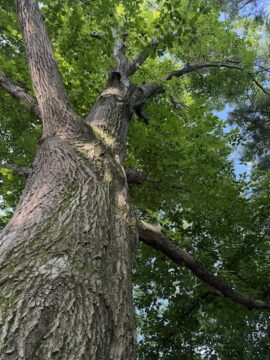
These were signs. It was time to act. What does it take to bring down a splendid 60-foot white oak that has held its ground for more than half a century? Unlike the woodmen of the 19th century, I did not need to swing an axe. All I had to do was make a phone call and sign a check.
The tree guys showed up shirtless on a 96-degree Fahrenheit day, with a tall crane, a wood chipper the size of a circus wagon, a dump truck, a flatbed, and gallons of energy drinks.
There was barely an ounce of fat on the torsos of the five young men who did the job, though each appeared to carry at least a pound of tattoo ink.
Tree service is at the top of any list of most dangerous jobs, and I wondered what kind of men these were, hauling chainsaws and rigging out of the trucks in the sweltering heat. Couldn’t they find some safer employment? Were they ex-cons? Or were they men who thrived on risk and complex challenges? Whatever had landed them in this dangerous line of work, they were organized and professional, each man briskly going about his task, with no slacking off until lunch.
The boss of the small, “veteran-owned” company wore a yellow construction helmet. But no other man on the job wore a hard hat, goggles, ear protection, chaps, or any other protective gear — undoubtedly violating every safety rule in the book.
I stepped over and identified the tree they were to take down, placing my palm on its bark for a moment before retreating into the house. For the next six hours, I pretended to work while a choir of differently pitched chippers and chainsaws screamed outside.
When silence finally descended, and the last of the woodmen were gone, I walked out the back door and around the house, to sneak up on what I knew would be a disturbing sight. And there it was: the yellow platter of naked flesh, exposed to the sun, moisture still gleaming around its edges, roots flexing in the soil as if they still supported their elaborate load of wood and bark and leaf.
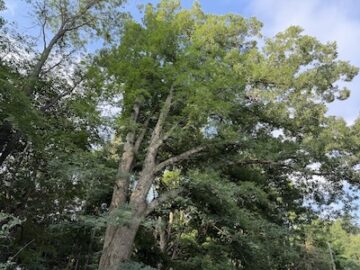
The light that now glistens on the ringed stump pours through an opening in the leafy roof, left behind when the dominant tree was subtracted — the remaining branches forming an oculus, as in the Roman Pantheon. This late tree had such a presence that all its arboreal neighbors had molded themselves to its crown — in one case, leaning dramatically away, like the apostle in DaVinci’s Last Supper.
I respected that tree, and by no means felt that, even though it stood on my property, I owned it in any sense of the word. It was a more dignified, beautiful, and useful presence on this earth than I will ever be. But — alas — survival is the prime directive of all living things, and to live with this immanent threat poised over our heads was more than I could bear indefinitely.
And yet I find that, according to NOAA, only 30 to 40 people die each year from falling trees or large branches — about the same number who die each year from being struck by lightning. About half of those fatalities are people in moving cars, with most of the rest engaged in outdoor activities. Almost none are people asleep in bed when a giant branch comes crashing through the roof.
So in this episode of tree removal over which I’ve been wringing my hands, the far more dangerous thing — the thing most likely to cause a death — was the taking down of the tree itself. Occupational safety summaries report that about 140 tree workers die each year in the performance of their duties. If I truly thought human life so precious, I should have let the tree be, and taken my chances.
But this is my life we’re talking about. And what’s done is done. So for the rest of the summer you’ll find me out on the front porch, a dozen feet from the stump of the murdered tree, watching the skies, looking forward to the next exciting tempest — afraid that by eliminating one source of danger, I have increased the odds of my perishing by another. Or that it’s all in my head, and I destroyed a great work of nature for nothing.
Enjoying the content on 3QD? Help keep us going by donating now.